- Best-Price Guarantee
- 24/7 Expert Support
- No Booking Fees
- Direct with Operators
- 500+ Boats Worldwide
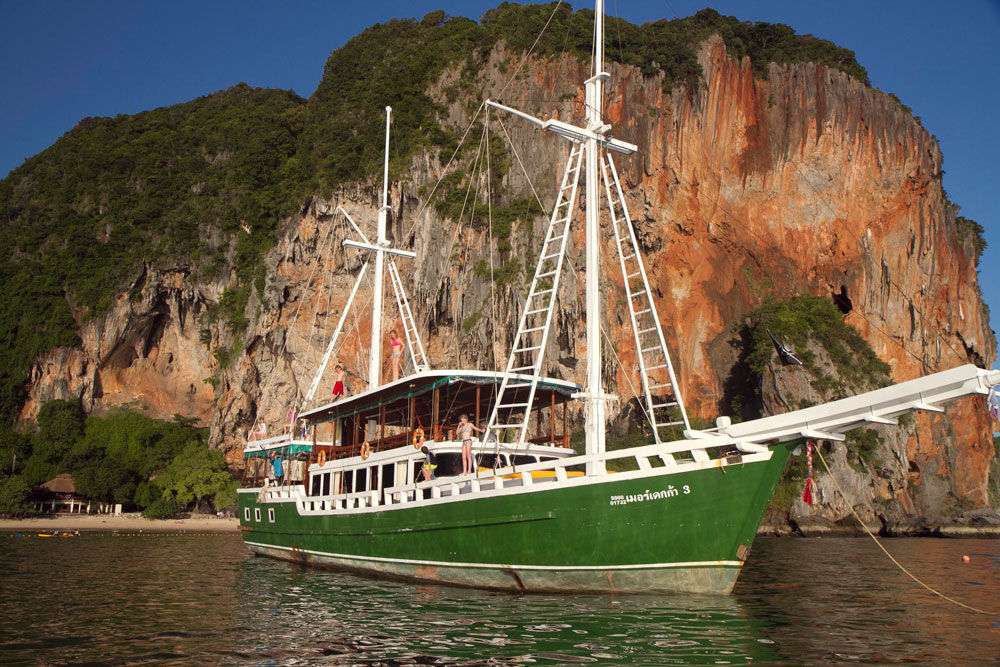
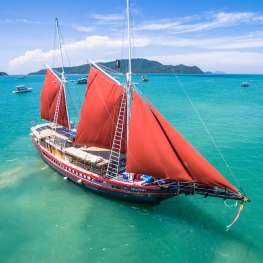
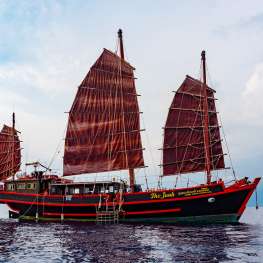
Merdeka 3 is a traditional wooden phinisi offering relaxed dive-and-snorkel cruises and private charters from Phuket. Her current detailed inventory supports 18 fixed berths in seven air-conditioned cabins: four king cabins with attached bathrooms, two four-person bunk cabins and one twin-bunk cabin using shared facilities. Full-board dining, shaded open-air lounges, massage, kayaks and South Andaman routes through Phi Phi, Koh Haa, Hin Daeng, Hin Muang and the Racha Islands create a slower alternative to a four-dive-per-day liveaboard.
Description
Boat
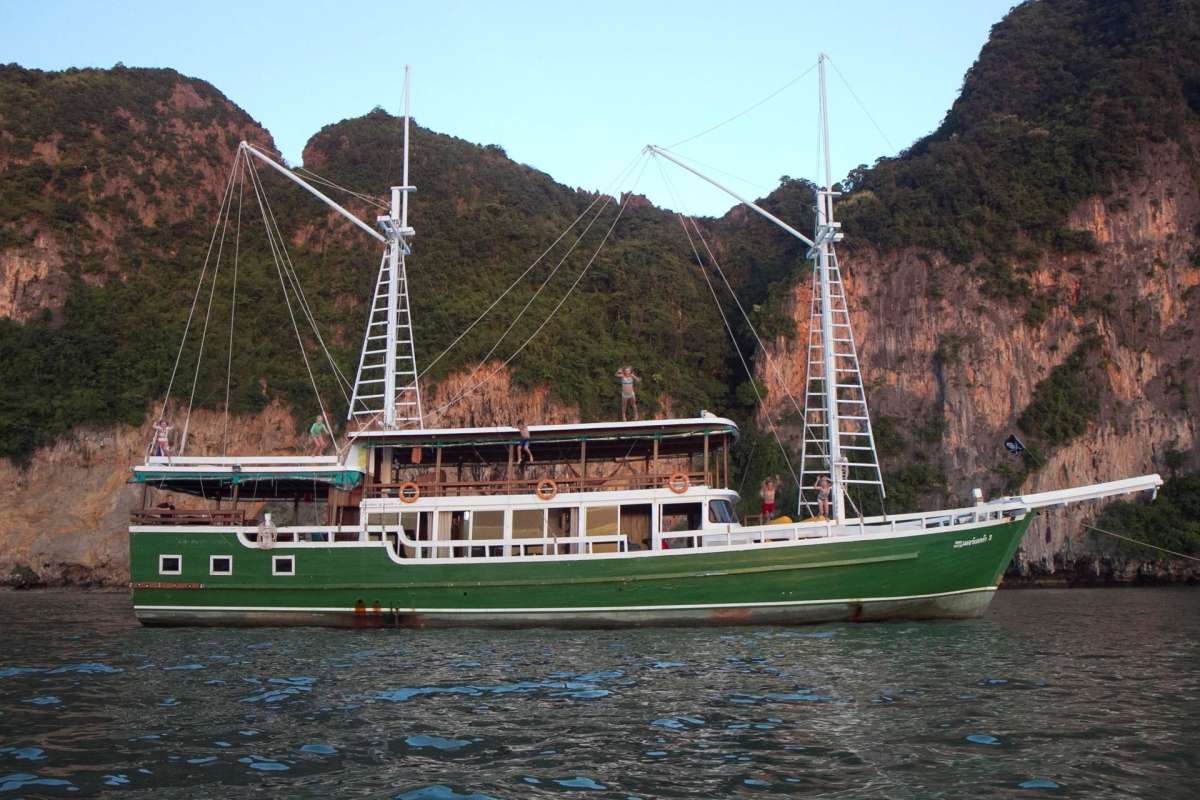
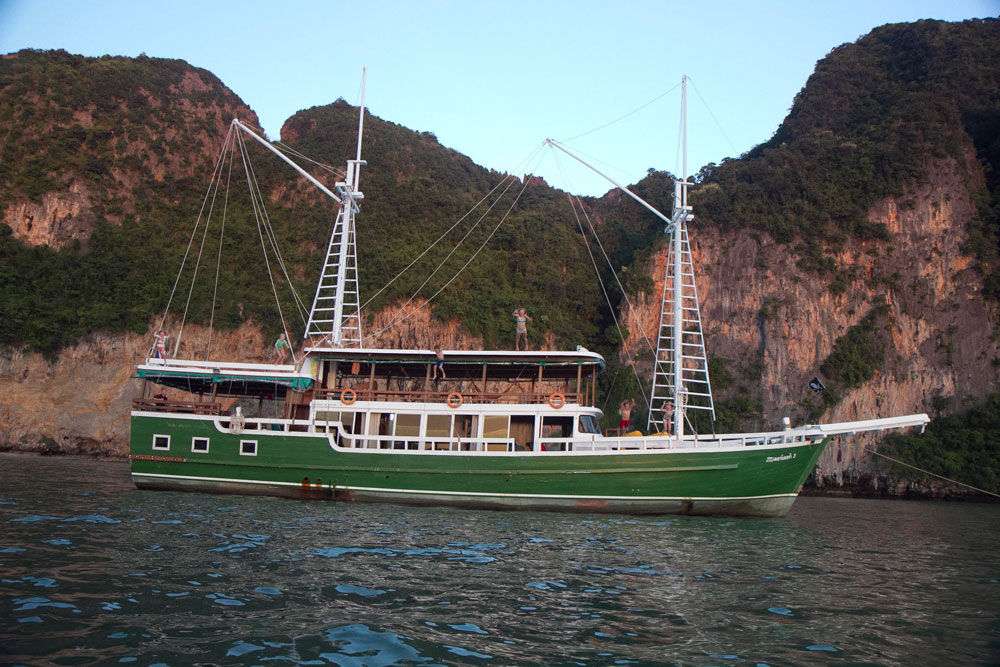
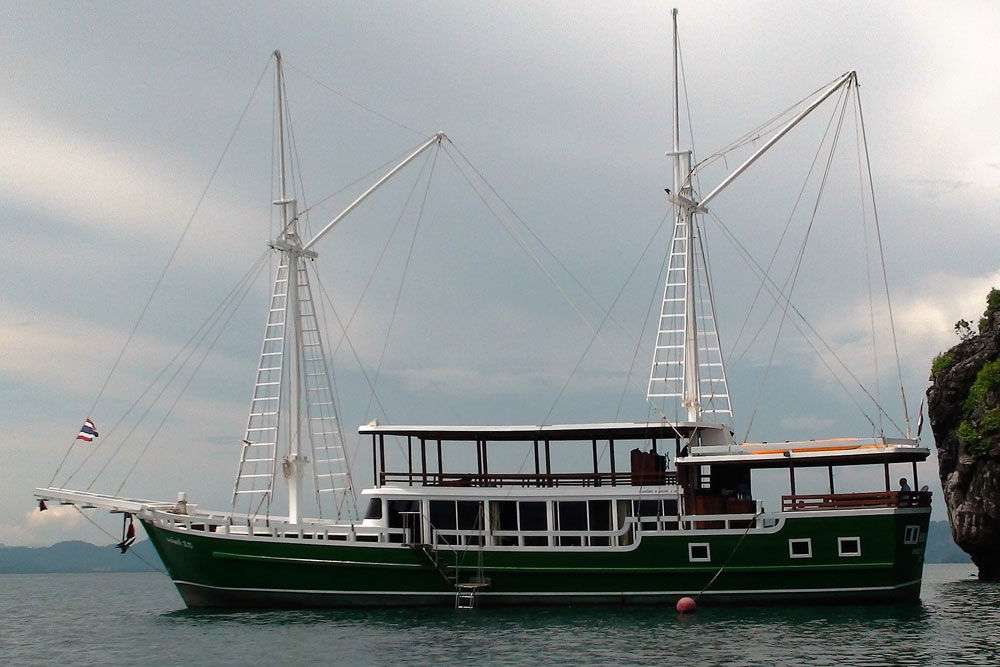
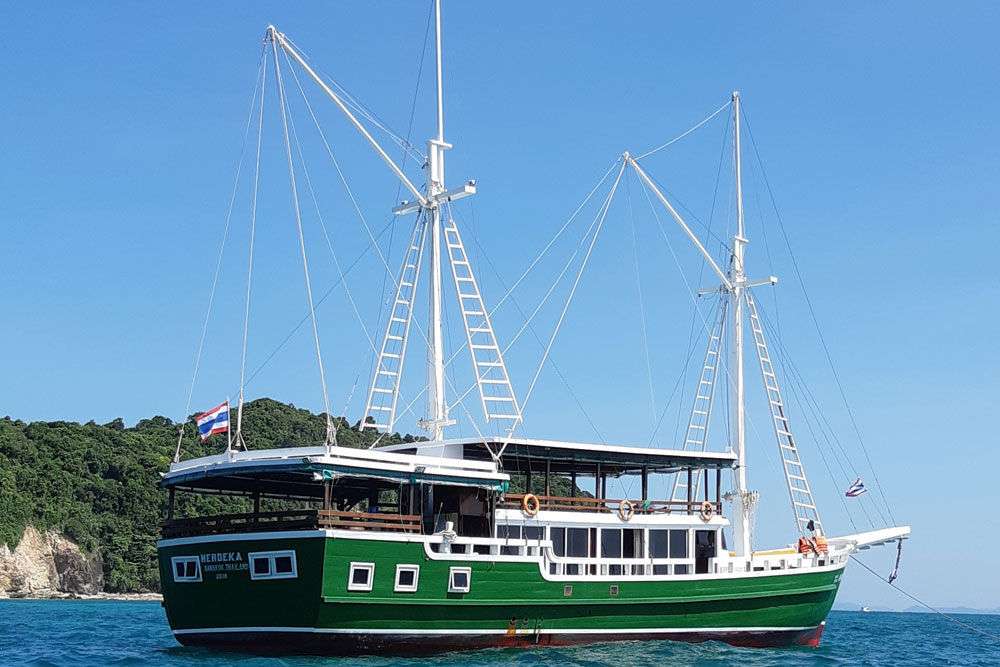
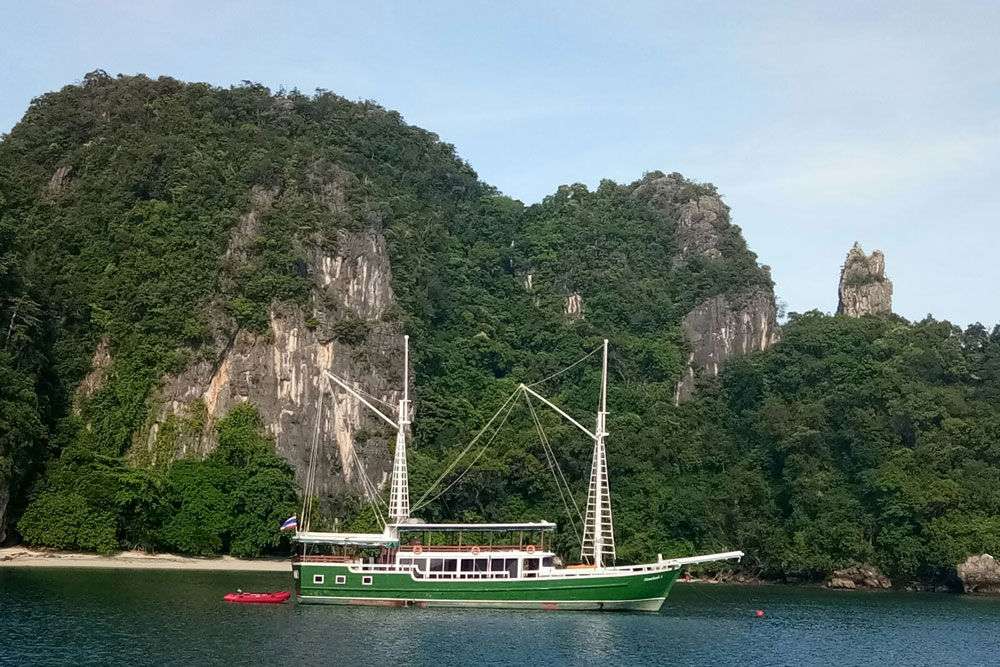
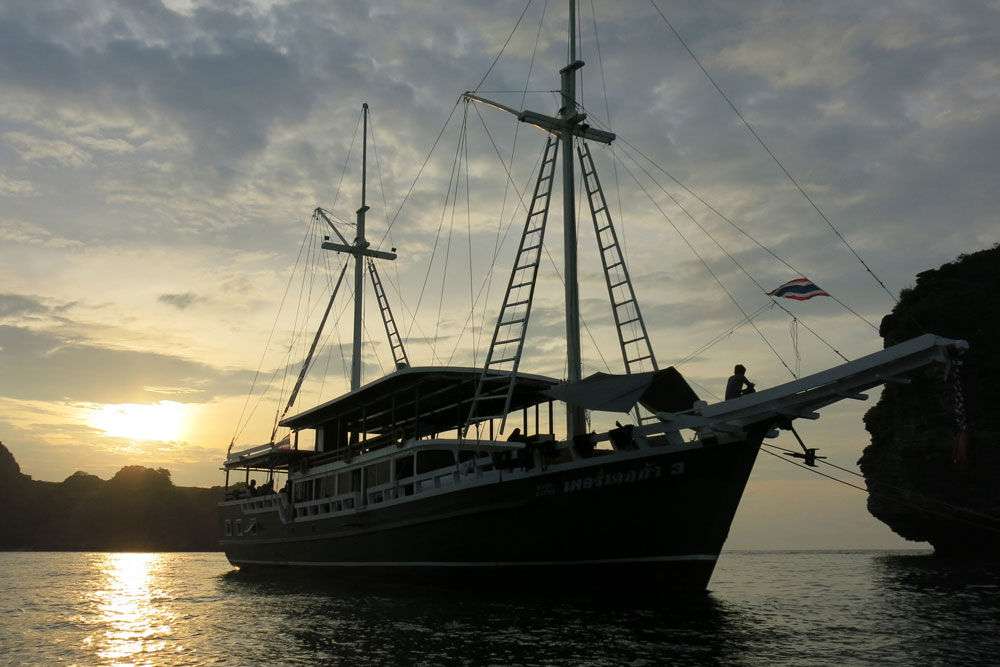
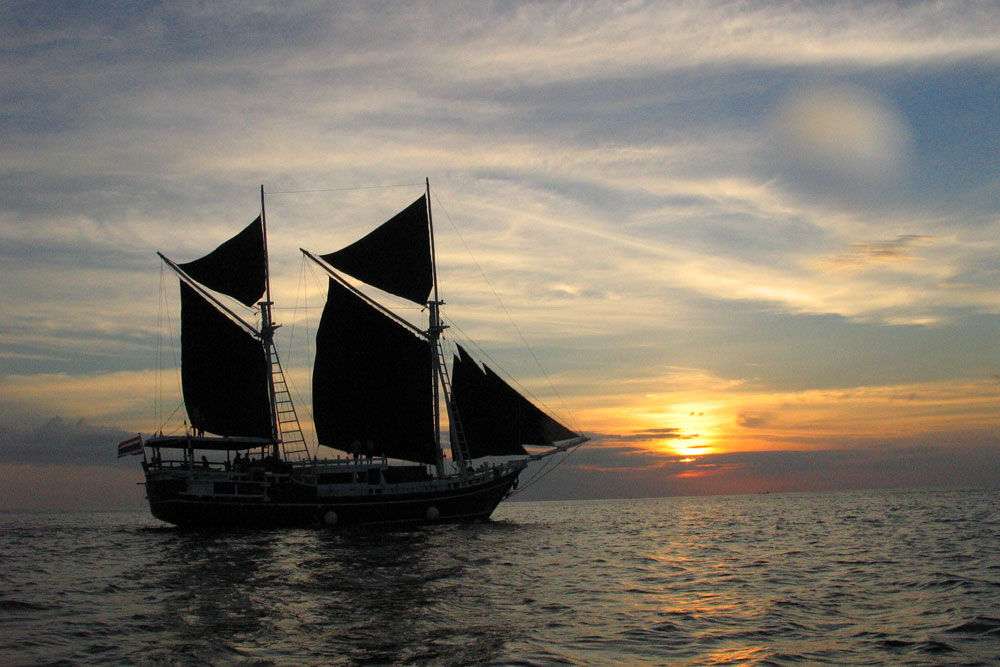
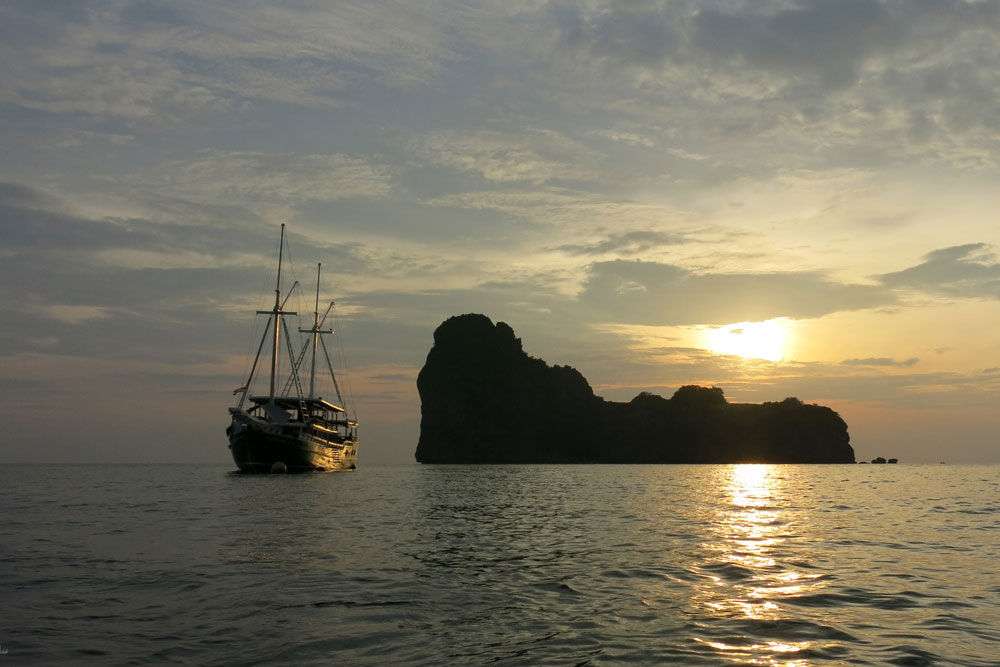
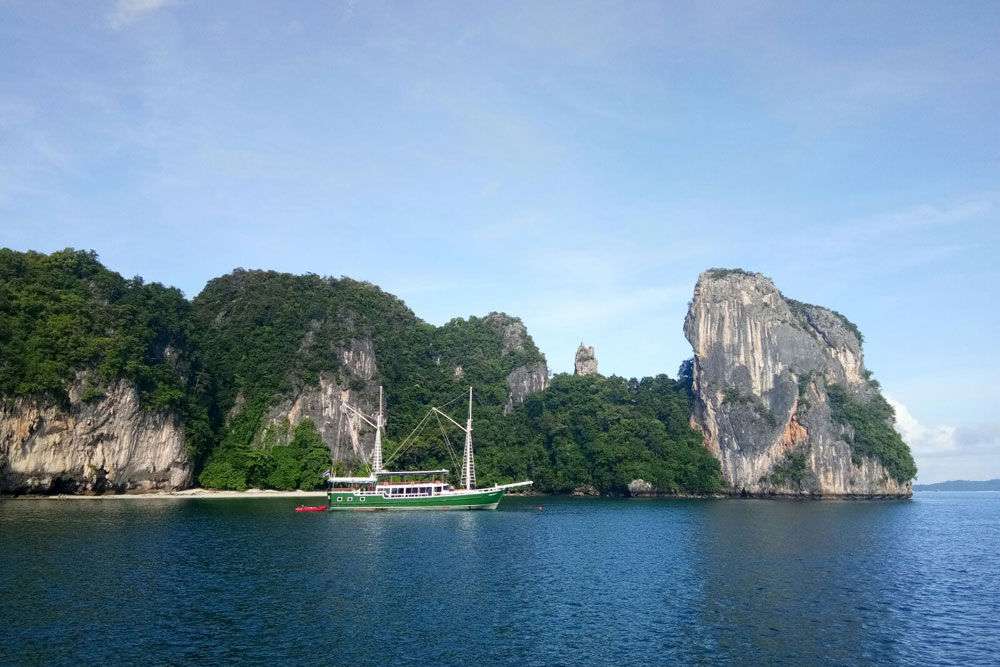
Merdeka 3, also marketed as the Merdeka “Spaboat,” is a traditional Indonesian-style phinisi operating overnight cruises from Phuket, Thailand. The operator focuses on a blend of diving, snorkelling, island exploration and unhurried time aboard rather than a high-intensity dive safari. Scheduled dive-and-chill trips, relaxed private charters and larger weekend celebrations are separate products and do not share the same capacity or inclusions.
The primary website does not publish a full technical sheet. Current specialist listings place the vessel at approximately 30–31 metres long and 6.5 metres wide, describe an ironwood/wooden construction, and associate the build or major commissioning with 2016. Because the operator itself does not confirm these measurements or a later refit date, website copy should use “approximately 30 metres” and avoid presenting 2016 as a guaranteed latest-refurbishment year.
Secondary specifications list one 350 hp Nissan engine, a 25 kVA / 230 V electrical system and a 3.6-metre RIB for diving and transfers. These details are useful for orientation but should be reconfirmed before appearing in a formal charter contract. Charging points are advertised, yet the number, socket format, USB provision and overnight charging rules are not consistently published.
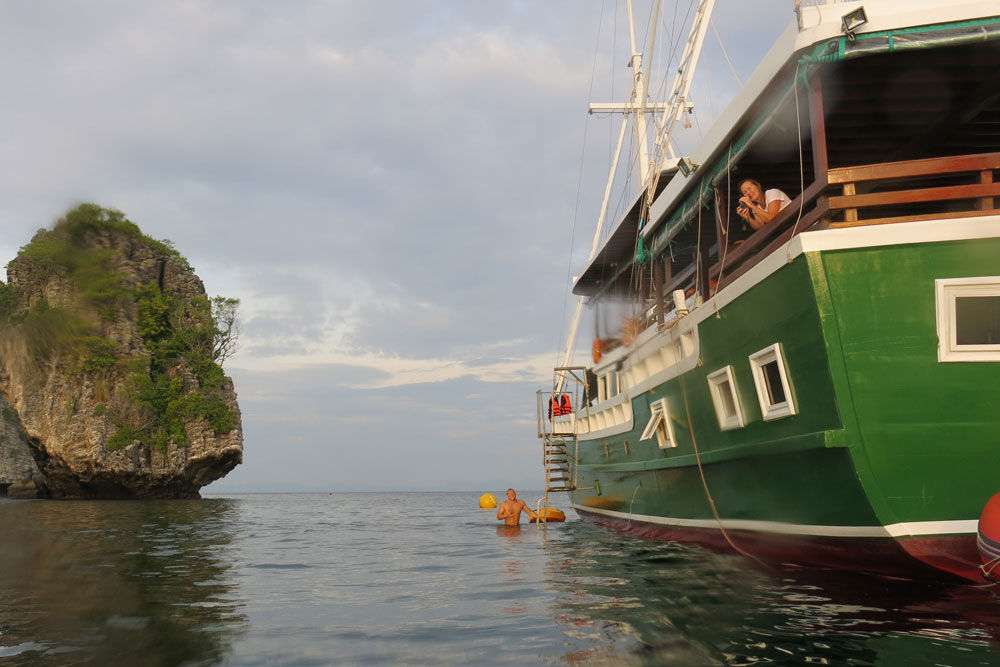
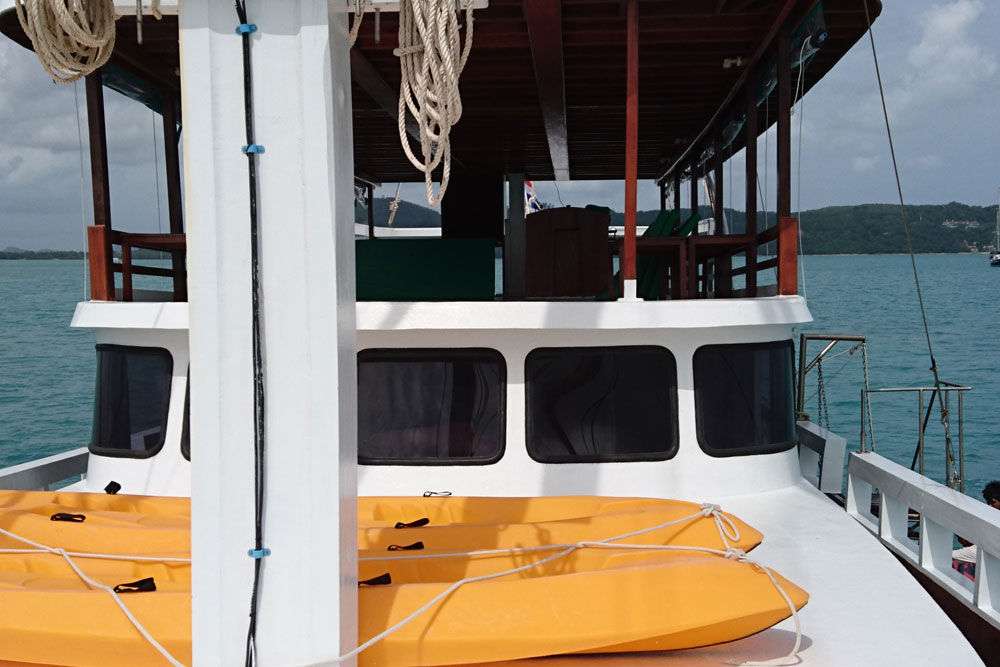
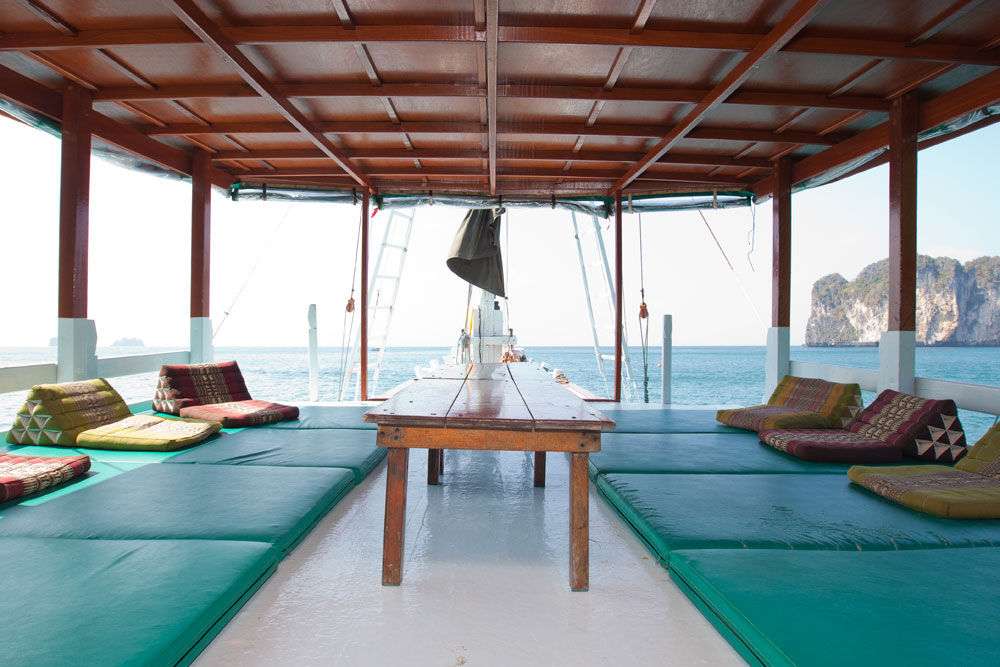
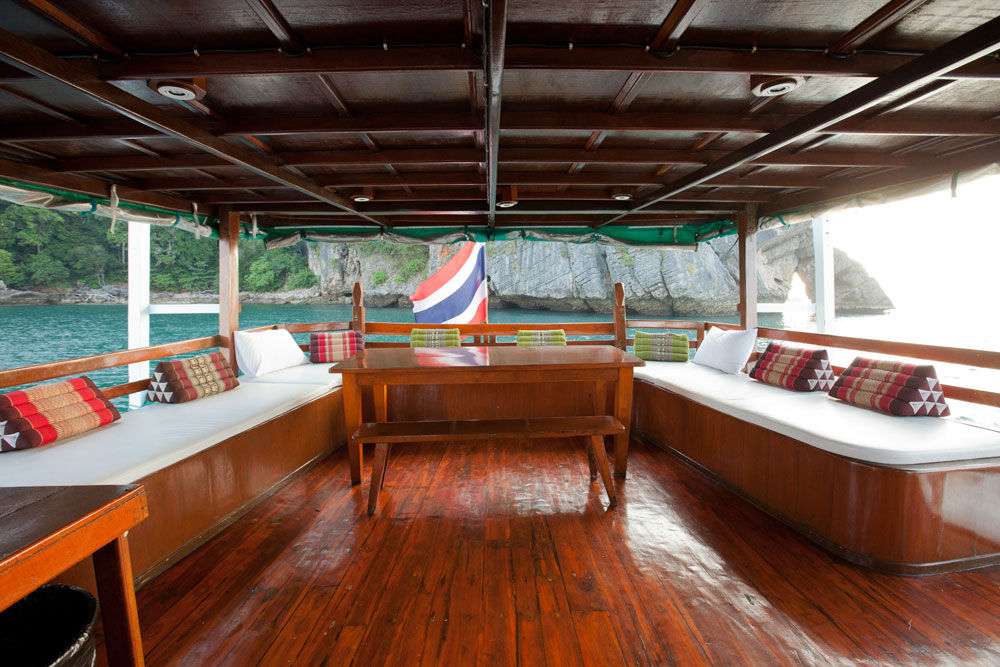
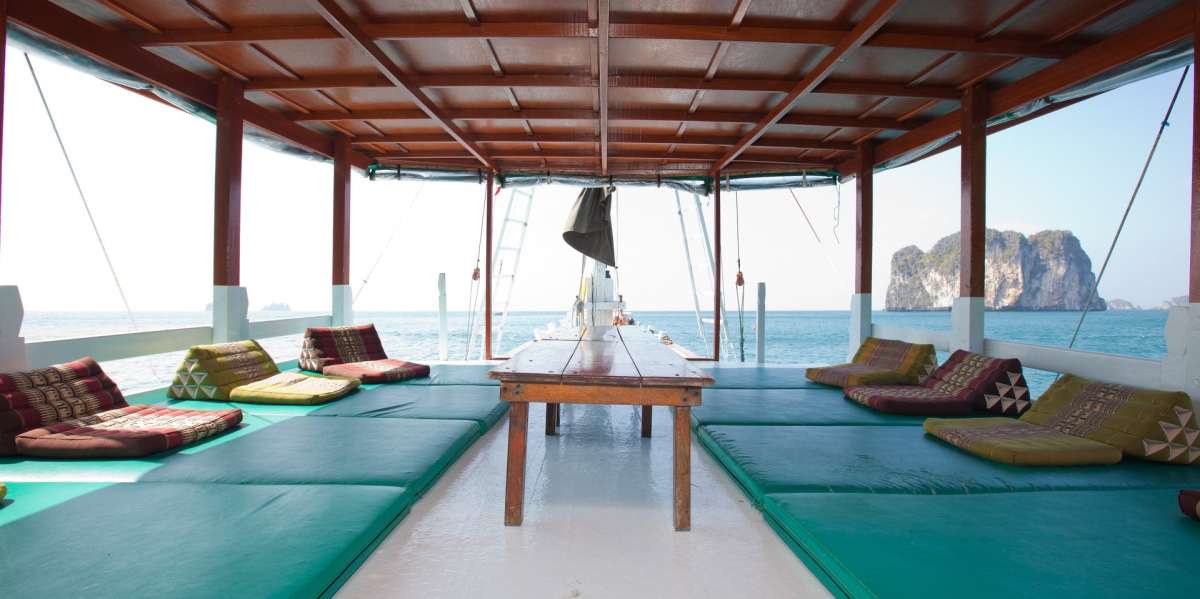
The phinisi layout favours open-air living. Current photographs show a large covered relaxation deck with mattresses and cushions, a shaded lounge, outdoor dining tables and long views over the islands. Massage is a signature feature, but “free massage” does not define the number, duration, treatment type or therapist availability. A booking should state the included treatment rather than imply unlimited spa service.
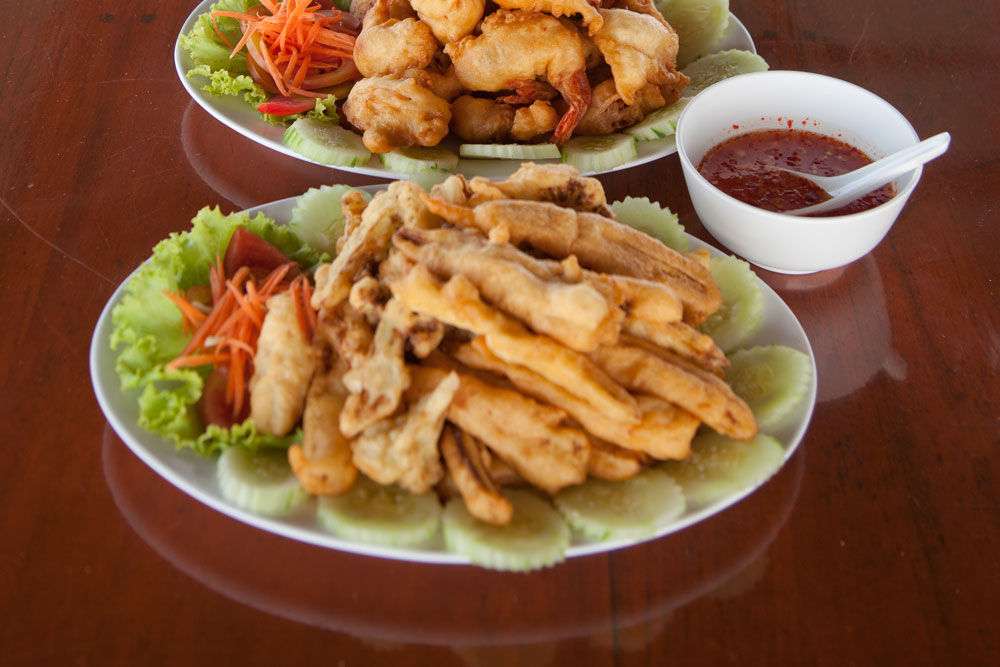
Meals are served in a casual full-board format. The direct private-charter and weekend pages specify three meals daily plus snacks and fruit, with water and soft drinks included. Current sales material describes a mixture of Thai and international food, buffet or set-menu service, and the ability to request vegetarian or vegan meals. Allergies, religious restrictions and medical diets must be sent in advance; a compact marine galley cannot promise a fully isolated preparation environment.
The vessel is designed for divers and non-divers travelling together. Snorkelling, swimming, kayaking, beach visits, island exploration and time on deck can be combined with a smaller number of dives. This family-friendly positioning does not mean every activity is suitable for every child or non-swimmer. Minimum age, lifejacket fit, supervision, water confidence and the exact activity schedule require confirmation.
Current safety inventories published by specialist sellers include VHF radio, depth sounder, life rafts or rescue craft, lifejackets, fire alarms and extinguishers, first-aid supplies, bilge alarm, searchlight and satellite/mobile communication. Equipment can change, and the exact oxygen capacity is not clearly published on the operator's present pages. Guests should rely on the onboard muster, fire, man-overboard and dive-recovery briefing rather than a generic list.
Merdeka 3 has no published lift, accessible cabin or step-free route. Narrow marine stairs, raised door sills, bunk access, movement between the RIB and mothership, and wet exterior surfaces can all affect mobility. A traveller with balance, transfer or medical-equipment needs should request an individual assessment before paying.
Cabin
Merdeka 3's current cabin information contains a numerical error that must be explained. The operator headline says “6 cabins (18 berths)”, but its detailed list describes four king cabins, two quad-bunk cabins and one twin-bunk cabin. That is seven physical cabins and 18 fixed sleeping places:
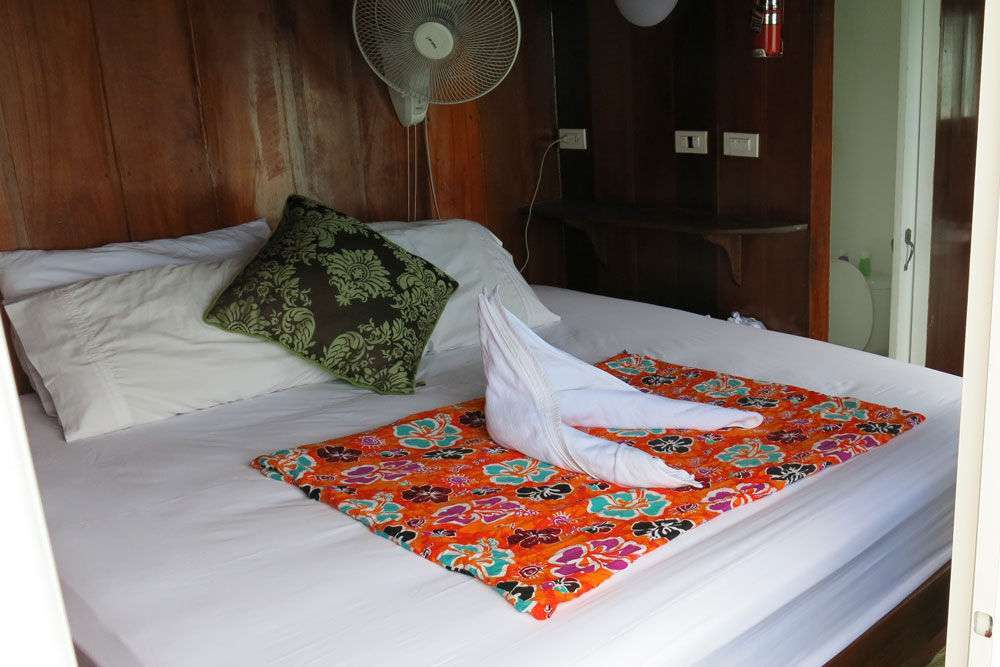
- 4 King Cabins — maximum 2 guests each, 8 berths total: one king-size bed according to the operator, individually air-conditioned and fan-cooled, with an attached private bathroom and hot water. A current sales platform says the bed may be prepared as one king or two singles and describes large sea-view sliding doors. Treat split-bed setup as a request requiring written confirmation, not an automatic feature.
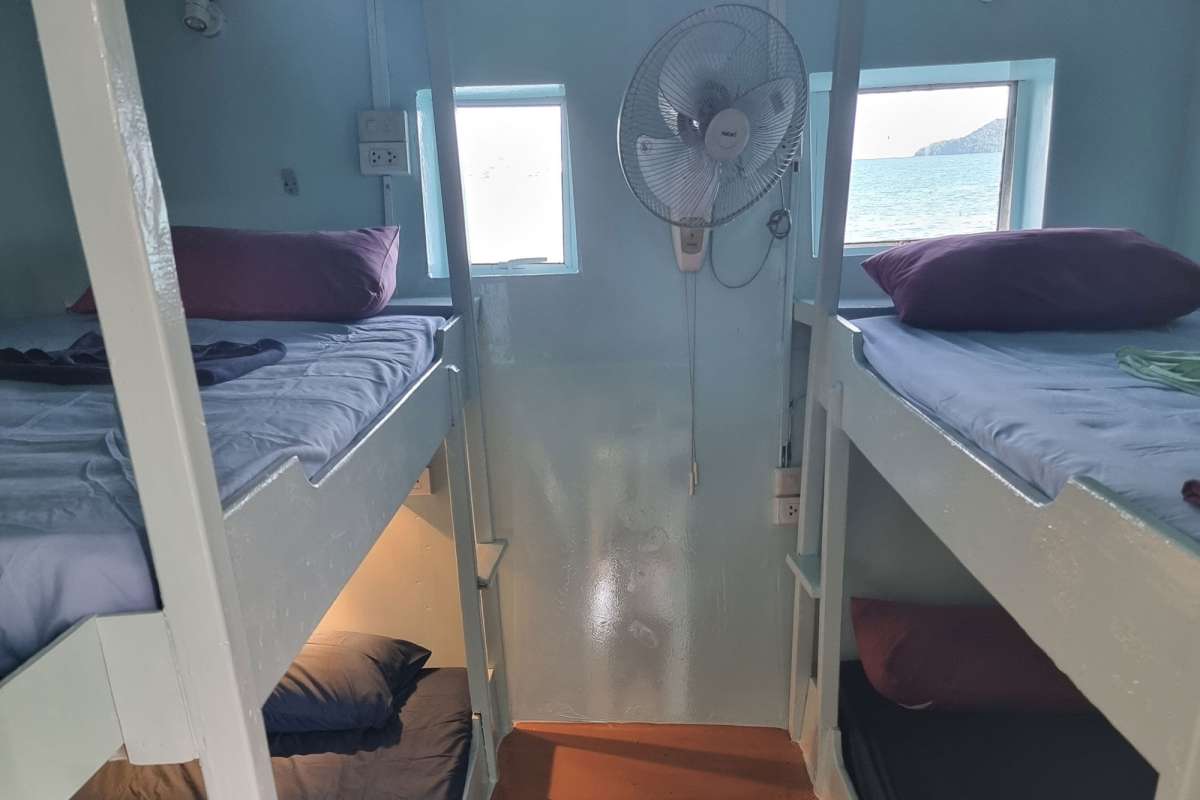
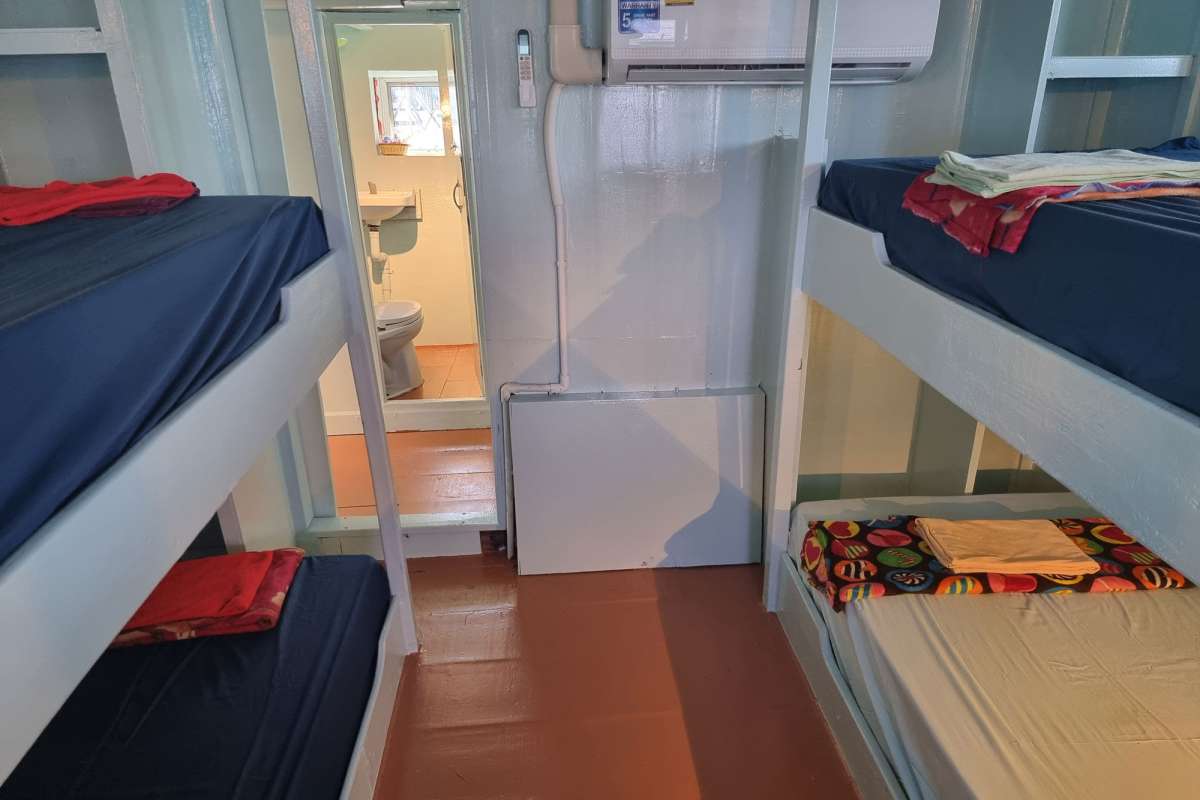
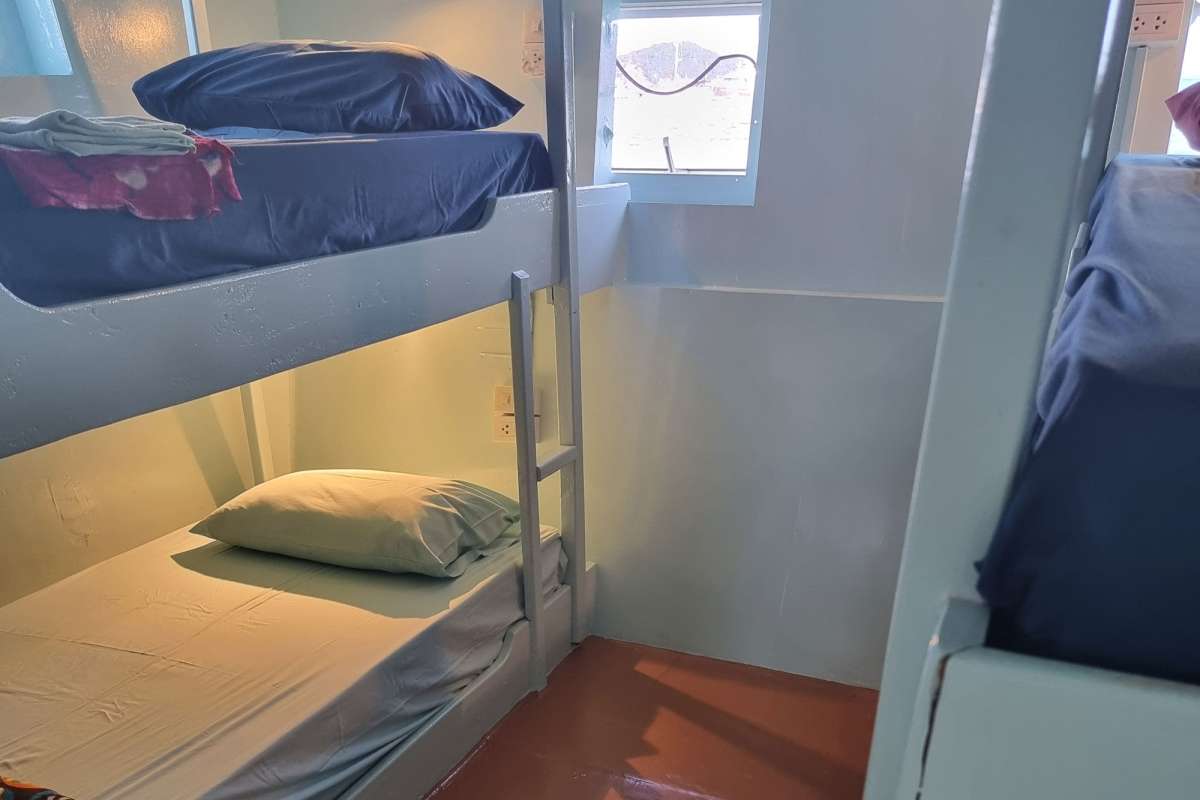
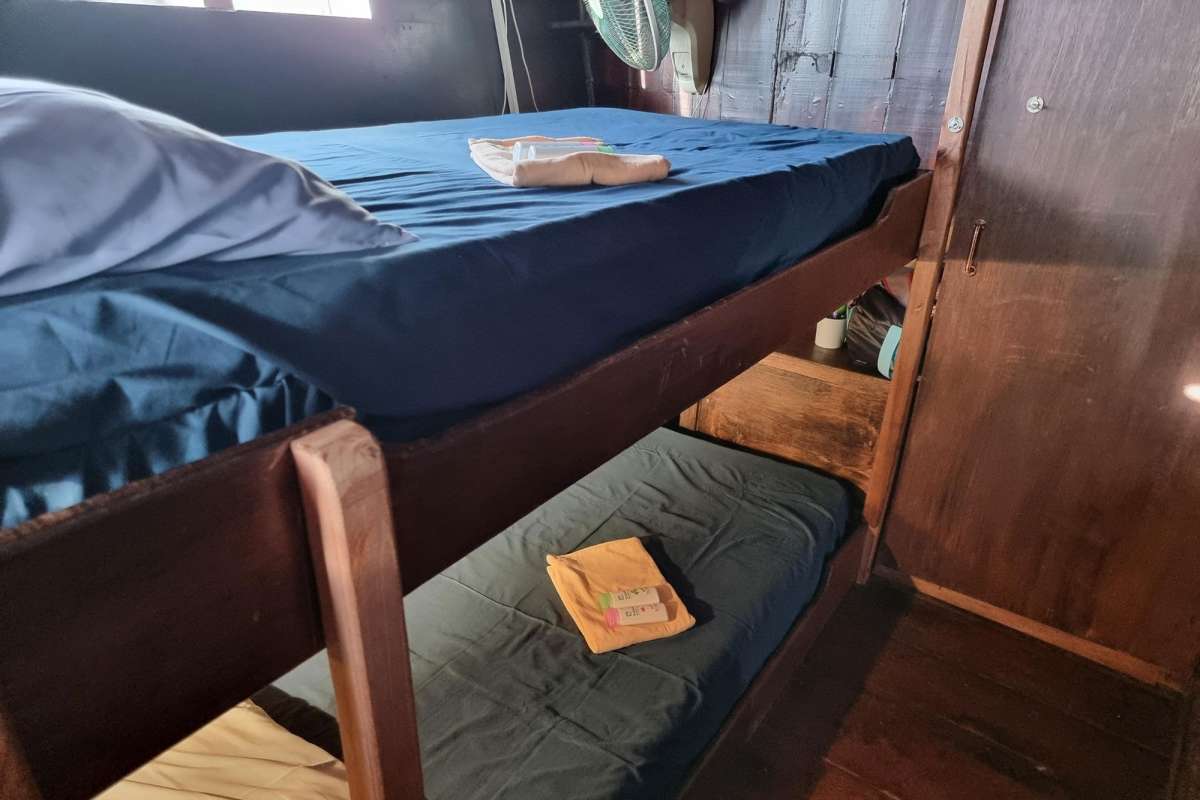
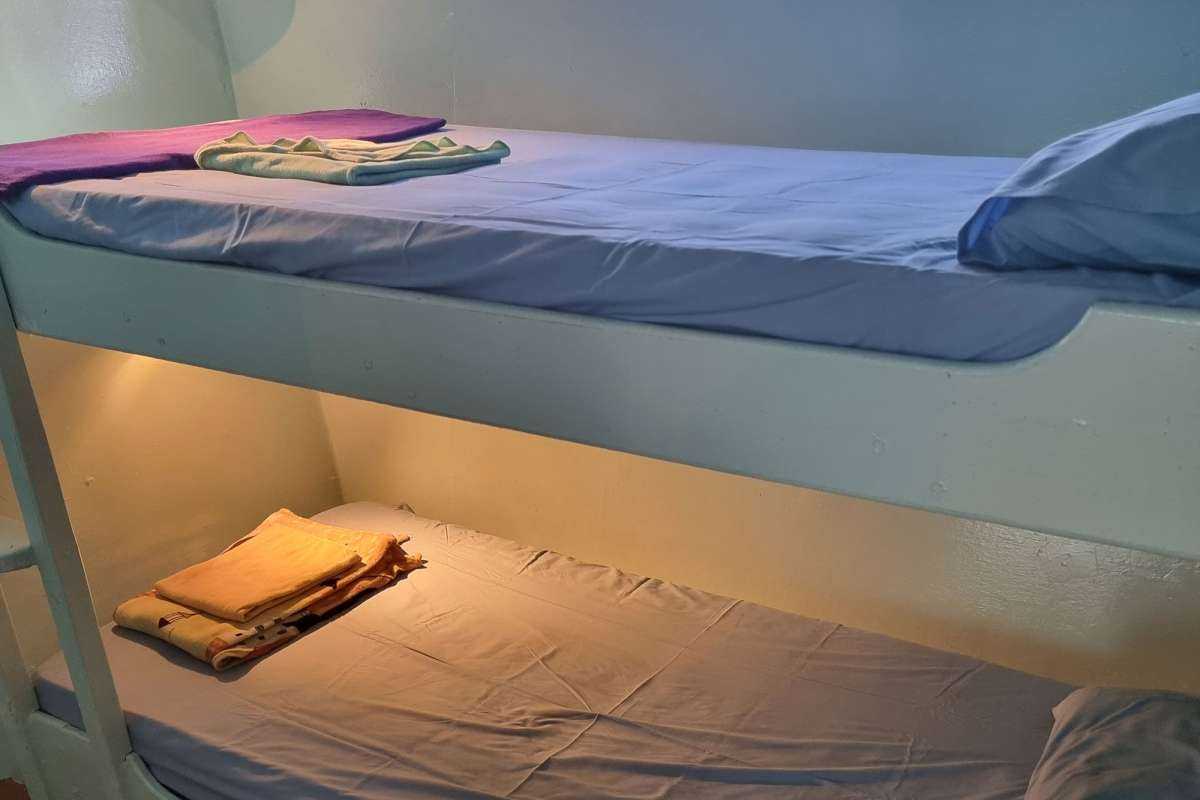
- 2 Quad-Bunk Cabins — maximum 4 guests each, 8 berths total: four individual bunk-style sleeping places, air conditioning and fans. The operator states that these cabins use shared bathroom facilities. Operator-linked 2024 photographs show two distinct quad cabins, supporting the quantity of two.
- 1 Twin-Bunk Cabin — maximum 2 guests, 2 berths total: two single bunk-style beds, air conditioning and a fan, with shared bathroom facilities outside or allocated separately rather than a reliably attached ensuite.
The resulting fixed-berth calculation is 8 + 8 + 2 = 18. The six-cabin headline is incompatible with the detailed room list and appears stale. Older dive-sales pages still describe six cabins and 14 guests—four kings, one quad and one twin—probably because only six rooms or 14 places were released to those departures. The safe website approach is to describe the physical layout as seven cabins/18 berths while making the saleable capacity specific to each cruise.
Bathroom wording also needs care. The four king rooms are clearly described as ensuite. Quad and twin rooms are described by the operator as sharing facilities, even though some reseller icons mark them “ensuite.” A current specification lists six bathrooms in total, which could reconcile as four attached bathrooms plus two common bathrooms, but the operator does not publish the exact assignment. Never promise a private ensuite to a quad- or twin-bunk guest without a room-specific confirmation.
All rooms are advertised with both air conditioning and fans, while hot water, pillows, bed linen and towels are included. A current seller estimates about 7 m² for each category, but no official measured floor plan is available, and a quad room with four bunks will naturally feel different from a king room. The figure should be treated as a sales estimate, not a surveyed guarantee.
The king cabins are the most private choice and the only category with a clearly attached bathroom. They suit couples; friends requiring separate beds must confirm the conversion described by the sales platform. The quad cabins are intended for families, groups or sociable solo travellers who accept bunk sleeping and shared facilities. The twin-bunk cabin can suit two friends but is not appropriate for a traveller unable to climb into a raised berth.
No public source consistently states cabin numbers, deck positions for every room, mattress dimensions, wardrobe size, safe, minibar, hairdryer, toiletries, USB layout or housekeeping frequency. Current imagery shows compact bunk rooms and a more spacious king layout, but an image cannot establish the exact cabin a guest will receive. Ask for the assigned cabin name, bed setup, bathroom access and current photograph on the booking confirmation.
Capacity changes with the product. Standard dive channels may sell only 14 guests. Direct private charters are capped at 18 people, matching the detailed fixed-berth total. The weekend-party page permits as many as 30 people, explicitly warning that guests above the cabin capacity sleep on covered deck areas and share cabin and bathroom facilities. “Up to 30” must never be converted into 30 cabin beds.
Single supplements, roommate matching, child rates and sole-use rules are not published as one universal policy. A group reserving all seven cabins should obtain a signed rooming list. Large event groups also need a clear division between fixed cabin berths, deck sleeping, bedding, bathroom sharing and maximum passenger approval.
Diving
Merdeka 3 is deliberately not a four-dives-per-day expedition boat. The operator promotes a balanced day with a couple of dives, leaving time for snorkelling, kayaking, beaches, sightseeing, massage and relaxation. Current specialist descriptions commonly refer to around two dives per day, but the exact package can offer more or fewer depending on route, arrival time, weather and optional extra dives.
Scuba inclusion depends on the product. Scheduled Dive & Snorkel or Dive 'n Chill departures normally include a defined dive package. On a direct private charter, the operator states that scuba can be added at extra cost based on the number of divers. The direct Weekend Party inclusion list does not include scuba. A customer must therefore book the correct product instead of assuming that every Merdeka 3 cruise contains diving.
Published South Andaman routes include Phi Phi, Koh Haa, Hin Daeng, Hin Muang and the Racha Islands. Phi Phi combines reef diving with limestone scenery and shore visits. Koh Haa offers protected lagoons and coral formations. Hin Daeng and Hin Muang are more exposed offshore pinnacles where current and depth can make the diving significantly more demanding. Racha Yai and Racha Noi provide a seasonal alternative, with Racha Noi generally requiring stronger buoyancy, current and open-water skills.
One current booking platform sets Open Water as the minimum certification and requires reasonable health, a completed medical form and at least 24 hours without flying after scuba. The operator does not publish one minimum logged-dive number for all routes. A newly certified guest may be comfortable on selected Phi Phi or Racha Yai profiles, while Hin Daeng, Hin Muang and Racha Noi can require recent experience and guide approval.
The vessel is listed with a dive deck, shaded preparation area, rinse points, separate camera rinse facilities, DIN adaptors and a RIB for entries and pickups. Tank size, valve standard, air-fill limit, weight allowance, diver-to-guide ratio and maximum group size are not consistently stated. These belong on the departure-specific dive sheet.
Nitrox is currently listed as unavailable and the boat is not marketed as technical-diving friendly. Rebreather support, oxygen/helium, booster, bailout, sidemount hardware and technical guides must not be inferred. The published product is recreational air diving unless a special charter contract says otherwise.
Rental equipment can be arranged. A current sales page shows a time-sensitive example of THB 500 per day for a set described as including a 15-litre tank, regulator, BCD, mask, snorkelling equipment, wetsuit and fins. The composition is unusual and may be a translation or bundle issue. Sizes, computer, torch, SMB, cylinder, valve and current price must be reconfirmed; do not promise free dive gear because an older reseller once labelled rental “free.”
Courses are offered, and a private charter can request scuba instruction. Discover Scuba Diving, Open Water or continuing education depends on medical clearance, instructor availability, water conditions and a separate fee unless clearly included. A try dive advertised by an older agent should not be treated as permanently free.
National-park access, currents, visibility, mooring availability and group ability control the daily plan. Manta rays, whale sharks, leopard sharks, reef sharks, turtles and seahorses are possible in the South Andaman Sea but are never guaranteed. Wreck entry, deep profiles, night diving and overhead environments require the correct training and explicit guide approval.
Travel and personal-accident insurance are excluded from direct packages. Scuba guests should also carry dive-accident coverage for recompression, marine evacuation and repatriation. Any short-term cover offered by an agency must be checked for depth, nationality, duration and exclusions; it does not automatically replace comprehensive insurance.
Other Information
Merdeka 3 has three distinct commercial formats—scheduled diving, overnight private charter and weekend event charter. Inclusions must be attached to the selected format.
Direct private-charter pricing currently states that it includes:
- Use of Merdeka 3 and lodging for the contracted charter period, up to the confirmed passenger and rooming limit
- Three meals per day plus snacks and fruit
- Bed linen and towels
- Masks and snorkels
- Water and soft drinks
- A complimentary massage, with duration and allocation to be confirmed
- A beer bundle of one case per charter day, stated as 24 cans
The direct weekend-event package currently includes:
- Full board and lodging from Friday night to Sunday evening under the set programme
- Three meals daily plus snacks and fruit
- Boat use, bed linen and towels
- Masks and snorkels
- Complimentary massage
- Water and soft drinks
- A stated beer bundle of four cases/96 cans for the group
Current scheduled Dive 'n Chill sales material may include:
- Accommodation, meals, drinking water, tea, coffee, selected soft drinks and snacks
- A defined dive package rather than unlimited diving
- Kayaking, fishing and stated shore excursions
- Cabin, deck and beach towels plus basic toiletries
- Massage
- The exact alcohol rule varies: a current agency lists alcoholic drinks as optional extras, while older boat summaries describe beer and wine as included. Use the selected invoice.
Normally excluded, optional or product-dependent:
- National-park and conservation fees; a current sales example shows THB 1,600 per trip, but government fees and route totals can change
- Airport and hotel transfers; the direct charter page gives a time-sensitive estimate of approximately THB 800–1,000 per minivan each way, paid to the driver
- Travel, personal-accident and dive insurance
- Scuba on a private or party charter unless separately priced
- Courses, extra dives, private dive guide, rental equipment and specialty services
- Nitrox and technical-diving support
- Gratuities, flights, hotels ashore, visas, medical costs and personal purchases
- Additional beer beyond the product bundle, wine delivery, birthday cake and other special orders
- Reliable Wi-Fi or mobile connection
Itineraries
Merdeka 3 explores the South Andaman Sea from Phuket with a programme designed around both water time and island life. Published formats include a combined five-day/four-night Dive 'n Chill cruise, shorter Phi Phi and Hin Daeng mini-liveaboards, a low-season Racha Islands trip, a two-night weekend event and customised private charters.
Routes, dates and ports change with monsoon season. The operator has published October–May as the main Hin Daeng period and May–October for the Racha alternative, while Phi Phi runs in both seasons with different port arrangements. Every programme below is representative, not guaranteed.
Five-Day South Andaman Dive 'n Chill — Phi Phi, Koh Haa, Hin Daeng and Hin Muang
This high-season combination joins the Phi Phi and Hin Daeng mini-liveaboards into one continuous journey. It is the most complete Merdeka 3 diving route, but still keeps the boat's relaxed identity: typically a couple of well-timed dives, shore or kayak opportunities, meals, massage and open-deck evenings rather than four dives every day.
Day 1 — Chalong to Phi Phi: morning boarding in Chalong, cabin allocation, equipment setup and safety briefing. Check dives are selected around the Phi Phi archipelago according to sea state and group experience. The afternoon can include snorkelling, kayaking or a sheltered beach.
Day 2 — Phi Phi reefs and island time: early dives aim to reach the reefs before the busiest day boats. Limestone walls, coral gardens and macro subjects can be combined with a quieter afternoon. When permitted, guests may go ashore in the evening for Phi Phi's restaurants, shopping or nightlife; return arrangements and alcohol limits follow the captain's briefing.
Day 3 — Phi Phi transition toward Koh Haa: the short Phi Phi sector formally ends around midday on some high-season schedules, while the Hin Daeng section begins from Phi Phi. Continuing guests remain aboard as the route turns south. A dive or snorkel around Koh Haa can introduce protected lagoons, coral heads and swim-through scenery, subject to conditions.
Day 4 — Hin Daeng and Hin Muang: the offshore pinnacles form the most serious diving day. Hin Daeng's red soft corals and Hin Muang's purple-toned ridge attract schooling fish and occasional large pelagics. Current, depth and blue-water pickups require conservative gas management and may reduce the number of dives.
Day 5 — final southern sites and Chalong: a final dive may be made around Koh Haa, Koh Rok or another suitable site before the return passage. Current direct route descriptions end in Chalong on Friday afternoon; the confirmed timetable controls flights.
Current specialist calendars also sell four-night Chalong-return variants titled Hin Daeng/Hin Muang and shorter three-night Phi Phi/Koh Haa departures. The sites above are a route framework, not a promise that every island appears on every date.
Three-Day Phi Phi Mini Liveaboard — All Seasons
The Phi Phi mini-cruise prioritises scenery and a mixed diver/non-diver experience. Diving centres on reefs around the archipelago, while kayaking, snorkelling, beaches and a possible shore evening make it suitable for couples or families with different interests.
High season, October–May: the published structure leaves Chalong on Monday at approximately 08:30 and finishes at Phi Phi on Wednesday around 12:00. Guests can stay ashore or arrange a ferry back to Phuket. That ferry and any hotel night must be confirmed as included or extra.
Low season, May–October: the published structure leaves Chalong on Wednesday around 08:30 and returns to Chalong Friday around 12:00. The captain chooses the sheltered side of the islands and can replace exposed sites.
A representative first day includes boarding, a shallow check dive and a second reef or snorkel session. The central day allows early reef diving, limestone scenery and island activities. The last morning has one or more dives only if timing and no-fly planning allow. The product should be sold by nights and included dives, not simply by the “three-day” title.
Three-Day Hin Daeng and Hin Muang Mini Liveaboard — October to May
This mini-expedition is the more dive-focused option. The operator's published pattern begins at Phi Phi on Wednesday around 12:00 and reaches Chalong on Friday at approximately 14:00. Guests coming from Phuket may need a ferry to Phi Phi or an island hotel night before embarkation.
After boarding and briefing, Merdeka 3 heads south through the Koh Haa/Koh Rok region as conditions permit. The full middle day concentrates on Hin Daeng and Hin Muang, where open-sea current, steep relief and deeper sections suit confident divers. Manta or whale-shark encounters are possible but cannot be scheduled.
The final morning uses a suitable southern reef before the return to Phuket. Exposed weather can cancel the offshore pinnacles entirely; in that case the captain substitutes safer sites. A diver booking only for Hin Daeng must accept that safety takes priority over the route name.
Two-Day Racha Islands Mini Liveaboard — May to October
During the lower-season period for the far southern route, Merdeka 3 publishes a shorter Racha programme from Chalong. The recent timetable leaves Monday around 08:30 and returns Tuesday around 17:00, with the possibility of remaining aboard before the following Phi Phi trip when specifically offered.
Racha Yai provides protected bays, reef slopes and accessible check-dive options. Racha Noi is farther south and more exposed, with clearer oceanic water possible alongside stronger current and deeper drop-offs. The captain can keep the programme at Racha Yai if weather or group experience makes Racha Noi unsuitable.
With only one night, embarkation efficiency matters. Certification check, rental fitting and medical forms should be completed before departure. The route can include several dives, but the exact number depends on sailing time and cannot be inferred from a two-day label.
Weekend Party Cruise — Krabi or Phi Phi
The direct weekend event leaves Chalong on Friday evening and returns Sunday evening. It follows a set route toward either Krabi or Phi Phi, chosen according to weather. This is a social charter with full board, drinks bundle, massage, snorkelling and island time; scuba does not appear in the current official inclusion list and must not be assumed.
Friday evening: boarding, room and deck-sleeping allocation, safety briefing, dinner or snacks and departure from Chalong.
Saturday: cruising, swimming or snorkelling, beach/island exploration and social time onboard. The beer bundle is group stock, not an individual allowance, and all water activities remain under the captain's safety rules.
Sunday: further island activity and a return to Chalong around 17:00 under the current outline.
The party format starts with 18 fixed berths but can accept additional deck sleepers, up to the operator's published event maximum of 30. The rooming plan must state who has a cabin bed, who sleeps on the covered deck, which bathrooms are shared and what bedding is provided. Travel insurance, transfers and park fees are excluded.
Private Charter — Phang Nga Bay, Krabi and Phi Phi
The private-charter product is intended for up to 18 guests and allows a flexible route around Phang Nga Bay, Krabi and Phi Phi. It normally begins at 09:00 and ends at 08:00 on the contracted final day. The group can emphasise beaches, limestone scenery, snorkelling, kayaking, relaxation or celebrations.
Scuba is an optional addition priced according to the number of divers. If diving is requested, the charter must specify instructor/guide numbers, included dives, tanks, weights, rental, certification limits and how non-divers are supervised simultaneously. A sightseeing charter cannot be converted into a full dive safari after boarding without equipment and staff.
A two-night example may spend the first day within Phang Nga Bay, use quieter anchorages overnight, continue toward Krabi or Phi Phi on the second day and return early on the third. Weather, park permission and sea conditions decide the practical range. Avoid promising a long wish list of islands within a short charter.
Private charters can be combined with the weekend package, but the inclusion and alcohol rules may change across the combined dates. Obtain one consolidated invoice rather than assuming every benefit doubles.
Typical Day and Route Choice
On a dive-and-chill day, an early briefing and dive are followed by breakfast or a substantial meal. A second dive is commonly planned while the site is quiet, leaving the afternoon for lunch, kayaking, snorkelling, a beach visit or massage. An additional afternoon or sunset dive can be offered on some schedules, but it is not the vessel's universal operating rhythm.
Choose Phi Phi for the easiest balance of reefs, limestone landscapes and shore activity. Choose Hin Daeng/Hin Muang for the strongest diving focus and more demanding offshore profiles. Choose the Racha trip for a compact low-season escape from Phuket. The Weekend Party suits social groups who do not require scuba, while a private charter gives the most control over pace and destinations.
Mixed groups should compare the needs of divers and non-divers before selecting the farthest route. Offshore pinnacles can be excellent underwater yet offer little sheltered snorkelling. Phi Phi, Krabi and Phang Nga Bay generally provide more land and surface alternatives, though access always depends on weather and park rules.
Season, Sea Conditions and Responsible Planning
The published October–May high season does not mean flat seas every day, and the May–October programme is not automatically unsuitable. Wind direction and swell determine which side of an island can be used. The Racha and low-season Phi Phi schedules give the captain alternatives when the outer South Andaman crossing would be uncomfortable or unsafe.
Hin Daeng and Hin Muang rise from deep open water with limited shelter. A cancelled offshore day can be replaced by Koh Haa, Koh Rok, Phi Phi or another safe reef, but no operator can reproduce the exact same type of dive. Travellers whose sole purpose is a particular pinnacle should understand this substitution risk before buying flights.
Visibility, current and water temperature vary by site and tide rather than by a single seasonal promise. A lightweight tropical wetsuit may suit many guests, but repeated dives, wind after surfacing and personal cold tolerance can require more protection. Ask for current water conditions close to departure and bring exposure protection that remains comfortable for the whole trip.
Responsible wildlife encounters depend on distance and restraint. Do not chase manta rays, whale sharks, turtles or leopard sharks, block their path or touch the reef for a photograph. Snorkellers and kayakers should follow the same guide instructions around shallow coral and nesting beaches. Fishing appears in one sales inclusion table, but it must comply with park zoning and should never be assumed legal at a dive site.
The best route is not necessarily the one with the longest destination list. Overnight navigation, tender operations and island visits consume real time. A well-paced mini-liveaboard with two uncrowded dives can be more rewarding than an unrealistic schedule of repeated transfers. The captain's authority to shorten or reverse the plan protects both safety and the quality of the experience.
Ports, Ferries and Nights Aboard
Chalong Pier is the normal Phuket base, but the high-season Phi Phi and Hin Daeng mini-cruises can form a one-way chain. A guest taking only the Phi Phi sector may disembark on Phi Phi; a guest taking only the Hin Daeng sector may need to reach Phi Phi before noon. Ferry tickets, pier transfer, baggage handling and an island hotel are not automatically included merely because the operator can arrange them.
Scuba equipment adds weight and volume to a normal ferry journey. Confirm the ferry's baggage policy and allow enough time between the public boat and Merdeka 3. Weather can delay or cancel island ferries independently of the liveaboard, so an arrival on the same morning as embarkation carries extra risk.
Charter pricing “per day” also needs interpretation because direct private trips start at 09:00 and end at 08:00. Ask how many calendar days and sleeping nights are billed, especially when extending into a weekend package. For every product, the written booking should show boarding night, last night aboard, final meal and exact disembarkation point.
Preparation and Booking Checklist
Confirm whether the booking is a scheduled dive cruise, private charter or weekend event. Obtain exact ports, times, cabin and bathroom allocation, fixed-bed/deck-sleeping plan, passenger count, meal and alcohol package, massage entitlement, park fees and transfers.
Divers should submit certification, logged experience, medical form and rental sizes in advance. Ask for the included dive count, guide ratio, tank and valve, weights, computer requirement, Nitrox status and insurance rule. Bring certification proof, suitable exposure protection, SMB, computer and personal signalling equipment unless the operator confirms supply.
Allow at least the operator or training agency's required no-fly interval after the final dive, with extra margin for a changing sea itinerary. A ferry from Phi Phi, minivan transfer and international flight should never be booked as a zero-buffer chain.
Schedules & routes

Prices & conditions
Included
- VAT and local taxes
- Fuel surcharge
- Full-board meal plan (including snacks)
- Complimentary beverages (water, tea, coffee)
- Soft drinks
- Diving activity (incl. tanks, weights, weight belts)
- Dive guide service
- Use of Kayaks or/and SUPs
- Land excursions and activities throughout the trip
- Cabin towels and complimentary toiletries
- Cabin cleaning service
Not included
- Domestic flights in destination country
- Transfers from airport and/or hotel to the yacht
- Marine park fees & Port fees
- Alcoholic beverage
- Dive equipment rentals
- Larger tank (15 L)
- Nitrox fills
- Dive courses on board
- Massage/Spa service
- Dive insurance (mandatory requirement)
- Travel insurance (trip cancellation insurance)
- Wi-Fi
- Crew gratuity
Useful information
South Andaman Sea
Best time for diving
Mid October - May is the optimum diving season on the Andaman coast (west coast). Thailand has a dry and a rainy season : it rains on the West coast during the Summer months (May- October) and on the East during the winter (October- May).
About temperatures
Air : throughout the year, temperatures range from 25°C to 34°C with April through May being the hottest month and January the coldest
Sea : between 27°C - 30°C year round, with May being the warmest and December being the coldest.
Wetsuit Recommendation
We recommend 3 mm wetsuit year round.
Diver requirement
Suitable for all levels. You can find out more information about diving in South Andaman Sea here : South Andaman Sea
Embarkation / Disembarkation
The embarkation and disembarkation are in Phuket or Khao Lak, guest can fly in/out Phuket International Airport (HKT).
Transfer between Phuket Airport and Tap Lamu Pier (Khao Lak) is approximately 1 ½ - 2hr, depending on traffic.
Transfer between Phuket Airport and Chalong Pier is approximately 1 ½hrs, depending on traffic.
Visa Requirements
Many nationalities can visit Thailand without a visa under the Visa on Arrival rule or Visa Exemption scheme. These options allow visitors to stay for up to 30 or 45 days.
To find out more information, please visit the Thai Visa on Arrival, or Visa Exemption and Bilateral Agreement or contact your nearest embassy/consulate.
Vaccinations
No specific vaccinations are required unless you are coming from or passing through contaminated areas. Yellow fever certificates are required for those who are coming from the following 14 countries: Bolivia, Brazil, Colombia, Peru, Angola, Burkina Faso, Gambia, Ghana, Guinea, Mauritania, Mali, Nigeria, Sudan and Zaire.
Money Matters
The local currency is Thai Baht (THB). The majority of established hotels and restaurants accept major credit cards.
However, smaller, family-run places probably will not. There are money-changers and ATM machines located at the airport and at the ports.
Drones
Tourists can bring their drones into Thailand. However, they are not allowed to fly their drones here until they have registered their devices with the Civil Aviation Authority of Thailand (CAAT).
Extending your holiday
We offer a range of hotels/resorts, land-based diving packages, and excursions that can be arranged before or after your liveaboard holiday. Just ask us if you need such service.
Diver's reviews (0)
Photos