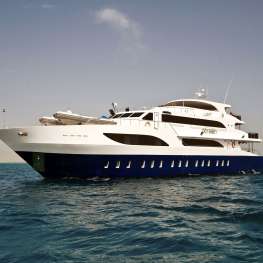
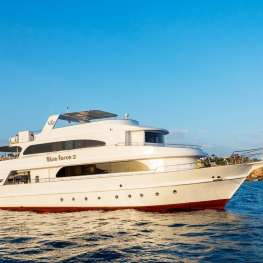
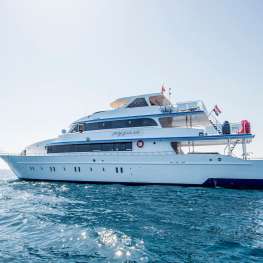
Diving the Southern Egyptian Red Sea — A Guide to the Main Liveaboard Itineraries
Few destinations in the diving world carry the kind of weight that Egypt's southern Red Sea does. This is a stretch of ocean where the geography itself seems designed to produce extraordinary encounters — isolated offshore pinnacles, cathedral walls plunging past recreational limits, and open-water columns that funnel pelagic life from the deep. Unlike the north, where wrecks and sheltered reefs dominate the agenda, the south is defined by remoteness, raw ocean energy, and an almost guaranteed proximity to sharks. Liveaboard is the only practical way to reach most of these sites, and virtually all itineraries run seven nights, with three or more dives per day. The principal routes break down into three broad categories, each with its own character, signature sites, and ideal diver profile.
Brothers, Daedalus & Elphinstone — The "Golden Triangle"
This is the route most divers mean when they talk about the southern Red Sea, and with good reason. Often called the Golden Triangle or the Shark Route, it strings together three of the most celebrated offshore reefs in Egypt into a single week-long circuit, typically departing from Hurghada or Port Ghalib.
The Brothers Islands (El Akhawein) sit roughly 60 miles off the coast near El-Quseir, two rocky volcanic cones barely visible above the surface save for a 19th-century British lighthouse crowning the larger of the two. Big Brother's walls drop vertically from the island's edge, home to two classic wrecks — the Numidia, a cargo ship that ran aground in 1901 with its bow resting at around 8 metres before cascading down the wall to technical depths, and the Aida, an Egyptian vessel lying stem-to-stern on the island's northwestern slope. Both are heavily encrusted in soft coral and serve as gathering points for Napoleon wrasse, moray eels, and clouds of glassfish. The southeastern point of Big Brother is where the shark action concentrates — grey reef sharks, oceanic whitetips, and occasional hammerheads patrol the blue just beyond the wall, and patient early-morning divers sometimes encounter threshers emerging from depth during autumn and winter.
Little Brother, just a short tender ride away, offers a different atmosphere. Its walls are arguably in even finer condition, the upper section a dense tapestry of hard and soft corals, while a shallow plateau on the northern tip drops into a shark aggregation zone at around 40 metres. Conditions at both islands can be demanding — strong currents, downwellings, and exposed open-ocean swells are part of the deal — making this a route firmly in the advanced diver category.
Daedalus Reef (also known as Abu Kizan) is the most isolated reef in the entire Egyptian Red Sea, located approximately 52 nautical miles east of Marsa Alam. The crossing alone takes six or more hours, but the payoff is a vast oval reef rising from depths exceeding 500 metres, its walls blanketed in pristine hard coral formations of a scale rarely seen elsewhere. Almost every dive here is a drift along these walls, and the current is the engine that drives the experience — pulling in giant trevally, dogtooth tuna, and the schooling hammerheads that make the northern point particularly electric. Oceanic whitetips are a common presence, manta rays and threshers occasional bonuses. Its status as a marine park, combined with the sheer difficulty of getting there, keeps this reef in exceptional condition.
Elphinstone rounds out the triangle as a somewhat more accessible bookend — a narrow, north-south finger reef just a few kilometres from the Marsa Alam coast. Its eastern and western walls are sheer drops into darkness, covered in gorgonians and soft corals in shades of pink, red, and orange, while the plateaus at the northern and southern tips serve as reliable meeting points with sharks and large schooling fish. Oceanic whitetips are a near-guarantee between October and December on the southern plateau, often approaching divers with curiosity. A partially submerged arch on the southern end, accessible only with technical qualifications, adds an exploratory dimension for those with the training to approach it safely.
Fury Shoals & South — Reefs for the Explorer
While the Golden Triangle route chases pelagic encounters in open water, the Fury Shoals and wider Southern Red Sea itinerary offers a contrasting experience — one of labyrinthine coral architecture, intimate reef life, and a sense of wilderness that even the Brothers can't quite match. These trips typically depart from Port Ghalib or Hamata and spend the bulk of their time in reef systems closer to the Egyptian coast, where the landscape shifts from sheer walls to shallow lagoons, swim-throughs, and coral gardens of remarkable density.
Fury Shoals is the centrepiece — a network of semi-submerged reefs stretching along the southwestern Egyptian coast, each with its own personality. Sha'ab Claude is famous for its massive porite coral heads and twisting swim-throughs, while Abu Galawa Soraya lures photographers with a small wreck smothered in soft coral and dense aggregations of glassfish. The overall character here is less about big encounters and more about immersive reef diving — hawksbill turtles, macro life, resting whitetip reef sharks, and the occasional dugong patrolling the sandy shallows of Abu Dabbab nearby.
This itinerary also incorporates Elphinstone in most cases, usually as a half-day stop before or after the Fury Shoals section, giving divers the best of both worlds — the concentrated reef life of the south and the offshore drama of the open sea.
Rocky, Zabargad & St. John's — The Deep South
The most remote of the three main itinerary categories, the Deep South route pushes southward to within striking distance of the Sudanese border, visiting sites that relatively few divers ever reach. The transit times are longer — St. John's is an overnight sail of around 14 hours from Port Ghalib — but the isolation is a large part of the appeal. These are waters largely free from day boats and casual divers.
Rocky Island is a compact pinnacle with near-vertical walls on every side, regularly swept by southerly currents that deliver nutrient-rich water to its coral formations. Visibility here can be extraordinary. The currents also attract grey reef sharks, hammerheads, and oceanic whitetips to the southern point, while the deep-water wreck of the SS Maidan, resting between 80 and 110 metres on the island's south side, draws technical divers seeking something genuinely remote.
Zabargad is a striking island with an ancient history — its name derives from the Arabic word for peridot, a semi-precious stone once mined here during Pharaonic times and prized by the Romans. Above water, an imposing mountain defines its profile; below the surface, the island is ringed by a spectacular reef, a shallow lagoon, and a couple of wrecks covered in decades of coral growth. The diversity of life here — everything from schooling reef fish to curious sharks — makes it one of those sites that rewards multiple dives across different sections.
St. John's is less a single reef than a vast collection of coral structures spread across a wide area near the Tropic of Cancer. Sites like Habili Ali offer dramatic drop-offs patrolled by silvertip and grey reef sharks alongside gorgonian forests and black coral, while Gota Soraya is celebrated for its caverns and swim-through tunnels that turn each dive into genuine underwater exploration. The reef systems here are among the healthiest in Egypt, a product of both their protected status and the minimal diver traffic compared to sites further north.
This route appeals particularly to divers who prioritise seclusion and raw reef quality over headline shark encounters, though the Deep South delivers plenty of the latter too. It is best suited to experienced divers comfortable with currents, deep dives, and the realities of spending time on the open sea well away from land.
Choosing Your Route
The three itineraries are not always mutually exclusive — many liveaboards run blended routes combining elements of two or more of the above, and the permutations on offer across Egypt's liveaboard fleet are considerable. What they share is a consistent set of conditions that set southern Egypt apart: exceptional visibility, water temperatures ranging from around 22°C in winter to 30°C in summer, and a marine environment that remains one of the most biodiverse in the world. For experienced divers willing to accept that the ocean will set its own terms, the southern Red Sea is one of the great liveaboard destinations on the planet.