- Best-Price Guarantee
- 24/7 Expert Support
- No Booking Fees
- Direct with Operators
- 500+ Boats Worldwide
Description
Boat
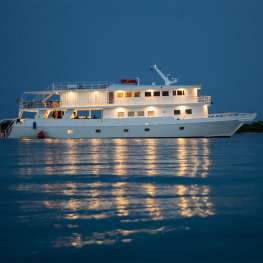
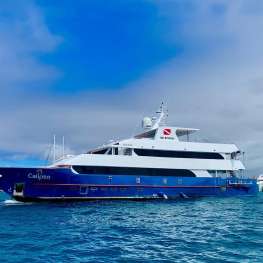
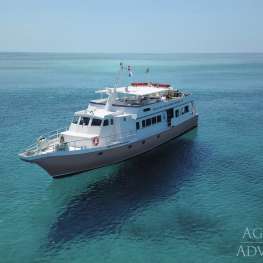
Danubio Azul is a Tourist Class Diving yacht ranked as 3 Stars. It is a MonoHull yacht, measures 24.84 meters long, 5.47 meters wide, built in 2008 and was introduced in August 2016 to the Galapagos.It has a max. cruise speed at 11 knots.
Guests can enjoy guided tours throughout your journey, including assistance during embarkation and disembarkation at the islands, as well as access to protected and tourist areas.
Danubio Azul has stringent safety measures, including water rescue-trained personnel, two radars, VHF radio, VHF-EPIRB, bidirectional VHF, life raft, two Zodiacs with 50 HP Yamaha engines, searchlights, oxygen supply, pump, fire extinguishers, life jackets, flares, and more.
Danubio Azul offers an Al Fresco Dining on the upper deck, guests will savor delectable cuisine prepared by a qualified chef, featuring healthy gourmet menus. There are also sun charis for guests who enjoys sun bathing.
On the main deck, there is the indoor dining room with a fully equiped bar, a small library which also can be used as an indoor lounge area in between the activites.
On the main deck, there is a shaded diving area and dive deck. Guests can access state-of-the-art diving equipment, including special suits, all compliant with safety standards. This includes 2 air compressors, 2 Coltri Nitrox compressors, oxygen tanks, all meticulously maintained.
Cabin
Danubio Azul has 8 guest cabins, accommodating up to 14 guests per trip:
All cabins feature air-conditioning, en-suite bathroom, power outlets and storage area.
1 Suite Cabin (#1) :
Located on the upper deck, this cabin comes with one large double bed or two single beds, seaview windows.
2 Single Cabins (#2, 3) :
Located on the upper deck, each cabin comes with one single bed, seaview windows.
2 Deluxe Cabins (#4, 5) :
Located on the main deck, each cabin comes with two single beds (not bunk style), seaview windows.
3 Standard Cabins (#6 - 8) :
Located on the lower deck, each cabin comes one small double bed and one single bed in bunk style, portholes.
Diving
- 3 dives per day + alternating additional sunset/night dives.
- Usually 8D/7N diving trip will offer 18 - 20 dives in total.
- 1 Check dive will be provided on the embarkation day.
- Only 1 - 2 dives will be provided on the last diving day.
- All diving will provide experienced guide to lead the dive.
- Divers must have AOW level with at least 50 logged dives.
- There are 4 kayaks available for guests to use, free of charge.
Other information
- Nitrox:Available with an additional cost
- 15L Tanks:Limited available with an additional cost
- Technical Dive Available: Not available at the moment
- REBREATHER Dive:Not available yet at the moment
- Dive Equipment Rental:Available with an additional cost
- Dive insurance:Divers must have valid dive insurance
- Wi-Fi Internet :Complimentary for all guests
- Laundry Service:Not available at the moment
- Massage Service:Not available at the moment
- Payment on board:By cash (USD only)
- Crew Number:8, include 2 dive guides
Itineraries
Galapagos 8D/7N Diving trip
Day 1
Once you arrive to the airport our transportation will be ready to transfer you to our great diving vessel Danubio Azul.
PM: Santa Cruz Island, Carrion Point
Day 2
AM: Bartholomew Island
PM: Cousins Rock
It’s famous for being a very special place for diving. Its amazing seahorses which love to cling to the black corals, but also the bloody frogfish attract lots of looks, however is kind of difficult to detect them, because of their mimic ability. Here you can also find abundance of species of endemic fish, and mega diversity of some others like don gringo fish, whitetail dascyllus, coral hawk fish, etc. On this place you will be able to do diving, panga ride and snorkeling.
Day 3
AM: Wolf Island, Punta Shark Bay
This place is the principal diving area at Wolf island placed at its south. The white coral covers the sea bottom and this is a very attractive for this place. Here you will also admire the presence of hammerheads sharks, as well as whale sharks or white head. There is also snorkeling activity for amateurs.
PM: Wolf Island, El Derrumbe
Here you can find the empire of three spices of sharks. Hammerheads, Galapagos and whale sharks are the most important where diving will become a memorable experience. El Derrumbe is located on the southeast coast of wolf, an uninhabited island and no shore excursions are allowed.
Strong horizontal and vertical descending currents occur generally; it is very normal to find here open water species such as green and hawksbill turtles, manta rays and rays are observed here too. There are also types of pelagic species such as voracious bluefin jureles, palometas and steers.
Day 4 - Day 5
AM: Darwin Island, El Arenal
PM: Darwin Island, Darwin´s Arch
El Arenal which is a sublime natural place where sea lions take their “nap”. Excellent for diving demanders, where you can find a lot of frigates, boobies and the colony of hammerheads and whales sharks is always present. An important note to consider is that the currents here are strong and its lands are uninhabited; no shore excursions are allowed El Arco, as its name implies, is a natural a physic structure with the shape of an arc made with rocks; its beauty will attire the attention of your camera.
Day 6
AM: Wolf Island, La Ventana Islet
Coming back to Wolf, it is possible to admire a variety of fish species due to the presence of seedling and grill. It is possible to find on the way with real spots of albacore, palometas, among others. It’s too much to say we will encounter hammerhead sharks on the way, as well as other spices of them.
PM: Wolf Island, La Banana
Due to the strong currents, it is strongly recommended that expert divers go through la Banana. Here you can see tuna fish, albacores, palometas, snappers and more big spices of fish.
Day 7
AM: Isabela Island, Marshall Cape
It is a bottom of basaltic rock of very variable sizes and descends in a relatively steep slope towards greater depths. It is surprising that this background originated, through ground lava flows that went into the sea. Being in a megafauna pass area, this dive site is ideal for spotting stingrays, devil rays, green turtles, sea lions, different shark species and more open water species.
PM: Santiago Island, Egas Point
This visit consists of a black beach and a circular path that begins with an old road, and returns through the intertidal zone.
Among its main attractions we will find the fur seals colony of Galapagos, the intertidal zone and the human history related to the site. There are also unique terrestrial birds of the archipelago such as the Galapagos hawk, the Galapagos dove, the Galapagos cucuve and a variety of Darwin finches.
Day 8
AM: North Seymour Island
The visit to North Seymour is the best way of saying goodbye to the Galapagos. Following a dry landing at sunrise we will walk amongst the largest blue-footed booby colony of the Islands. It is likely that you will enjoy their dancing and singing to find a mate. Not far from the dancers we have great and magnificent frigate birds nesting. The males inflate their pouches to attract the ladies that fly above them. Swallow tailed gulls and tropicbirds decorate the large basaltic walls of the island
We will be back on board for breakfast at 8:00 and we have to be ready to check out at 9:00. It is always a good idea to do most of your packing the previous night so you can have a pleasant last early morning visit and a relaxed breakfast.
The cruise itinerary and activities are subject to change at any time due to circumstances that are beyond our control, like weather conditions or official requests from local authorities.
Schedules & routes
Prices & conditions
| Cabin | From price per person |
|---|
Included
- Transfers from airport and/or hotel to the yacht
- Full-board meal plan (including snacks)
- Complimentary beverages (water, tea, coffee)
- Soft drinks
- Diving activity (incl. tanks, weights, weight belts)
- Dive guide service
- Use of Kayaks or/and SUPs
- Land excursions and activities throughout the trip
- Boat accident insurance
- Cabin towels and complimentary toiletries
- Cabin cleaning service
- Wi-Fi
Not included
- Domestic flights in destination country
- Marine park fees & Port fees
- VAT and local taxes
- Fuel surcharge
- Alcoholic beverage
- Dive equipment rentals
- Larger tank (15 L)
- Nitrox fills
- Dive courses on board
- Dive insurance (mandatory requirement)
- Travel insurance (trip cancellation insurance)
- Crew gratuity
Useful information
Ecuador (Galapagos)
Best time for diving
There is no "wrong time" for Galapagos! There are two seasons in the Galapagos : The Manta season (Wet season, warmer water) - December to May, the Whale shark season (Dry season, cooler water) - June to November. Any time is a good time, as you'll see more species in Galapagos on a bad day than you see in most dive sites around the world on the very best day. However, Dive and Cruise team do recommend to visit Galapagos between mid June and November, as the chances of seeing whale sharks are definitely higher and the schools of hammerheads usually tend to be bigger in this period.
The average visibility is around 10 - 30 meters. Currents can be very strong at times, and the surface conditions can be choppy.
About temperatures
Air : Wet season (Dec - May) is between 23°C - 30°C, Dry season (Jun - Nov) between 21°C - 27°C. Evening temperatures can drop to just 15°C.
Sea : Wet season (Dec - May) is between 18°C - 26°C - with the western part of Galapagos being the coolest at 17°C -19°C. Dry season (Jun - Nov) between 17°C - 25°C - with the western part of Galapagos being the coolest at 15°C -18°C. Wolf and Darwin are usually between 24°C - 25°C all year.
Wetsuit Recommendation
Thermoclines are to be expected throughout the year and divers are advised to bring suitable thermal protection for all expected temperatures. We recommend 5mm - 7mm wetsuit with additional layers (shorty / skin-suit /vest / hood) for cooler waters and gloves for warmth and support in strong currents.
Diver requirement
Diving in Galapagos can be challenging even for experienced divers. Strong currents and tough conditions are not rare. Therefore, all liveaboards require divers to have at least AOW certification with minimum 50 logged dive. In addition, we strongly suggest divers to get some experience in strong currents and reduced visibility! You can find out more information about diving in the Galapagos Islands here : Galapagos
Embarkation / Disembarkation
Depends on the liveaboard you pick, the embarkation and disembarkation is either San Cristobal (SCY) or Baltra (GPS) in the Galápagos islands.
Guests need to take their international flights to Quito (UIO) or Guayaquil (GYE), in mainland Ecuador at least one day before the embarkation.
Flights to the Galápagos Islands originate in Quito, making a quick stop at Guayaquil, then carrying on to the islands and do the reverse on the way back.
One the day of embarkation, please at the airport in Quito or Guayaquil one and a half hours (90 minutes) prior to departure for check-in. A Transit Control Card (also referred to as TCT card) is required for travel from mainland Ecuador to the Galápagos Islands. The cards are obtainable from the INGALA booths at Quito and Guayaquil Airports before checking in for your flight to the Galapagos, and cost 20 USD.
Upon arrival in Galápagos, passengers form a line to process passenger Passports and Park entrance fees in cash. Then you will meet the pickup crew outside of the airport door with a sign.
Visa Requirements
There is no visa requirement for most foreign visitors who carry passports with at least six months’ validity from their entry date. Please contact your nearest Ecuadorian embassy / consulate for the latest requirements.
Vaccinations
Proof of yellow fever vaccination is mandatory for anyone arriving from regions where the disease is prevalent, such as Brazil, the Democratic Republic of Congo and Uganda (including airport transit).
Insurance Requirements
In addition to the mandatory Dive insurance, a Travel health insurance is a mandatory requirement for entry into Ecuador. All foreign tourists are required to have travel health insurance which covers the entire duration of their intended stay in the country. Traveller who are unable to provide proof of insurance may be denied entry.
Ban on plastic
Since 2018, single use, non-recyclable and non-biodegradable plastics have been banned in Galapagos. Before travelling, please ensure that plastic packaging is removed from any items you are bringing with you.
Money Matters
The local currency in Ecuador is the US Dollar (USD). Larger hotels, resorts, shops and restaurants will normally accept Visa and Mastercard for which a charge of 4 – 10% may be levied.
Drones
Tourists are NOT permitted to fly camera drones anywhere in the Galapagos Islands. Please refer to Drone Laws in the Galapagos Islands for more details.
Extending your holiday
We offer a range of hotels/resorts, land-based diving packages, and excursions that can be arranged before or after your liveaboard holiday. Just ask us if you need such service.
Diver's reviews (0)
Photos


More details
Danubio Azul liveaboard in Ecuador (Galapagos) — at-a-glance facts on capacity, cabins, duration, facilities and languages. FAQs below cover pricing, certification and how to book.
| Destination | Ecuador (Galapagos) |
|---|---|
| Boat type | Liveaboard dive boat |
| Capacity | 14 guests maximum |
| Country | Ecuador |
| Facilities | Nitrox support, Sidemount Friendly, Camera Station, Wi-Fi |