Four volcanic islands rising from the deep Pacific Ocean, 400 kilometres south of the tip of Baja California, the Socorro Islands — officially the Revillagigedo Archipelago — are what happens when you combine extreme geological isolation, exceptional oceanic productivity, and an almost complete absence of human disturbance. The result is one of the most extraordinary marine wildlife encounters available anywhere on the planet, built around a single species that has made this place famous: the giant oceanic manta ray.
Mantas at Socorro are not the shy, evasive animals encountered at most dive destinations. They are inquisitive, habituated to divers over generations of protected interaction, and they approach. Not occasionally, not unpredictably — they approach deliberately, positioning themselves in front of divers, hovering, circling, making eye contact in a way that feels unmistakably intentional. Encounters lasting 30 to 45 minutes with individual animals are commonplace. Multiple mantas at a single site simultaneously is the norm rather than the exception. A single dive at Cabo Pearce or Roca Partida on a good day can involve ten or more mantas alongside dolphins, whale sharks, and silky sharks in numbers that belong to a category of diving entirely separate from anything available at a resort destination.
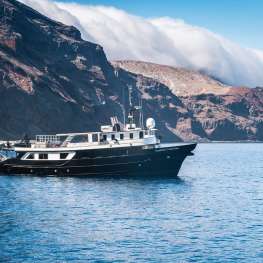
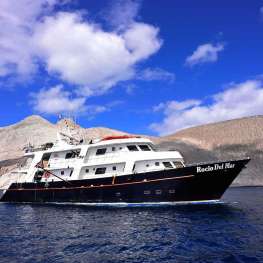
Socorro is accessible only by liveaboard from Cabo San Lucas, a crossing of 18 to 24 hours across open Pacific swell. There are no land-based facilities, no hotels, and no infrastructure of any kind on the islands beyond a small Mexican Navy station on Socorro Island itself. This is exactly the condition that has preserved it.
Why Dive the Socorro Islands by Liveaboard
There is no alternative. The Revillagigedo Archipelago was declared a UNESCO World Heritage Site in 2016 and a national park in 1994, and access is tightly controlled by the Mexican Navy. Day trips are not permitted. Shore diving is not permitted. The only way to dive here is aboard a permitted liveaboard vessel departing from Cabo San Lucas, and itineraries run either 7 nights or 10 nights depending on the operator and season.
The crossing itself — 18 to 24 hours across open ocean — acts as a natural filter. Not every diver makes the trip. Not every boat is permitted. The relative exclusivity that results is not a luxury concept; it is the direct reason the marine life here behaves the way it does. Generations of mantas, dolphins, and whale sharks at Socorro have interacted with divers without being harassed, fed, or exploited. The animals here approach because approach is their learned response to divers — a relationship built over decades of protected contact that cannot be replicated anywhere that less rigorous protection has been applied.
Liveaboards to Socorro typically carry between 12 and 20 divers, with dive operations running up to 4 dives per day including night dives. The four main islands — Socorro, San Benedicto, Roca Partida, and Clarión — each offer distinct diving conditions and distinct animal communities, and a full 10-night itinerary visits all four, spending multiple days at the best sites depending on conditions and season.
The Four Islands for Scuba
San Benedicto is the first island visited on most itineraries, approximately 24 hours from Cabo San Lucas. The main site, Cabo Pearce, is the single most reliable manta ray encounter in the entire archipelago — a submerged cleaning station on a shallow rocky point where mantas arrive in the early morning and remain throughout the day. The site is suitable for all experience levels, with the primary action occurring between 15 and 25 metres on a gently sloping reef. Alongside mantas, Cabo Pearce regularly produces bottlenose dolphins, Galápagos sharks, and whitetip reef sharks. The secondary site at San Benedicto, El Cañon, is a deeper wall dive with hammerheads, silky sharks, and occasional whale shark transits.
Socorro Island is the largest island in the group and home to the Navy station. The main dive site, El Boiler, sits on Socorro's northern tip — a shallow, current-swept rock formation rising to within a few metres of the surface that concentrates manta rays, dolphins, and whale sharks in a compressed area of extraordinary biological density. The dolphins here — primarily bottlenose — are extraordinarily interactive, often initiating contact with divers and engaging in extended play behaviour that makes every encounter feel genuinely mutual. Conditions at El Boiler can be challenging, with surge and current requiring good buoyancy and positional control, but the rewards are proportionally exceptional.
Roca Partida is a single needle of volcanic rock protruding 20 metres above the surface of the open Pacific, surrounded by deep water in every direction and lashed by current and swell. It is the most remote, most dramatic, and — on a good day — most productive site in the archipelago. The rock's walls descend vertically to beyond 40 metres and are heavily encrusted with corals and sea fans, but the real action at Roca Partida is in the blue water surrounding it. Silky sharks aggregate here in numbers that can reach into the hundreds. Galápagos sharks and whitetip reef sharks rest on the ledges near the surface. Schools of bigeye jacks and Pacific creolefish move in dense formations around the pinnacle. Roca Partida rewards patience: the standard approach is to descend to 25 to 30 metres, find a sheltered position against the rock out of the current, and wait. What comes past — mantas, whale sharks, silky sharks in colossal aggregations, dolphins, hammerheads — arrives on its own schedule.
Clarión Island is the most distant island in the group, approximately 700 kilometres from the Mexican coast, and is included only on longer 10-night itineraries when Navy permission is granted. It is the least visited and least documented site in the archipelago, with shallower reefs, excellent hard coral coverage, and a resident community of endemic species including the Socorro dove and the Clarión angelfish. The diving is gentler than Roca Partida but offers an intimacy of wilderness — and a near-certainty of having the island entirely to yourself — that few other destinations can provide.
Marine Life by Season
The Socorro Islands are diveable year-round, and liveaboard operations run from November through June, with the archipelago officially closed to visitor access during the hurricane season from approximately late June to October. Each season within the open window has distinct strengths.
November to January marks the start of the season, with water temperatures around 24°C to 26°C and the arrival of large numbers of giant oceanic manta rays at the cleaning stations. Humpback whale activity begins in December, with singers and escorts increasingly common throughout the month. Visibility is typically good at 20 to 30 metres, and conditions are generally calmer than later in the season.
February to April is the peak season for humpback whale encounters — these are the months when Socorro delivers one of the rarest experiences in scuba diving: in-water encounters with singing humpback whales, whose vocalisations can be heard and felt through the water column on virtually every dive during peak weeks. Manta ray activity remains very high. Whale shark frequency increases through March and April, with April being one of the best months for multiple whale shark sightings in a single day. Water temperature drops slightly to around 22°C to 24°C, and a 5mm wetsuit is the minimum recommendation.
May to June closes the season with warmer water returning (26°C to 28°C), high manta ray and dolphin activity, and the best conditions for baitball encounters — large aggregations of jacks, tuna, and dolphins hunting cooperatively in the blue water around Roca Partida and El Boiler. Whale shark activity remains solid through May.
Best Time to Dive Socorro
For humpback whale encounters, February and March are the most reliable months — the probability of hearing whale song on virtually every dive and seeing whales underwater, not merely at the surface, is as high here as anywhere on earth during this window.
For whale sharks, April and May offer the best frequency of sightings, with multiple encounters in a single day possible at peak times.
For manta rays, the entire season from November to June is productive, but December through March sees the highest numbers at the cleaning stations — particularly Cabo Pearce on San Benedicto and El Boiler on Socorro.
For the best overall balance of warm water, multiple large species simultaneously, and the most dynamic diving conditions, March and April are widely considered the sweet spot — delivering mantas, whale sharks, humpbacks, dolphins, silky sharks, and Galápagos sharks in a combination that no other destination on the planet can match.
Water Temperature and Visibility
Water temperature at Socorro ranges from 22°C at the coolest point of the season (February to March) to 28°C at the warmest (May to June). A 5mm wetsuit is adequate for most divers from March onwards; a 7mm is strongly recommended for February and is comfortable rather than excessive for January and March.
Visibility is generally excellent and ranges from 20 to 40 metres across the season. The open-ocean setting of Roca Partida in particular can deliver visibility of 35 to 40 metres in good conditions, making blue-water photography some of the best available in the eastern Pacific. Occasional plankton blooms can reduce visibility at individual sites, but these are typically short-lived and are associated with exactly the kind of oceanic productivity that drives baitball and whale shark activity.
Diving Conditions
Socorro is suitable for confident intermediate divers and above. It is not technically an advanced-only destination in the way that Malpelo or Cocos Island are — conditions at Cabo Pearce and some sites around San Benedicto are genuinely approachable for divers with solid open-water fundamentals and some experience with currents.
However, conditions at Roca Partida can be genuinely demanding: strong surge, powerful and shifting currents, and the psychological challenge of blue-water diving far from any shore wall require a level of experience and composure that not all intermediate divers possess.
The standard recommendation from experienced Socorro operators is a minimum of 50 logged dives, with prior experience in drift conditions. Open-water certification is the minimum requirement for calmer sites; Advanced Open Water is recommended for Roca Partida.
Current conditions vary by site, tidal state, and season. Drift diving is common at Roca Partida; controlled descents and ascents in open water are essential. An SMB (surface marker buoy) is mandatory equipment and should be deployed on every open-water ascent without exception — the Pacific swells that characterise the area make surface spotting without an SMB genuinely hazardous.
The crossing from Cabo San Lucas can be rough, particularly during the February to April swell season, and a degree of tolerance for open-ocean passage is worth considering before booking. Most vessels are well-equipped and stable, but seasickness medication is strongly recommended for sensitive travellers.
Who Is Socorro For?
Socorro is for the diver who has moved past the stage of being thrilled by the act of diving itself and is now seeking encounters that are extraordinary by any objective measure.
The manta rays alone make Socorro one of the most compelling dive destinations on earth — but the totality of what the islands deliver in a single week is genuinely unmatched. Humpback whale song felt through the water column on a morning dive. A 4-metre manta hovering motionless 50 centimetres from your mask, studying you with the same curiosity you're directing at it. A colossal aggregation of silky sharks rolling through a baitball at Roca Partida at dusk. Dolphins initiating contact and playing in your exhaled bubbles. The combination of charismatic megafauna, genuine wilderness, and interactive animal behaviour belongs to a category that very few places on earth can access.
It is also one of the finest destinations on earth for underwater photographers — particularly those focused on large animal and blue-water work. The combination of outstanding visibility during the warm months, extraordinarily cooperative manta rays, and the structural drama of Roca Partida creates a photographic environment that has produced some of the most widely published underwater images of the last two decades.
Socorro is part of the Mexico diving circuit, and many divers combine it with the Sea of Cortez — a fundamentally different diving environment in the same country — to experience the full range of Mexican Pacific diving in a single trip.
Practical Information
Liveaboards depart from Cabo San Lucas, at the southern tip of Baja California. The closest airport is Los Cabos International Airport (SJD), with direct connections from major US cities including Los Angeles, San Francisco, Dallas, Houston, Chicago, and New York, as well as from Mexico City and Guadalajara. Arriving the day before departure is strongly recommended.
Most itineraries run 7 nights or 10 nights (with access to all four islands including Clarión, subject to Navy permission). Nitrox is available on most current Socorro liveaboards. A 5mm wetsuit is standard equipment; 7mm is recommended for February and March. An SMB, dive computer, and whistle are mandatory for all diving.
The nearest decompression chamber is in Cabo San Lucas — well within reach compared to truly remote destinations, but conservative dive profiles and strict computer adherence remain essential. Dive insurance covering emergency medical evacuation is a must.
Browse Socorro Islands liveaboards on Dive and Cruise
Frequently Asked Questions
Do the manta rays really approach divers on their own?
Yes — and this is what makes Socorro genuinely unlike any other manta destination. The mantas here are habituated to divers over generations of protected, non-feeding interaction. They approach out of curiosity and apparent social interest, not because they are fed or attracted by bait. The standard guidance from experienced Socorro guides is to remain still, control your bubbles, and let the manta approach on its own terms. Active pursuit reliably terminates an encounter; patience reliably extends one.
Is this suitable for beginner divers?
Most operators recommend a minimum of 50 logged dives and prior experience with currents before attempting the full Socorro itinerary. The open-ocean crossing and variable conditions at the outer islands require a level of comfort and composure that genuinely benefits from experience.
Can I hear humpback whales underwater?
Yes — from approximately December through April, and peaking in February and March, humpback whale song is audible underwater on virtually every dive during peak weeks. In optimal conditions the sound is felt as well as heard, a low-frequency resonance that carries through the water column at full strength regardless of whether the whale itself is visible. In-water sightings — not merely surface breaches but genuine subsurface encounters — are possible during February and March, though not guaranteed.
What is the best itinerary length?
A 7-night itinerary covers San Benedicto, Socorro, and Roca Partida, which represent the three most productive sites. A 10-night itinerary sometimes can adds Clarión Island, subject to Navy permission. For first-time visitors, the 7-night itinerary is the standard choice and delivers a complete Socorro experience. For returning divers or those specifically seeking Clarión, the 10-night itinerary is the only option.
What certification and experience do I need?
Open Water Diver certification with 30+ logged dives is the minimum requirement for most operators at calmer sites. Advanced Open Water with 50+ logged dives is strongly recommended for a full itinerary including Roca Partida. Prior experience in open-ocean drift conditions is highly advisable.
Part of Mexico · Americas & Caribbean · Browse Socorro Islands liveaboards on Dive and Cruise
Marine life
Socorro is the Mexican Pacific's "little Galapagos" — pelagic big-animal diving. Highlights include:
- Oceanic manta rays (famous friendly encounters)
- Whale sharks (Nov-May)
- Hammerhead shark schools
- Silky sharks (often hundreds)
- Whale encounters (humpback Jan-Apr)
- Silvertip sharks at The Boiler
- Schooling jacks and tuna
- Sea turtles (occasional)
- Whale shark aggregations Nov-May
- Dolphins (common on surface intervals)