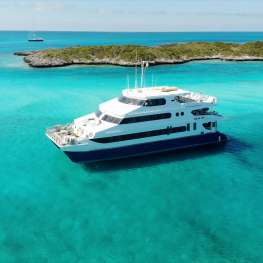
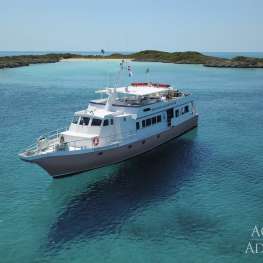
Three hundred and sixty-five cays — one for every day of the year, as the local saying goes — stretch in a thin, curving arc for roughly 160 kilometres through the central Bahamas, separating the shallow turquoise expanse of the Great Bahama Bank to the west from the deep indigo of Exuma Sound to the east. The Exuma Cays are among the most visually spectacular island chains in the Atlantic world: low-lying limestone and sand formations fringed with mangroves, fringed in turn by the kind of white-sand beach that exists in Caribbean imagination before experience arrives to complicate it, and surrounded by water of such extraordinary clarity and colour that first-time visitors frequently mistake it for a photograph.
Below the surface, the Exumas deliver a marine environment that matches the visual promise above it. The Land and Sea Park — the Exuma Cays Land and Sea Park, established in 1958 as the first land and sea park in the western hemisphere — covers 456 square kilometres of the northern Exumas and enforces strict no-take regulations that have allowed its reef ecosystems to recover to a density and health that stands in sharp contrast to the more heavily fished waters surrounding it. Outside the park, the Exuma Sound's blue holes, shark nurseries, and open-ocean passages provide a completely different diving character — deeper, more pelagic, and in some cases among the most unusual dive experiences in the Bahamas.
The Exuma Cays are part of the Bahamas diving circuit. They offer a fundamentally different experience from the shark-focused operations at Bimini or Tiger Beach — broader, more varied, and in terms of above-water scenery and overall Caribbean character, arguably the most beautiful liveaboard destination in the entire Bahamas chain.
Why Explore the Exuma Cays by Liveaboard
The Exuma Cays span 160 kilometres of ocean. George Town, the main settlement on Great Exuma, sits at the southern end; the Land and Sea Park occupies the northern section around Warderick Wells Cay. Between them lies a spread of dive sites, anchorages, blue holes, and wildlife encounters that no single land-based location can access efficiently. A liveaboard is not merely convenient here — it is the natural way to experience a destination whose entire character is defined by movement through an island chain, anchoring in new water each night, and waking to a different view of the same impossibly blue sea.
The Exuma Land and Sea Park is anchor-permit only — private yachts and liveaboards must obtain advance permits to anchor within the park boundaries. Compliance with park regulations, including the strict no-take rules, is non-negotiable. The reward for this additional logistical step is diving in reef ecosystems that have been protected for over 65 years and that display a biomass and structural complexity that has largely disappeared from the broader Caribbean. The contrast between a dive inside the park and a dive outside it — in terms of fish density, coral cover, and shark presence — is immediately apparent.
Most Exuma Cays liveaboards carry 8 to 16 guests and run itineraries of 5 to 8 nights, moving north or south through the cay chain depending on conditions and season. The combination of diving, snorkelling, beach walks on uninhabited cays, kayaking in the mangrove channels, and the various above-water wildlife encounters that the Exumas are famous for make this a destination that rewards guests who are not exclusively divers as much as it rewards those who are.
Key Dive Sites and Experiences
The Exuma Cays Land and Sea Park encompasses the most pristine reef diving in the Bahamas and arguably in the entire Caribbean Basin north of the deep tropical reefs of the eastern Caribbean. The no-take regulations — in force since 1958, making this one of the longest-protected marine areas in the world — have allowed the park's Nassau grouper, Caribbean reef sharks, nurse sharks, and reef fish populations to recover to densities that feel genuinely pre-commercial-fishing. A dive inside the park on the outer reef walls — particularly around Warderick Wells Cay, Shroud Cay, and Compass Cay — produces the kind of layered fish communities that Caribbean divers of a certain vintage describe from the 1970s: grouper on every ledge, snappers in schools too dense to see through, reef sharks circling the outer edges with the casual proprietary confidence of animals that have never been threatened.
The Blue Holes of the Exuma Sound are among the most dramatic and geologically significant dive sites in the Bahamas. The Exuma Sound drops to over 1,800 metres in places, and where the limestone of the cays meets this deep water, submarine caves and blue holes create diving environments of extraordinary character.
The Crab Cay Blue Hole, Dean's Blue Hole (technically on Long Island nearby, and the deepest known blue hole in the world at 202 metres), and the various unnamed blue holes accessible from the outer cay edges offer a combination of cavern diving, dramatic topography, and the particular quality of light that blue holes produce — a shaft of sunlit water descending into darkness — that is available nowhere else in the Bahamas with such concentration.
Compass Cay and the Nurse Shark Encounter is one of the Exumas' most famous wildlife experiences and a consistent highlight of liveaboard itineraries: a sheltered dock at Compass Cay where dozens of large nurse sharks have aggregated over years of benign human interaction, making this one of the most accessible large-shark encounters in the Bahamas. The nurse sharks rest in the shallows, allow handling under guide supervision, and move around divers and snorkellers with the unhurried calm of animals entirely comfortable in close human company. The site is appropriate for all ages and experience levels and is a reliable crowd-pleaser — including for non-divers in the group.
Thunderball Grotto, near Staniel Cay, is a sea cave system that achieved fame as a filming location for the James Bond film Thunderball (1965) and has remained one of the most distinctive dive sites in the Bahamas ever since. The cave system consists of interconnected chambers with multiple surface openings that flood with sunlight at certain tidal states, creating an extraordinary quality of dappled, cathedral light on the cave walls and on the dense fish communities inside. The grotto is accessible by snorkel as well as scuba and is suitable for all experience levels. At morning low tide, beams of light descend through the ceiling openings in a display of underwater illumination that photographers specifically plan itineraries around.
Stocking Island and the Mystery Cave near George Town offer accessible reef diving with a resident Caribbean reef shark community and a limestone cave system — Mystery Cave — that penetrates some distance into the seabed and provides a memorable cavern dive in conditions appropriate for non-cave-certified divers. The outer reef around Stocking Island has good hard coral coverage and a reliable resident population of reef species.
The Swimming Pigs of Big Major Cay are not a dive site but are one of the most famous wildlife encounters in the entire Caribbean — a colony of free-roaming pigs that swim out to meet boats in the turquoise shallows of the cay's beach. The encounter is above water and is reached by tender from the liveaboard; it is almost universally described as one of the most joyfully absurd wildlife experiences available anywhere, and responsible liveaboard operators include it as a standard itinerary highlight. The pigs are healthy, habituated to visitors, and entirely willing to accept fruit and snacks from the hands of people standing in knee-deep water.
Staniel Cay and its surroundings serve as a geographic and logistical hub for many Exuma itineraries, providing access to Thunderball Grotto, the swimming pigs at nearby Big Major Cay, and a range of reef dives on the outer edges of the cay chain. The community at Staniel Cay is small, friendly, and genuinely charming — a working Bahamian settlement rather than a tourist resort — and an evening ashore here is often cited by liveaboard guests as a memorable counterpoint to the isolation of the outer cays.
Marine Life
The Exuma Cays' marine ecosystem is defined by the contrast between two water masses: the shallow, warm, highly oxygenated water of the Great Bahama Bank to the west, and the deep, blue, oceanographically complex Exuma Sound to the east. The outer cay edges — where the bank drops into the sound — concentrate marine life in a transition zone of high productivity and diversity.
Caribbean reef sharks are present throughout the cay chain and are among the most consistently encountered sharks in the Bahamas outside the dedicated shark-feeding sites. The Land and Sea Park's long-term protection has allowed the resident reef shark population to recover to genuine pre-exploitation density — not the occasional sighting of a nervous individual, but groups of calm, confident animals that treat the reef as their territory and regard divers with the detached interest of creatures entirely unthreatened.
Nassau grouper — heavily overfished throughout the Caribbean and now scarce at most reef sites — are present in the Land and Sea Park in numbers that are increasingly rare in the region. Their presence is one of the clearest visible indicators of the park's ecological health and one of the experiences that most affects divers who are used to the depleted reef fish communities of the broader Caribbean.
Nurse sharks aggregate in large numbers at Compass Cay and rest under ledges throughout the park. Spotted eagle rays cruise the outer reef edges. Green sea turtles and hawksbill turtles are common throughout the cay chain. Lemon sharks use the cay mangroves as nursery habitat. Oceanic whitetip sharks are occasionally encountered in the deeper water of the Exuma Sound passage.
Reef fish diversity in the Land and Sea Park reflects the full community of a healthy Caribbean reef system — parrotfish in multiple species and life stages, angelfish, triggerfish, filefish, goatfish, wrasse, damselfish, and the schooling species — snapper, grunt, goatfish — that form the ecological backbone of Caribbean reef ecology and that have been largely harvested out of unprotected areas.
Dolphins — Atlantic spotted and bottlenose — are regularly encountered in the shallow water of the Bank and in the passages between the cays. Manatees are occasionally reported in the calmer, shallower areas of the western bank. Manta rays pass through the outer sound on seasonal movements.
Best Time to Dive the Exuma Cays
The Exuma Cays are diveable year-round, with conditions varying relatively modestly across the seasons compared to Pacific or Indian Ocean destinations.
December to April is the dry season and the most popular period for Bahamas liveaboards generally. Conditions are settled, visibility is typically at its best (20 to 30 metres), water temperatures are at their coolest (22°C to 25°C), and the prevailing easterly trade winds are predictable and manageable for a liveaboard navigating between anchorages. This is the peak season for visitors prioritising diving quality and conditions.
May to November is the warm season, with water temperatures rising to 27°C to 30°C and conditions generally more variable due to the possibility of tropical weather systems from August through October. Outside of storm events — which a well-run liveaboard operator will monitor and manage carefully — diving conditions in this period are excellent, visibility remains very good, and the warmer water brings increased pelagic activity in the outer Sound. The warm season is also lower in visitor density, which translates to more remote anchorages, fewer other vessels, and a greater sense of genuine isolation in the outer cays.
For the best overall balance of settled conditions, peak visibility, and comfortable temperatures, January through March is the optimal window for a first Exuma Cays liveaboard.
Water Temperature and Visibility
Water temperature ranges from 22°C to 25°C in winter to 27°C to 30°C in summer. A 3mm wetsuit is sufficient for summer; a 5mm is recommended for winter, particularly for multiple-dive days when cumulative heat loss becomes a factor.
Visibility is among the best in the Caribbean — the shallow Bank water is extraordinarily clear, and the outer reef and blue hole sites routinely produce 20 to 30 metres. The blue holes and caverns can have reduced visibility due to halocline layers — the mixing boundary between fresh groundwater and salt water that creates a shimmering visual distortion distinctive to blue hole diving — but ambient visibility outside these transition layers is typically excellent.
Diving Conditions
The Exuma Cays offer one of the widest ranges of site difficulty in the Bahamas, from the genuinely beginner-accessible waters of the inner cays to the more demanding blue hole and outer Sound dives.
Inner cay reef and cave dives — Thunderball Grotto, Compass Cay nurse sharks, Stocking Island — are suitable for Open Water divers with 15 to 20 logged dives. Depths are shallow, currents are minimal in the protected waters, and the sites reward slow, attentive diving rather than technical challenge.
Land and Sea Park outer reef diving involves some current on the outer wall edges — manageable drift conditions that benefit from prior open-water experience. Advanced Open Water with 30+ dives is a sensible recommendation for the outer reef sites.
Blue hole diving varies considerably by site. Most accessible Exuma blue holes are suitable for Advanced Open Water divers with cavern diving experience or a willingness to be briefed thoroughly before entry. Full cave certification is required for penetration beyond the natural light zone. Halocline layers, the darkness of the deep shaft, and the overhead environment require composure and buoyancy control; blue hole diving is not suitable for nervous or inexperienced divers regardless of certification level.
The Exuma Sound crossing between cay clusters can involve choppy conditions when trade winds are strong — typically short passages of 30 to 60 minutes that most travellers manage without difficulty, but seasickness medication is sensible for those with any sensitivity.
Who Are the Exuma Cays For?
The Exuma Cays are for divers — and travellers — who want the most complete Caribbean liveaboard experience. This is not a destination defined by a single species encounter or a single type of diving. It is a destination defined by variety, by beauty, and by the rare experience of travelling through an island chain that is simultaneously one of the most visually spectacular and one of the most biologically intact in the Atlantic.
The combination of world-class reef diving inside the Land and Sea Park, genuinely unusual blue hole diving on the outer Sound, accessible wildlife encounters at Compass Cay and Thunderball Grotto, and the above-water spectacle of the swimming pigs, uninhabited white-sand beaches, and turquoise Bank shallows makes the Exuma Cays a destination that delivers something exceptional every day of a week-long itinerary — and something different every day.
For divers travelling with non-diving partners or family members, the Exumas are an outstanding choice. The snorkelling is exceptional, the above-water wildlife is genuinely engaging, the beaches are extraordinary, and the liveaboard experience here carries less of the physical challenge and logistical intensity that characterises the Pacific pelagic destinations. An Exuma Cays liveaboard can be genuinely enjoyed by non-divers in a way that a Socorro or Cocos Island trip cannot.
It pairs naturally with Bimini for a comprehensive Bahamas diving itinerary — Bimini's concentrated, specialist shark diving complementing the Exumas' broad variety and scenic beauty — or with Tiger Beach in the northwest Bahamas for divers whose primary interest is the shark diving of this exceptional archipelago.
Practical Information
The main entry point for Exuma Cays liveaboards is Nassau (NAS) or George Town, Great Exuma (GGT), both with regular flight connections from Miami, Fort Lauderdale, and other US East Coast cities, as well as from Nassau to most other Bahamian islands. Most operators provide transfers from Nassau or George Town to the vessel embarkation point; confirm embarkation logistics with us before booking.
Standard itineraries run 5 to 8 nights. Shorter 3 to 4-night itineraries focusing on the southern Exumas around George Town are available through some operators for guests with limited time. Nitrox is available on most current Exuma liveaboards. A 3mm wetsuit suffices in summer; 5mm is recommended in winter. An SMB is recommended for all open-water dives.
The Exuma Cays Land and Sea Park requires advance anchor permits for all vessels. Your liveaboard operator will manage park permit requirements, compliance with no-take regulations, and briefings on park rules. Guest compliance with no-take regulations is mandatory and enforced by park rangers.
The nearest recompression chamber to the Exuma Cays is in Nassau. Dive insurance with emergency medical evacuation coverage is strongly recommended.
Browse Exuma Cays liveaboards on Dive and Cruise
Frequently Asked Questions
Is the Exuma Cays Land and Sea Park actually different from unprotected reef areas?
The difference is immediately and dramatically visible underwater. The Land and Sea Park has been a strict no-take reserve since 1958 — 65+ years of uninterrupted protection — and its reef ecosystems reflect this. Nassau grouper, a species that has been commercially fished to scarcity throughout most of the Caribbean, are present in numbers inside the park that have not been seen elsewhere in the region for decades. Caribbean reef shark density is visibly higher than at comparable unprotected sites. Coral cover and structural complexity are notably greater. For divers who have only experienced the depleted reefs of much of the Caribbean, a dive inside the Exuma Land and Sea Park is a meaningful encounter with what a healthy Caribbean reef actually looks like.
Can non-divers enjoy an Exuma Cays liveaboard?
Genuinely yes — more so than almost any other liveaboard destination in the Atlantic. The snorkelling at Thunderball Grotto, Compass Cay, and the shallow Bank reefs is world-class and does not require scuba certification. The swimming pigs at Big Major Cay, the uninhabited beaches, the mangrove kayaking, and the general visual drama of moving through the cay chain by boat are experiences of real quality independent of diving. The Exuma Cays liveaboard is one of the few in this class where a non-diving traveller is likely to feel the trip was genuinely designed for them as much as for the divers aboard.
What is the best way to see the swimming pigs?
The swimming pigs at Big Major Cay are reached by tender from the liveaboard, anchored nearby in the shallow turquoise water. The pigs are free-roaming on the beach and in the shallows and typically swim out to meet approaching boats. The visit is best done in the morning before the site becomes busy with day-trippers from Nassau and from the private yachts that anchor nearby. Responsible operators carry fruit and appropriate food to offer the pigs; guests should follow guide instructions and avoid feeding human food items that can be harmful. The experience lasts around 30 to 60 minutes and is typically combined with a beach walk on the uninhabited cay.
Part of Bahamas · Americas & Caribbean · Browse Exuma Cays liveaboards on Dive and Cruise