- Best-Price Guarantee
- 24/7 Expert Support
- No Booking Fees
- Direct with Operators
- 500+ Boats Worldwide
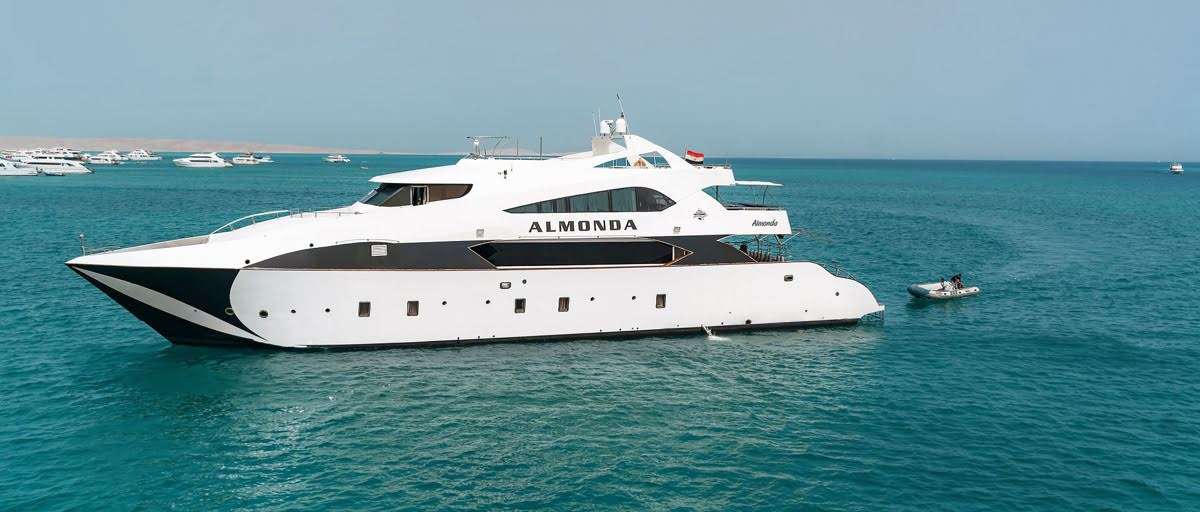
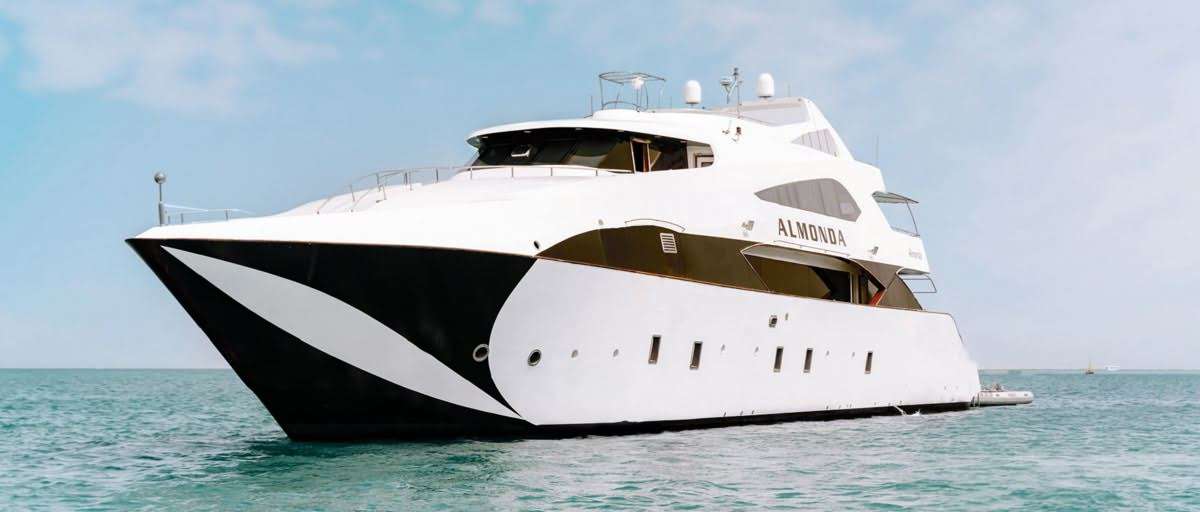
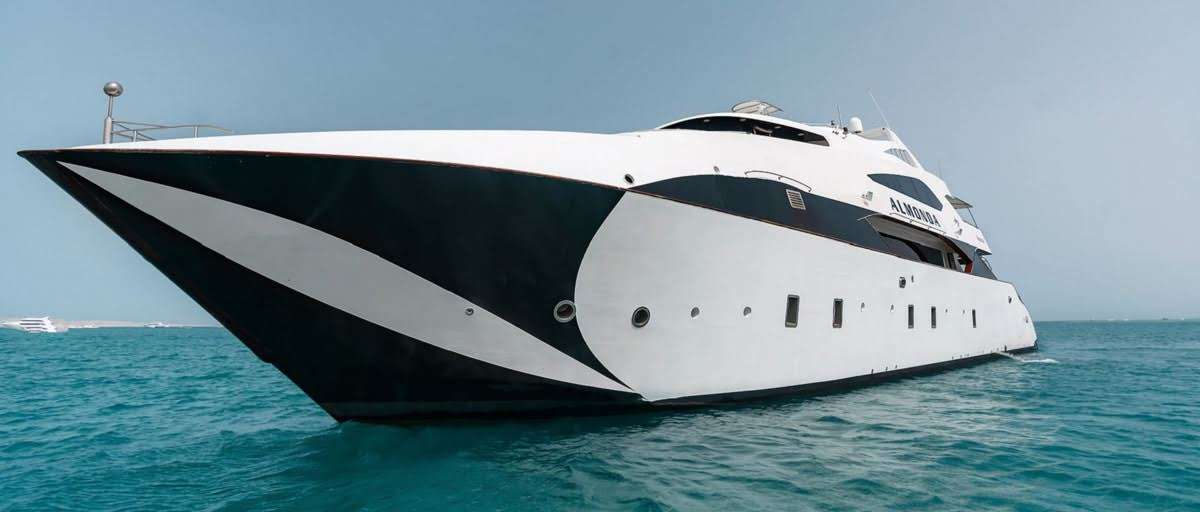
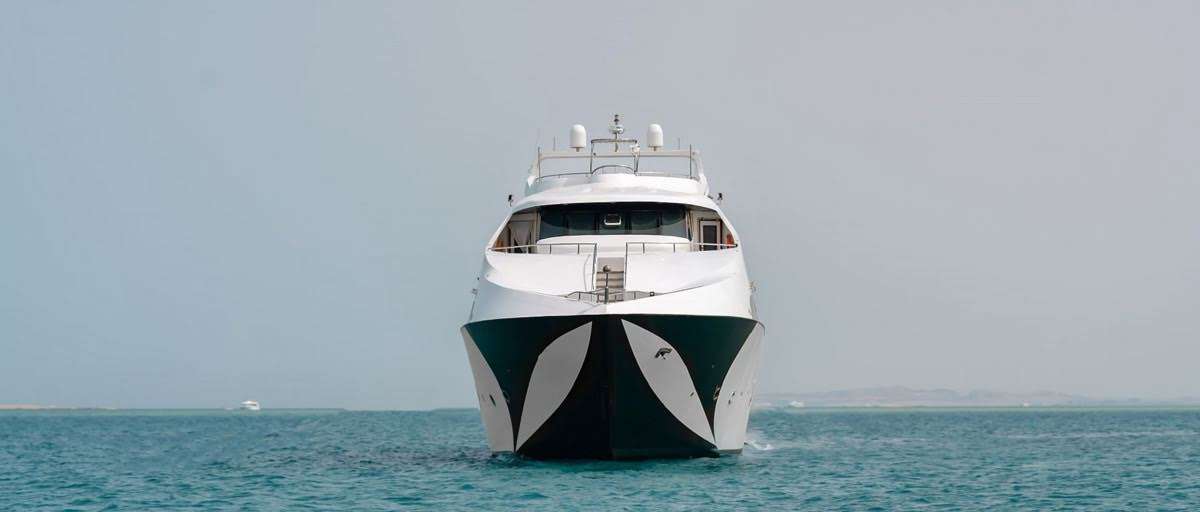
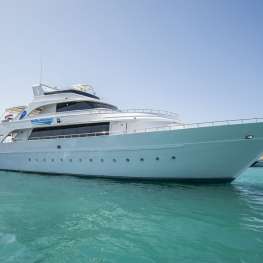
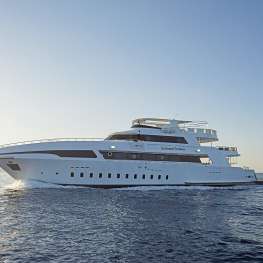
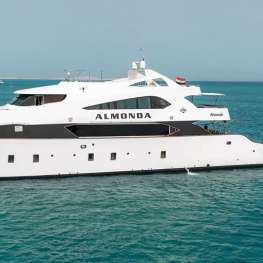
Almonda is a spacious 39.9-metre liveaboard created for scuba diving Saudi Arabia's Red Sea. Accommodating 24 guests in 12 ensuite cabins, she combines a large dive platform, two Zodiacs, complimentary Nitrox, three camera tables, generous lounges and a sun deck with Jacuzzi for expeditions to Farasan Banks, Seven Sisters and Five Corals.
Description
Boat
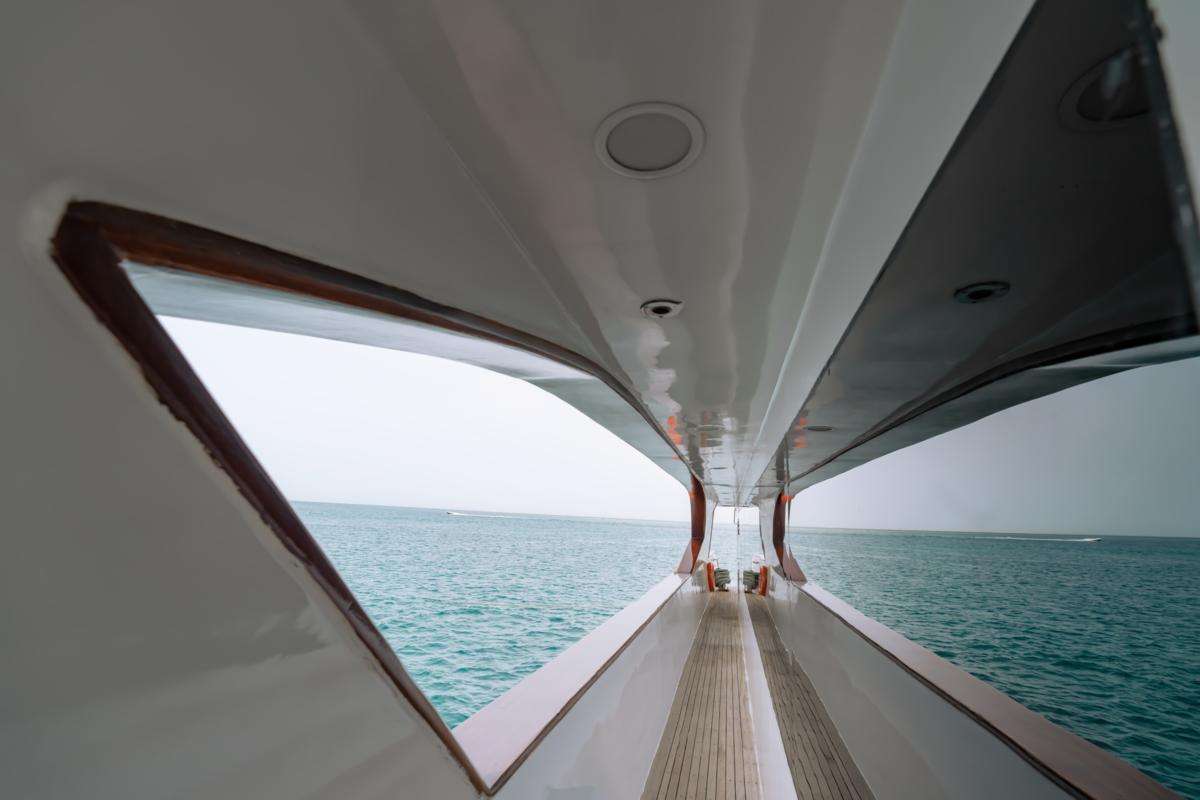
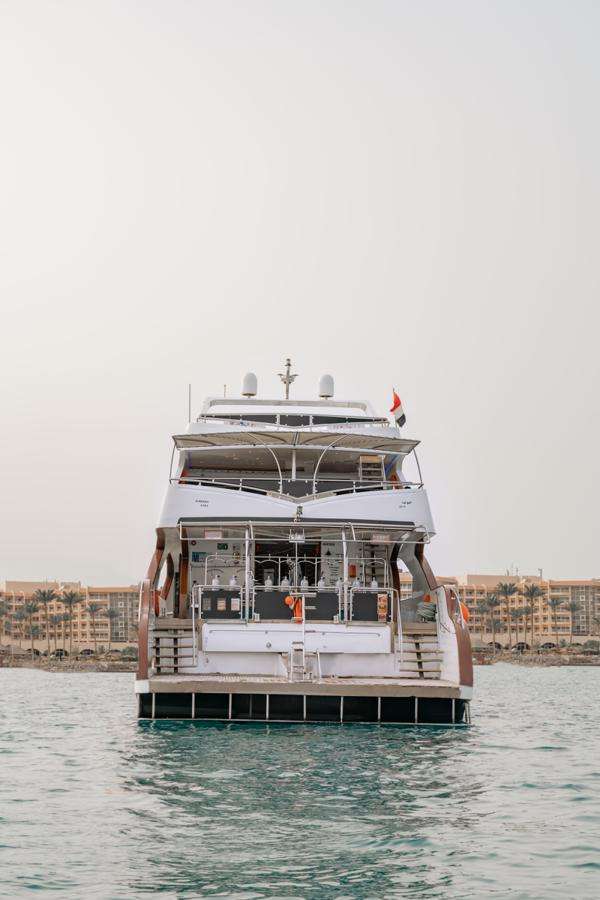
Built in 2017, M/Y Almonda is a substantial Saudi Arabia liveaboard designed to carry divers comfortably into some of the least crowded reef systems of the Red Sea. At 39.9 metres long and 8.57 metres wide, she offers far more usable space than her capacity of 24 guests might suggest. A cruising speed of around 10 knots and twin 1,050 hp MAN engines give her the range to operate from Al Lith, Yanbu or King Abdullah Economic City, depending on the itinerary.
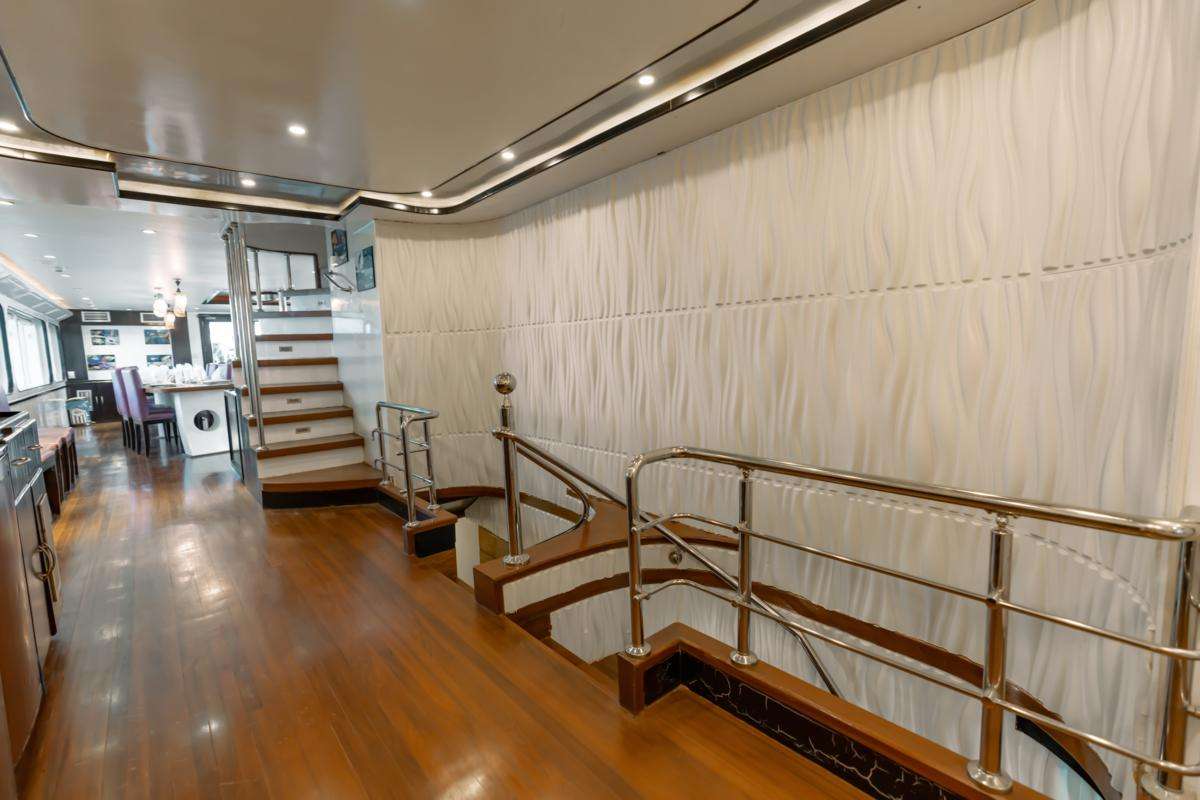
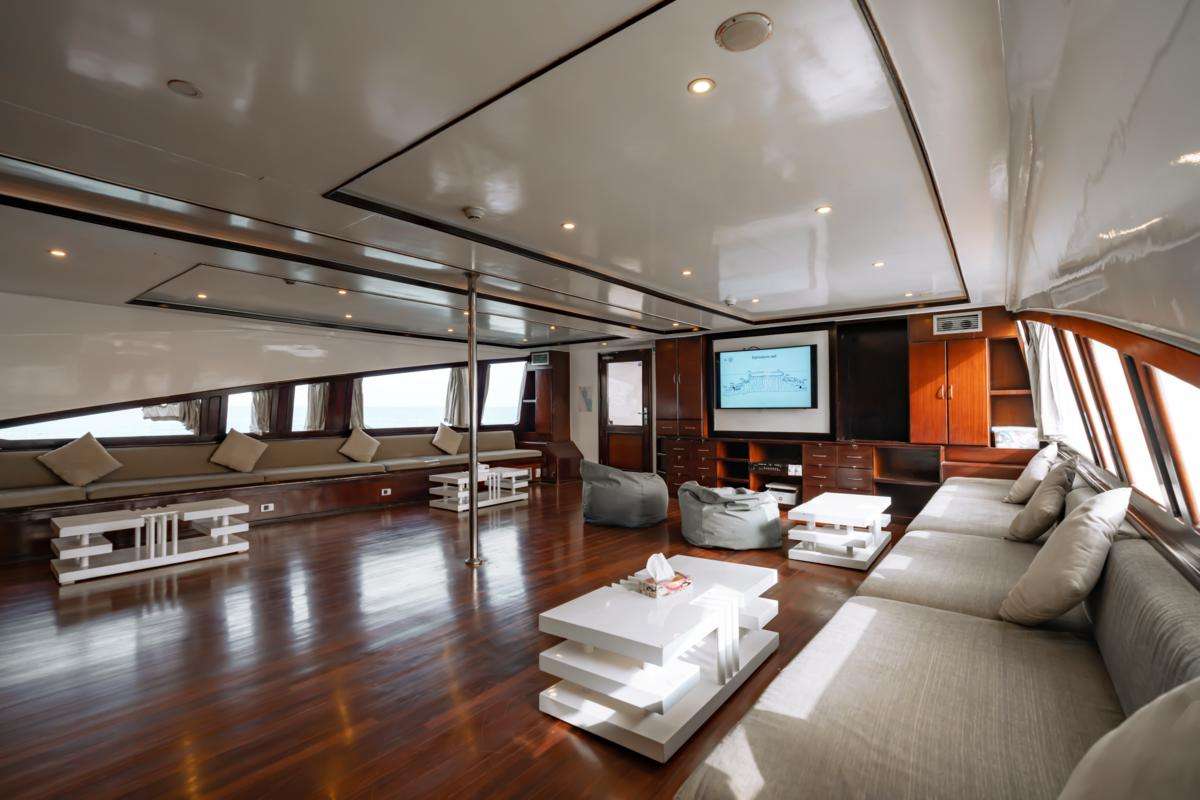
Inside, the air-conditioned salon provides a bright social area with sofas, entertainment equipment and room for presentations or underwater image review. The separate dining room seats all 24 guests at two large tables. Three buffet meals are served daily, supported by snacks and a selection of non-alcoholic drinks throughout the cruise. Catering normally begins with dinner on embarkation day and finishes with breakfast on disembarkation day.
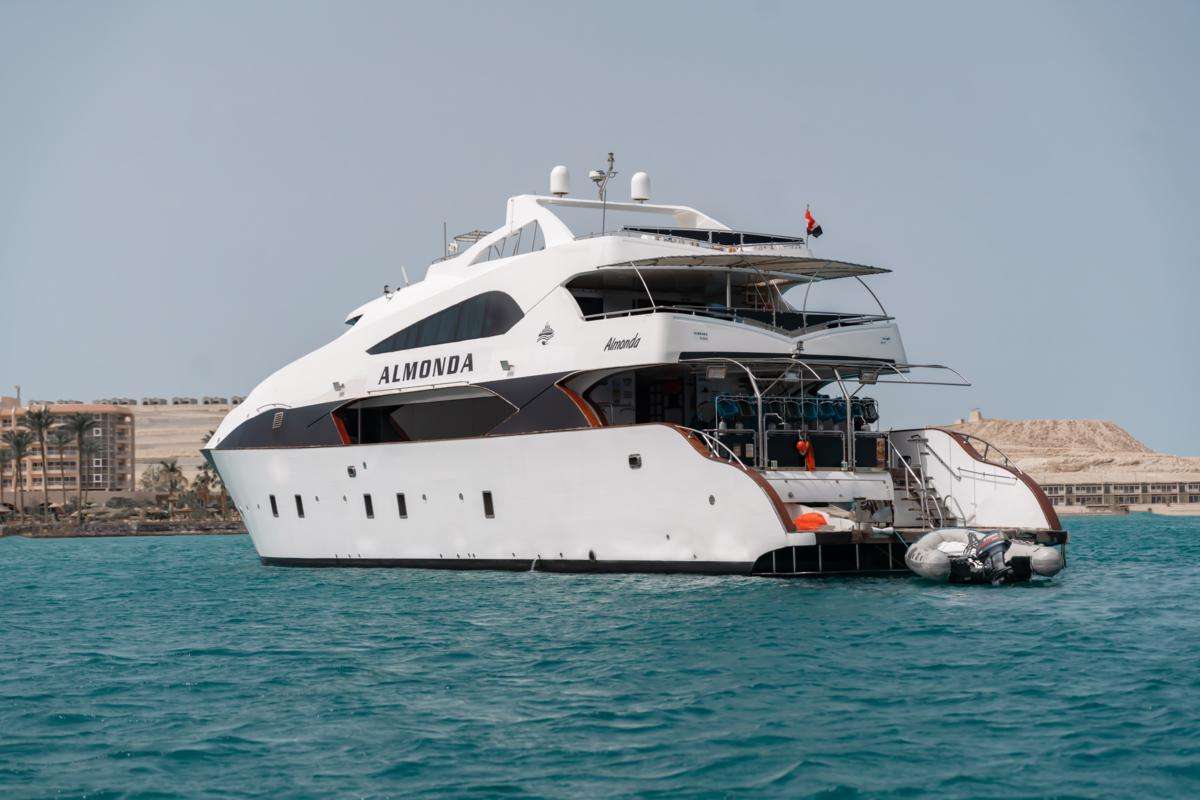
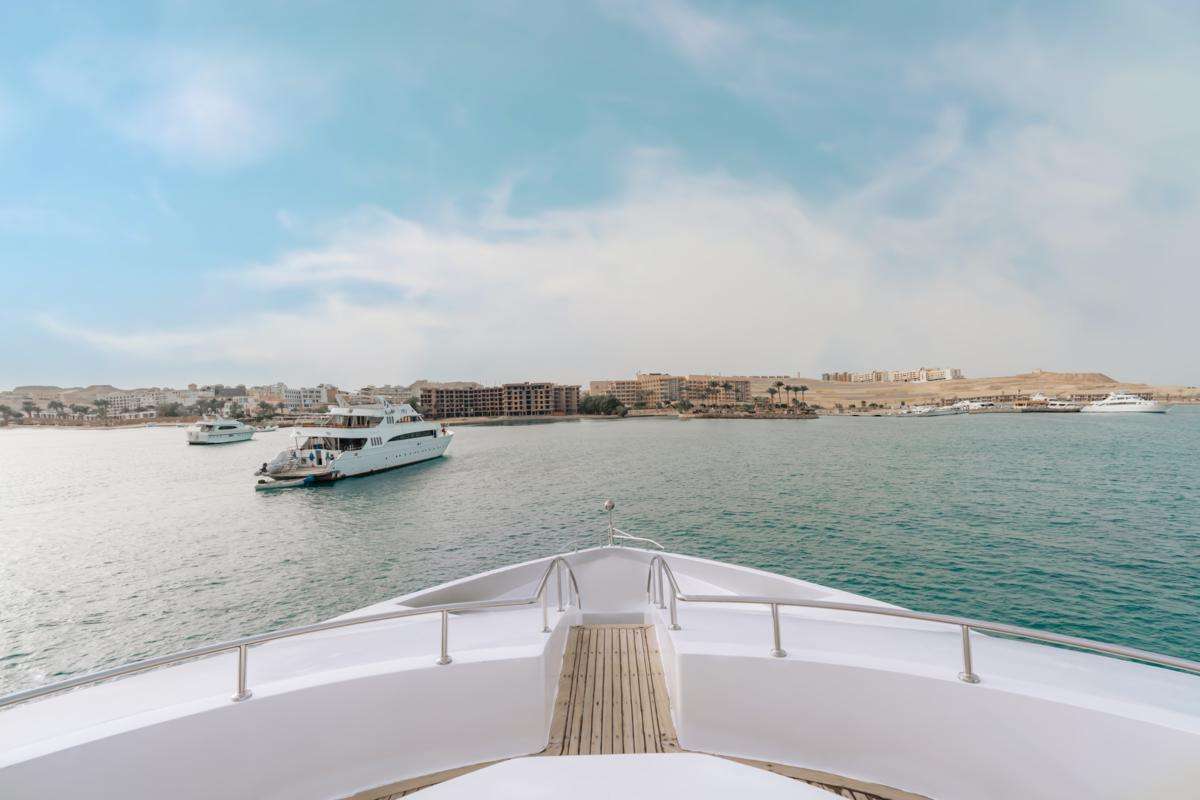
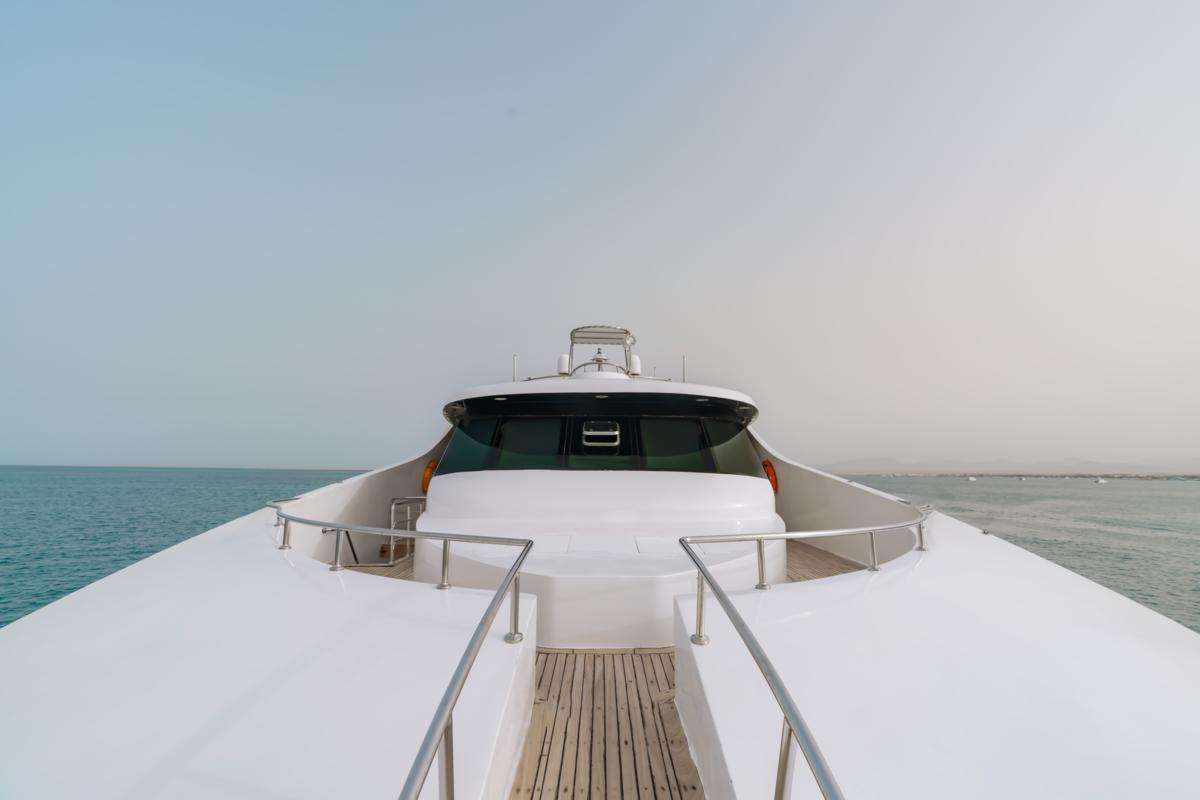
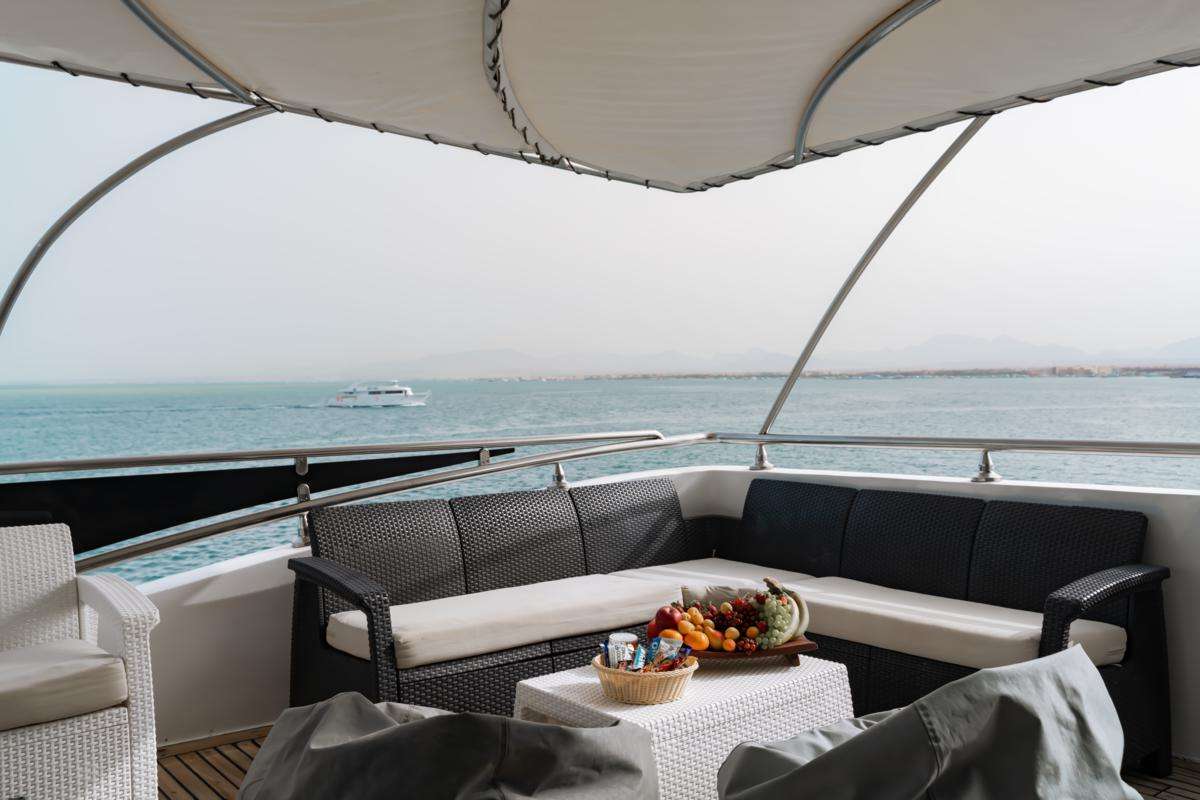
Outdoor life is equally spacious. A shaded lounge and bar create a relaxed setting between dives, while the upper sun deck combines seating, sunbeds and a Jacuzzi. The forward decks provide clear views over Saudi Arabia's island-dotted coast, and the wide stern gives direct access to the working dive area and tenders.
Almonda is engineered for extended operation at remote sites. The vessel carries 14 tons of fresh water, 16 tons of fuel, two Cummins generators and comprehensive navigation and communication systems. Two 6.5-metre Zodiacs transport divers to exposed reef edges, while the main platform remains large enough for organised entries, exits and equipment storage.
For travellers looking beyond the heavily visited Egyptian Red Sea, Almonda offers an appealing combination of onboard comfort, long-range capability and access to coral reefs where another safari boat may not be visible for days.
Cabin
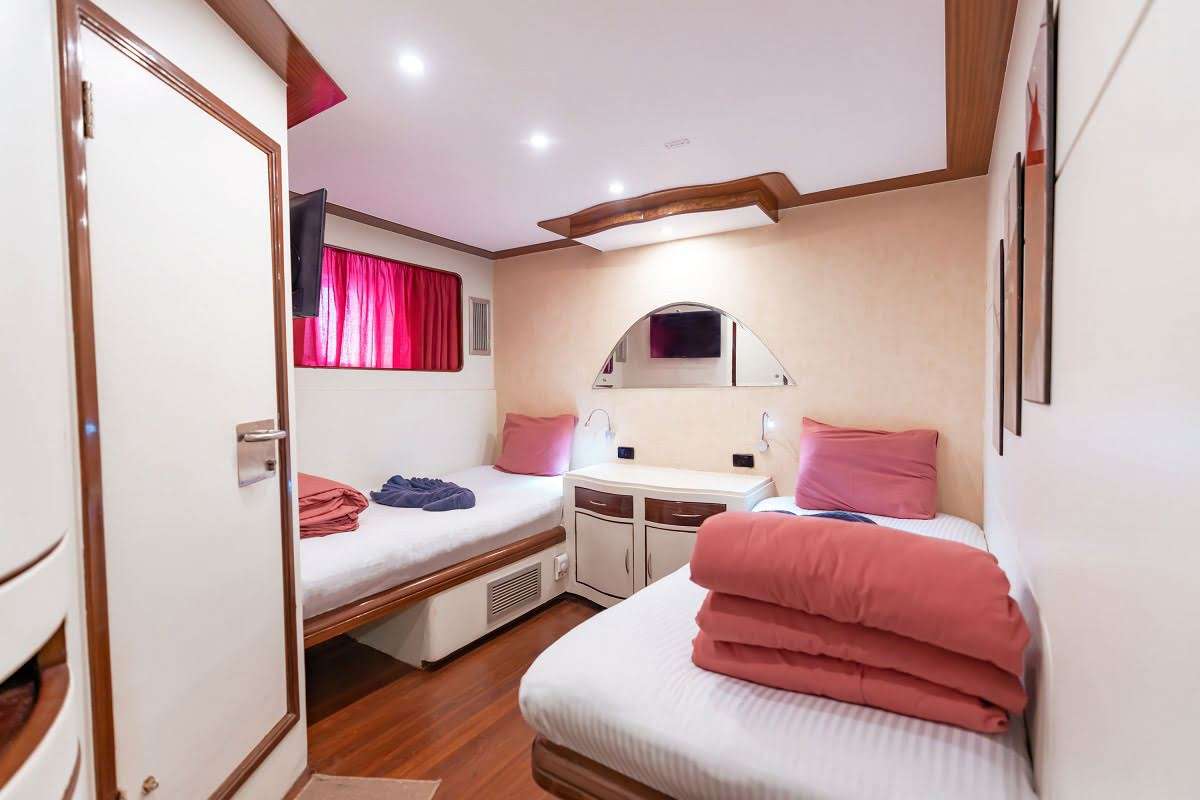
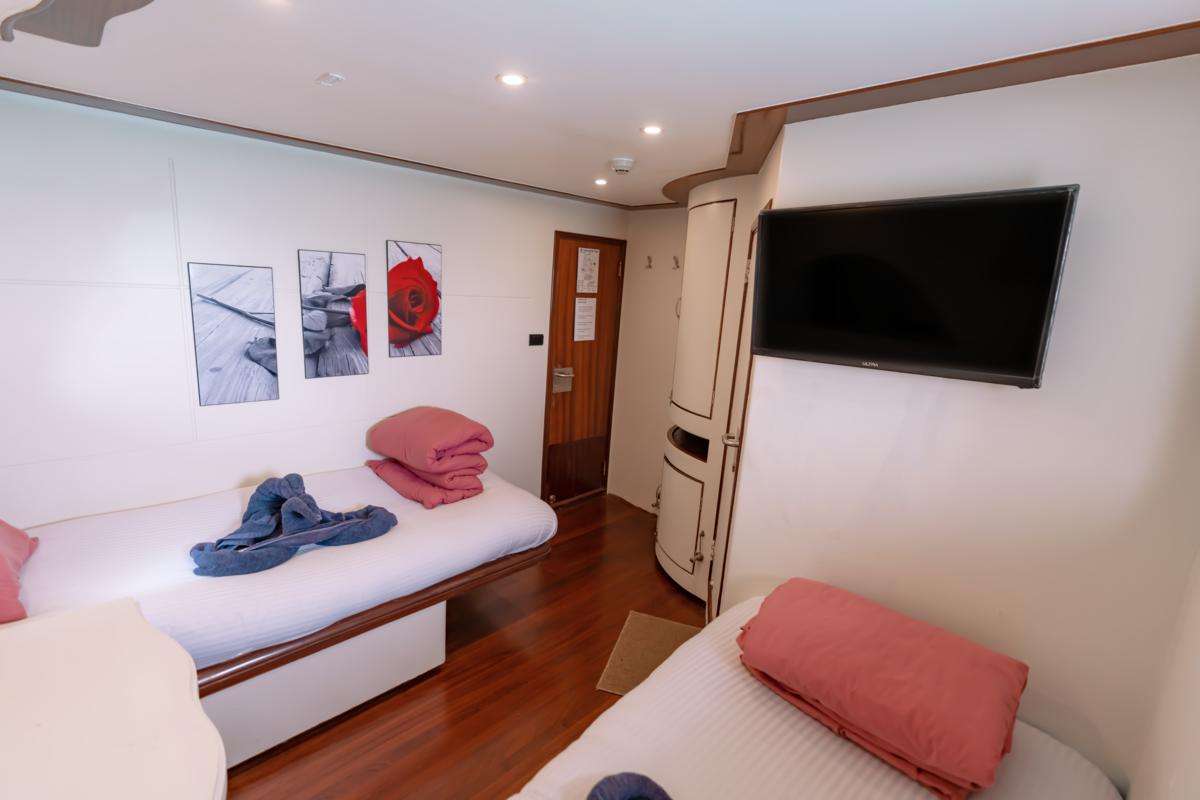
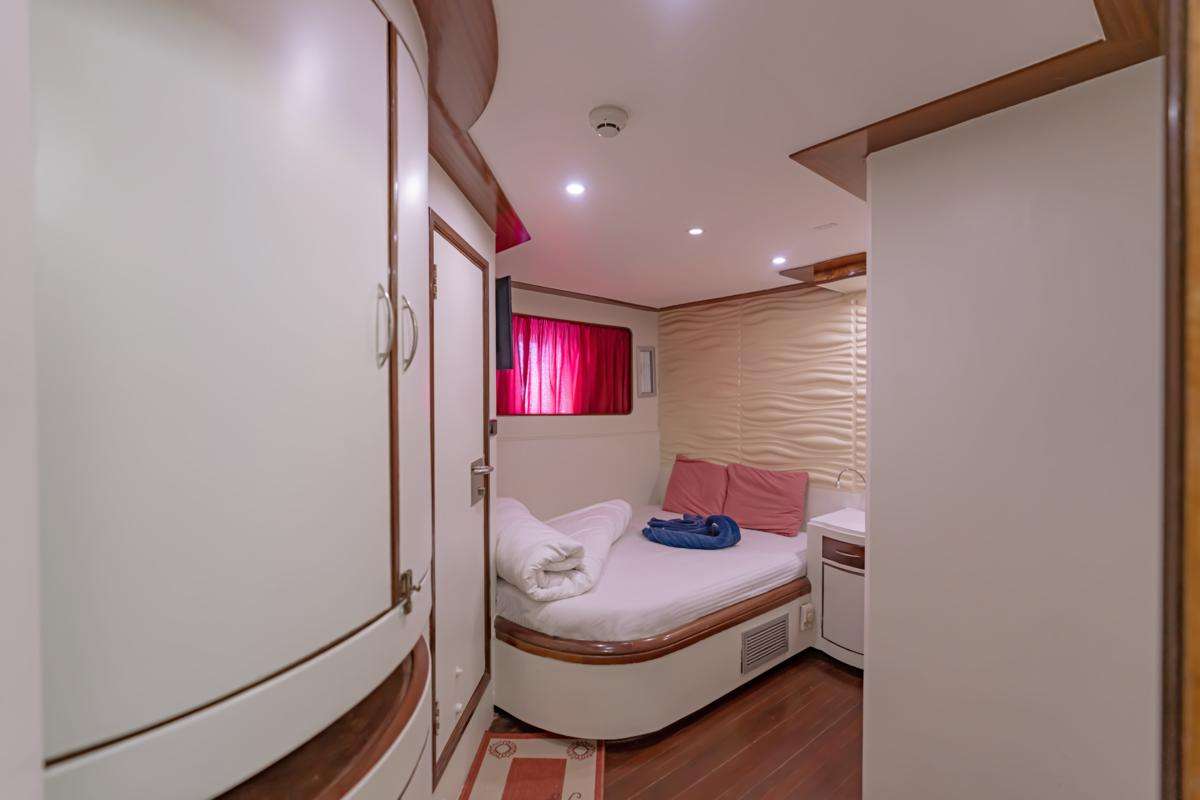
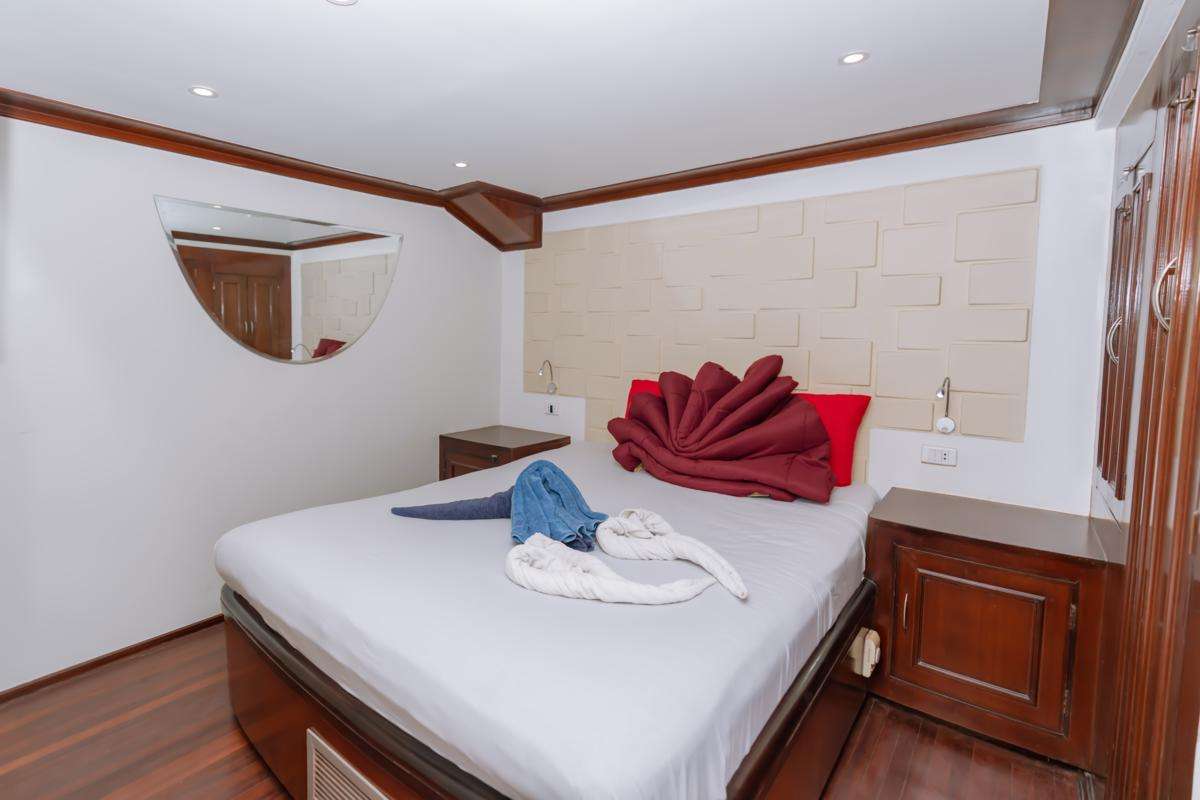
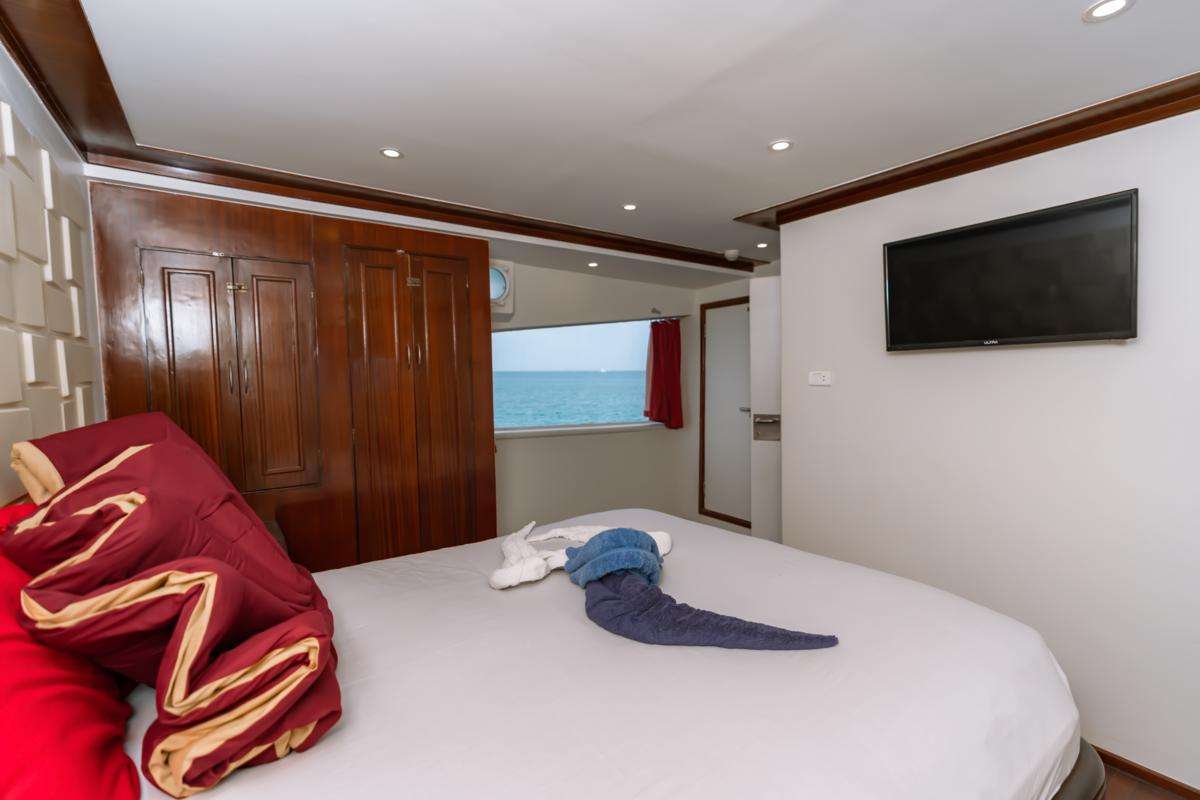
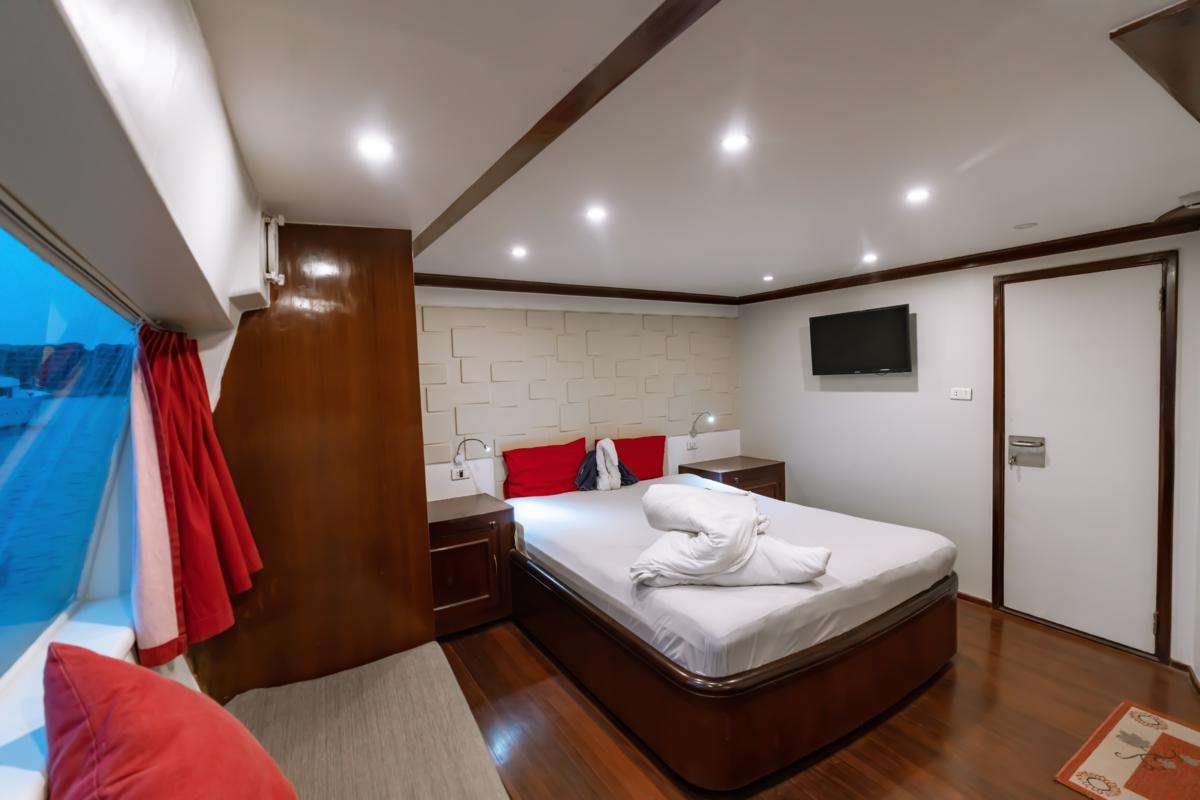
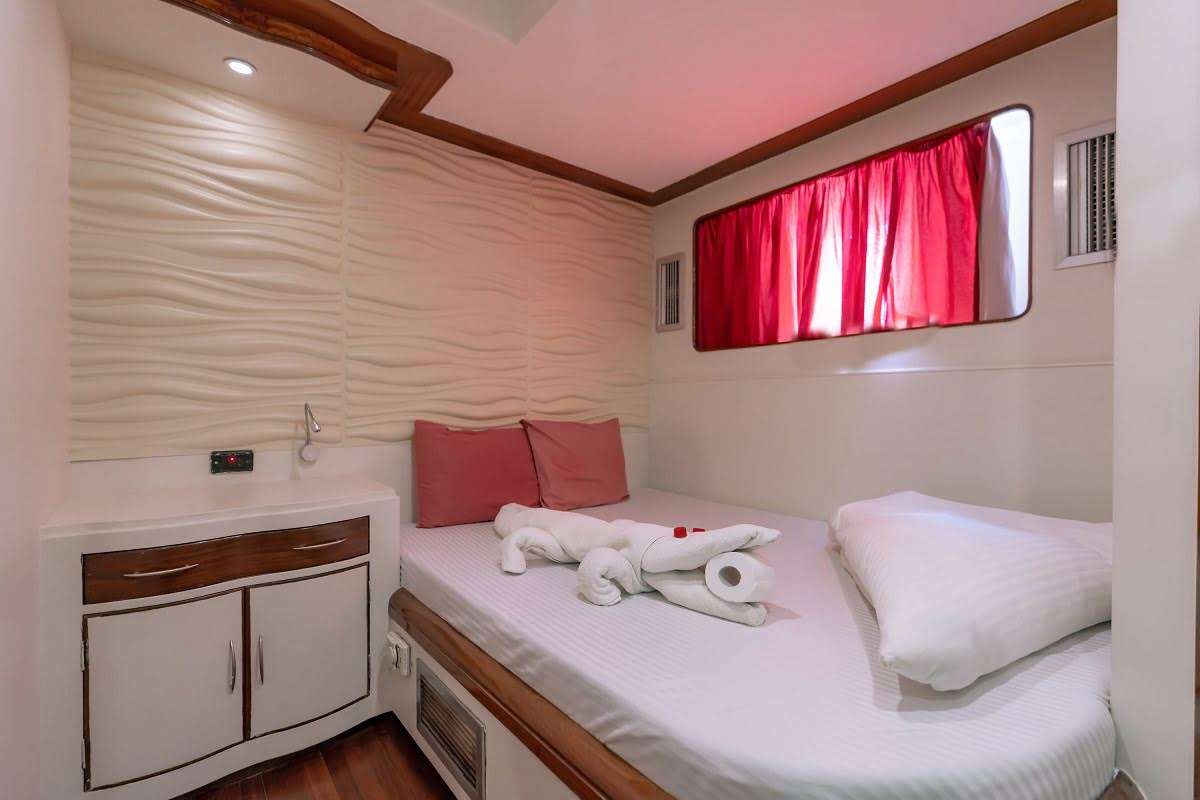
Almonda accommodates 24 guests in 12 air-conditioned staterooms, all with private bathrooms. The layout includes eight deluxe twin cabins, two lower-deck double cabins and two main-deck master suites, giving couples, friends and solo travellers several booking options.
The cabin categories are:
- 8 Deluxe Twin Cabins: two single beds
- 2 Lower Deck Double Cabins: one queen-size bed
- 2 Main Deck Master Suites: one queen-size bed and a more spacious location
Standard cabin facilities include:
- Individually controlled air conditioning
- Private ensuite shower, toilet and washbasin
- 32-inch flat-screen television with a selection of entertainment
- Porthole or sea-view window depending on location
- Mirrored storage cabinet and luggage space
- Hair dryer, bathrobes and fresh towels
- Ability to connect a computer to the television for reviewing underwater images
Cabin air conditioning may be temporarily switched off while scuba cylinders are being filled. Portholes must remain closed during navigation, and wet dive equipment is not allowed inside cabins or the salon. Guests are also asked to follow the vessel's marine-toilet instructions carefully.
Diving
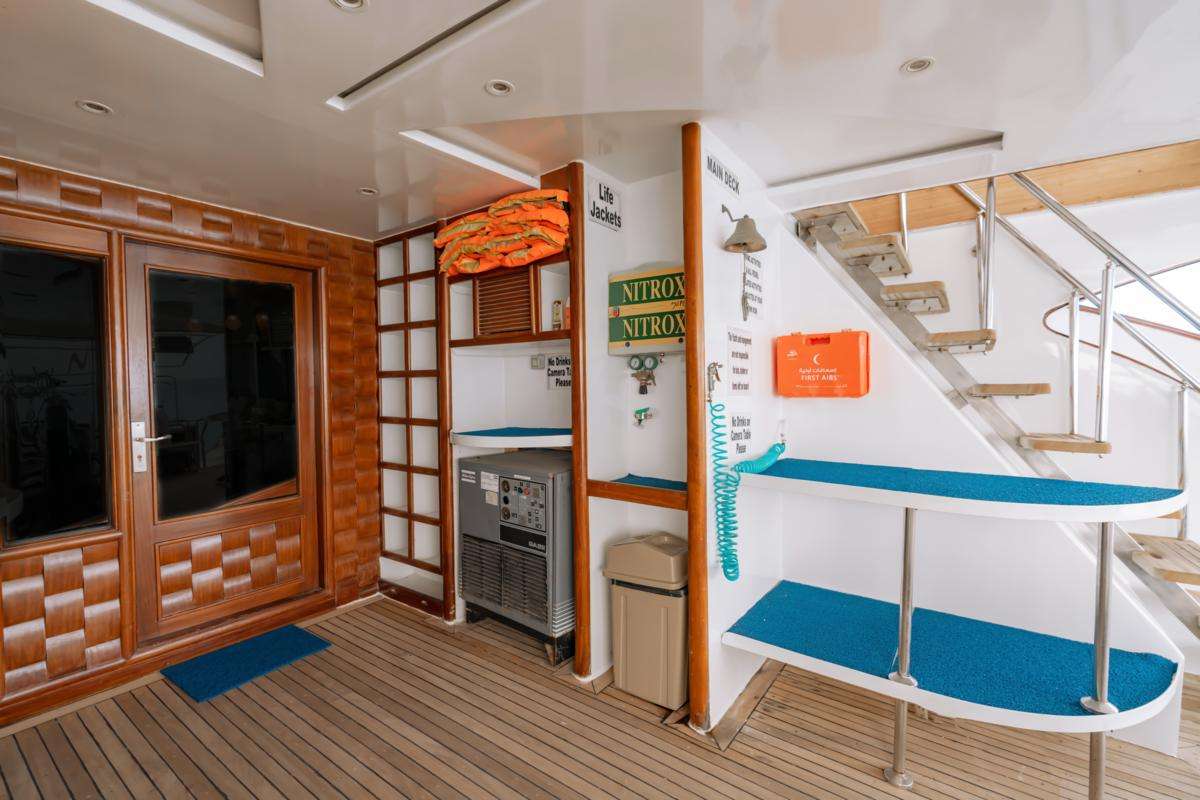
Almonda's stern is arranged around a large dive platform with personal equipment boxes, bench space, rinse access and three camera tables. Two 6.5-metre tenders powered by 45 hp outboards allow divers to reach offshore plateaus and drop-offs safely, then return directly to the main vessel.
The published equipment inventory includes 29 aluminium 12-litre cylinders, five 15-litre cylinders, two 350 l/min compressors and one 600 l/min compressor. DIN valves are standard and INT adaptors are available. The boat can produce enriched-air blends; the technical page lists EAN 32% and EAN 36%, while the FAQ describes complimentary Nitrox 28. Certified divers should confirm the blend planned for their departure rather than assuming a fixed percentage.
Typical programs offer two or three dives per day, with night diving when the selected reef and local regulations permit. Some sites specifically prohibit night dives. All dives follow no-decompression profiles, and the operator sets a maximum depth of 40 metres. Detailed briefings allow experienced buddy teams to explore within the agreed plan, while less experienced guests may be placed with a guide or stronger group.
Important diving provisions include:
- Complimentary Nitrox for certified divers
- 12-litre cylinders and weights for standard diving
- A limited number of 15-litre cylinders; availability and price must be confirmed
- Three camera tables and compressed-air hose
- Personal dive-equipment storage
- Two Zodiac tenders
- Professional dive guides and site briefings
- Nitrox and other scuba courses available at additional cost with advance registration
- Rental equipment excluded from the standard package and requiring advance reservation
Currents at Farasan Banks are often mild but can strengthen around exposed points. Seven Sisters and Five Corals can bring medium to strong current, deeper plateaus and blue-water shark searches. A surface marker buoy, computer and good buoyancy control are therefore essential even when the general route is described as intermediate.
Other Information
The following details reflect the operator's published itinerary and FAQ pages. Inclusions can change by departure, charter or promotion, so the final booking confirmation remains authoritative.
Published as included:
- Airport and hotel transfers associated with the scheduled cruise
- Cabin accommodation and full-board meals
- Three buffet meals per day, from first-night dinner to final-morning breakfast
- Snacks throughout the trip
- Soft drinks, juice, tea, coffee and mineral water
- Nitrox for certified divers
- Standard dive support, including briefings, 12-litre cylinders and weights
- Night dives where permitted by the site and conditions
- Cabin, beach and dive-deck towels
- Complimentary toiletries
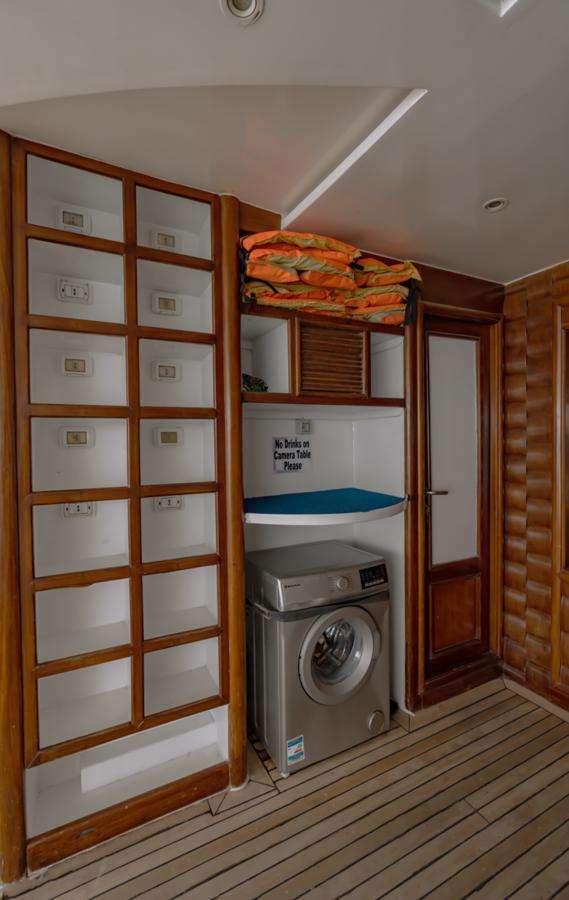
- Laundry and pressing service
- Wi-Fi while mobile-network coverage is available
- Stand-up paddleboard use
- National-park fees
- Fuel surcharge and port fees
Published as excluded or payable separately:
- Saudi entry visa
- International and domestic flights
- Gratuities: one itinerary page lists USD 80 per person per trip, while the FAQ describes a customary 400 SAR; reconfirm the current guideline
- Land excursions
- Scuba-diving courses, including Nitrox certification
- Rental scuba equipment
- Private dive guide unless specifically added
- Travel insurance and specialist dive-accident insurance
- Alcoholic beverages; alcohol is not available in Saudi Arabia
- Any hotel or transfer outside the routing confirmed for the selected departure
Practical details:
- Main routes: Farasan Banks; Seven Sisters, Five Corals and Umlajj
- Embarkation ports: Al Lith for Farasan Banks; Yanbu or KAEC for northern routes
- Airport: Jeddah International Airport is the usual gateway
- Approximate transfers: Jeddah–Al Lith 2.5 hours; Jeddah–KAEC 1 hour; Jeddah–Yanbu 3.5 hours
- Check-in / check-out: Published guidance requests check-in from 18:00 and check-out by 09:00
- Internet: Free when a mobile signal exists; unavailable in some remote areas
- Payments onboard: Cash in USD or SAR; Visa and Mastercard are advertised
- Languages: Dive guides generally speak English and German; crew English levels vary
- Environmental rules: No fishing, collecting coral or shells, feeding animals, touching or walking on reefs; gloves and dive knives are prohibited
- Safety: Fire and smoke alarms, extinguishers, emergency oxygen, first-aid equipment, life jackets, life rafts, radar, GPS, SSB, VHF, satellite phone and EPIRB
- Insurance: Coverage for evacuation and hyperbaric treatment is strongly recommended and is not included
Itineraries
Almonda concentrates on two exceptional Saudi Red Sea regions: the Farasan Banks south of Jeddah and the Seven Sisters/Five Corals systems around Yanbu and Rabigh. The following route flows are representative rather than fixed daily schedules. The captain chooses sites according to wind, current, visibility, permits and the experience of the group.
Farasan Banks Diving Adventure
Farasan Banks cruises normally begin and end at Al Lith, approximately 210 kilometres south of Jeddah. After the first night in port, the vessel needs only a few hours to reach a wide field of wild islands, submerged atolls and coral plateaus. Spring can bring plankton-feeding whale sharks close to Al Lith, but any encounter remains seasonal.
Northern Banks and Mar Mar area
Early stages of the route may explore Mar Mar Island and the surrounding reefs of Dohra, Jadir and Malathu. Mar Mar offers a protected overnight setting, while nearby walls and plateaus combine hard-coral gardens, soft corals, gorgonians, turtles and schooling fish. Long South Reef is more exposed: current along its outer edge can attract grey reef sharks, hammerheads, barracuda and trevally.
South Gorgonian and Twenty Miles
South Gorgonian Reef is an isolated atoll whose walls support dense fans and colourful soft coral. The southern plateau descends toward deeper terraces used by jacks, tuna and sharks. Twenty Miles is a compact submerged tower surrounded by a sandy ring and coral blocks; dives spiral around the reef before finishing among anthias near its shallow top.
Dohra, Jadir and turtle islands
Dohra is also known as Turtle Island because turtles use its beaches for nesting. North Dohra offers a broad sandy plateau and current-fed drop-off where hammerheads may appear. North Jadir is generally more approachable, with intact hard coral, anemones, reef fish and frequent turtle activity.
Danak, Choppy and central reefs
Danak Island mixes sandy plateaus, coral towers and steep outer walls. Choppy Reef is distinguished by an emerald lagoon, huge black-coral growth and sponge-covered walls. Depending on conditions, the route may also include Qadd Humais, Mudarr, Jabbara, Fantasy Reef or Sha'ab Ammar.
Southern points and pelagic action
South West Malathu and North Mudarr are among the stronger big-fish sites. Their plateaus lead toward current-exposed tips where grey, silky and hammerhead sharks may cruise with barracuda, tuna and trevally. Dives are planned conservatively because the most active areas can also be the deepest and most current affected.
Return toward Al Lith
The final part of the safari may visit Mubarak, Marbat Al Khail or Canyon Reef before the vessel returns to port. The exact sequence is deliberately flexible, allowing the captain and guides to select the strongest combination of visibility, shelter and marine-life activity.
Seven Sisters & Five Corals Diving Adventure
Northern Saudi Red Sea itineraries may operate from Yanbu or King Abdullah Economic City (KAEC). Some are return journeys, while others link two ports. The route joins the Five Corals of Rabigh with the Seven Sisters reefs offshore from Yanbu, producing a varied safari of plateaus, gorgonian walls, night-diving sites and pelagic encounters.
Five Corals of Rabigh
Joey Reef is the largest reef in the Five Corals area, with a lagoon, lighthouse and broad outer wall. Gorgonian forests flourish around 35 metres, while tuna, amberjack, barracuda, hammerheads and manta rays may pass through the blue. Night diving is permitted at Joey when conditions allow.
Maria South Reef offers a different shape, with a narrow plateau, coral towers and channels filled with reef fish. Dense schools of jacks, barracuda and tuna move along the ridge, while shallower caves shelter glassfish, sweetlips and snapper. Other Five Corals sites are selected according to current and visibility.
Transit toward Yanbu
The journey north can include reefs such as Marker 11, whose southern plateau and gorgonian wall provide a gentler introduction to the region. Trevally and tuna patrol the open side, with occasional grey reef or hammerhead sharks.
Seven Sisters plateaus
The Seven Sisters group includes Marker 32, Marker 34, Abu Galawa and Marker 39. These isolated reefs project into deep water, concentrating current and pelagic life. Abu Galawa South combines a sheltered lagoon with a broad coral plateau and shark-active outer edge. Its walls are especially rich in soft coral and large gorgonian fans, and selected areas can support night diving.
Mansi and Sha'ab Suflani
Mansi, sometimes identified around Marker 41/42, rises like a solitary column from deep water. Its vertical walls are covered with gorgonians, black coral and soft coral. Hammerheads, tuna, trevally and grey reef sharks may appear away from the wall. Farther south, Sha'ab Suflani drops into very deep water and rewards careful current assessment.
Umlajj extensions and return
Certain departures continue toward Umlajj or operate one-way between Yanbu and KAEC. These extensions add island scenery and less frequently visited reef systems. The final dives are chosen to keep the vessel within a safe return schedule and to provide a suitable surface interval before disembarkation.
Seasonal Conditions and Marine Life
The operator recommends January to early May for Farasan Banks. Water is commonly warm, current is usually manageable and spring offers the strongest published chance of whale sharks near Al Lith. Five Corals, Seven Sisters and Umlajj are generally promoted from September through June, with water temperatures around 26–32°C, visibility commonly 15–35 metres and occasional stronger current or rougher surface conditions.
Potential encounters include scalloped hammerheads, silky sharks, silvertip sharks, grey reef sharks, whitetip and blacktip reef sharks, tiger sharks, whale sharks, manta and eagle rays, turtles, dolphins, tuna, barracuda and large schools of trevally. These are wild populations; no species or number of encounters can be guaranteed.
Important Itinerary Notes
- Site order is never guaranteed and may change for safety or weather.
- Some reefs allow night diving, while others explicitly prohibit it.
- No-decompression diving and a 40-metre maximum depth apply.
- Farasan Banks usually uses Al Lith; northern programs may use Yanbu or KAEC.
- A Saudi visa and adequate travel/dive insurance are the guest's responsibility.
- Flights should be planned with a safe interval after the final dive.
Schedules & routes
Prices & conditions
Included
- Transfers from airport and/or hotel to the yacht
- Marine park fees & Port fees
- Fuel surcharge
- Full-board meal plan (including snacks)
- Complimentary beverages (water, tea, coffee)
- Soft drinks
- Diving activity (incl. tanks, weights, weight belts)
- Dive guide service
- Nitrox fills
- Boat accident insurance
- Cabin cleaning service
Not included
- Domestic flights in destination country
- Alcoholic beverage
- Dive equipment rentals
- Larger tank (15 L)
- Dive courses on board
- Land excursions and activities throughout the trip
- Dive insurance (mandatory requirement)
- Travel insurance (trip cancellation insurance)
- Crew gratuity
Useful information
Northern Egypt
Best time for diving
The best diving conditions are usually from March to May and from September to November, when water temperatures are comfortable and visibility is excellent. During the summer months from June to August, the water becomes warmer and marine life is very active. In winter months, divers can still enjoy great visibility with fewer crowds. Dolphins, turtles, reef sharks, napoleon wrasse, and large schools of barracuda and jacks are commonly seen throughout the year. Wreck diving is one of the main highlights in this region, including the famous SS Thistlegorm, Dunraven, and Abu Nuhas wrecks.
About temperatures
Air : winter months are between 18°C - 24°C, summer months are between 30°C - 38°C.
Sea : winter months are between 21°C - 24°C, summer months are between 26°C - 30°C.
Wetsuit Recommendation
For the Northern Red Sea liveaboard, we recommend a 5mm full wetsuit during the cooler months (Dec – Apr) and a 3mm full wetsuit during the warmer months (May – Nov). Some divers may also prefer a hooded vest during winter dives, especially on repetitive dives and night dives.
Diver requirement
The Northern Routes are suitable for all levels of divers, including beginners on many itineraries. However, some wreck dives and drift dives may require better buoyancy control and experience with currents. Certain wreck penetration dives may require Advanced Open Water certification and previous wreck diving experience. Most liveaboards provide dive guides and detailed dive briefings before every dive. You can find out more information here : Northern Egypt.
Embarkation / Disembarkation
Depending on which route you are heading to, the embarkation and disembarkation can be from Hurghada (HRG), Marsa Alam (RMF), or Sharm El Sheikh (SSH).
Visa Requirements
Most nationalities can obtain a visa on arrival at Egypt’s international airports. If you opt for a visa on arrival, you’ll need a passport that’s valid for at least six months from your arrival date, a travel itinerary, and documentation to prove accommodation or any booked tours.
Vaccinations
A yellow fever vaccination certificate is required if traveling from a country with a risk of YF virus transmission and ≥9 months of age, including transit >12 hours in an airport located in a country with a risk of YF virus transmission. This includes Eritrea, Rwanda, Somalia, Tanzania, and Zambia.1 In the absence of a vaccination certificate, the person will be detained in quarantine for up to 6 days after departure from an area at risk of YF virus transmission. An overview of the countries to which this applies can be downloaded here: Yellow Fever Risk Countries.
Money Matters
The local currency is the Egyptian Pound (EGP), and ATMs are common, especially in the main tourist areas. Major hotels will usually accept payment by credit card. However, smaller hotels may expect cash and hard currency payments (USD/EUR).
Drones
To bring a drone to Egypt and fly it, you need to receive permission from the country’s Civil Aviation Authority (CAA). If you do not have documentation of authorization, your drone will be confiscated at customs. However, getting permission to fly a drone from the CAA is difficult. Should you somehow manage to get your drone in, the onboarding screening will detect your drone and one of two things will happen: 1. your drone will be confiscated at the point of arrival and stored at the airport. 2. the drone will be detected and confiscated when you are leaving the country and you’ll be sanctioned for bringing an illegal commodity to Egypt. - So don't risk it, and leave your drone at home if you’re planning to travel to Egypt.
Extending your holiday
We offer a range of hotels/resorts, land-based diving packages, and excursions that can be arranged before or after your liveaboard holiday. Just ask us if you need such a service.
Southern Egypt
Best time for diving
The Southern Red Sea in Egypt offers excellent diving conditions year round, with warm water, good visibility, and rich marine life throughout the seasons.
Daedalus, Elphinstone & Brothers : The best time is from March to November when sea conditions are calmer and pelagic encounters are more frequent. Oceanic whitetip sharks are commonly seen from October to December, while hammerhead sharks are most frequently encountered from June to September around Daedalus Reef. Thresher sharks can occasionally be spotted early in the morning at Brothers Islands.
St. Johns & Fury Shoals : Best diving conditions are generally from April to November with warm water and excellent visibility. These southern reefs are famous for colorful coral gardens, reef sharks, dolphins, turtles, and abundant macro life. Encounters with manta rays are possible during spring and autumn seasons.
About temperatures
Air : winter months are between 20°C - 26°C, summer months are between 30°C - 40°C.
Sea : winter months are between 22°C - 24°C, summer months are between 27°C - 30°C.
Wetsuit Recommendation
For the Southern Red Sea liveaboards, we recommend a 5mm full wetsuit during the cooler months (Dec – Apr) and a 3mm full wetsuit or shorty during the warmer months (May – Nov).
Diver requirement
The Southern Red Sea routes are generally recommended for Advanced Open Water divers or experienced Open Water divers due to strong currents, deep dives, and blue water drift diving conditions around offshore reefs such as Daedalus, Elphinstone, and Brothers Islands. For St. Johns and Fury Shoals, some itineraries may be suitable for less experienced divers when sea conditions are calm, however good buoyancy control and comfortable drift diving skills are still recommended.
You can find out more information here : Southern Egypt.
Embarkation / Disembarkation
Most Southern Red Sea liveaboard trips depart from either Hurghada, Port Ghalib, or Marsa Alam. Guests usually need to fly into Hurghada International Airport (HRG) or Marsa Alam International Airport (RMF), depending on the itinerary and liveaboard selected.
Visa Requirements
Most nationalities can obtain a visa on arrival at Egypt’s international airports. If you opt for a visa on arrival, you’ll need a passport that’s valid for at least six months from your arrival date, a travel itinerary, and documentation to prove accommodation or any booked tours.
Vaccinations
A yellow fever vaccination certificate is required if traveling from a country with a risk of YF virus transmission and ≥9 months of age, including transit >12 hours in an airport located in a country with a risk of YF virus transmission. This includes Eritrea, Rwanda, Somalia, Tanzania, and Zambia.1 In the absence of a vaccination certificate, the person will be detained in quarantine for up to 6 days after departure from an area at risk of YF virus transmission. An overview of the countries to which this applies can be downloaded here: Yellow Fever Risk Countries.
Money Matters
The local currency is the Egyptian Pound (EGP), and ATMs are common, especially in the main tourist areas. Major hotels will usually accept payment by credit card. However, smaller hotels may expect cash and hard currency payments (USD/EUR).
Drones
To bring a drone to Egypt and fly it, you need to receive permission from the country’s Civil Aviation Authority (CAA). If you do not have documentation of authorization, your drone will be confiscated at customs. However, getting permission to fly a drone from the CAA is difficult. Should you somehow manage to get your drone in, the onboarding screening will detect your drone and one of two things will happen: 1. your drone will be confiscated at the point of arrival and stored at the airport. 2. the drone will be detected and confiscated when you are leaving the country and you’ll be sanctioned for bringing an illegal commodity to Egypt. - So don't risk it, and leave your drone at home if you’re planning to travel to Egypt.
Extending your holiday
We offer a range of hotels/resorts, land-based diving packages, and excursions that can be arranged before or after your liveaboard holiday. Just ask us if you need such a service.
Saudi Arabia
Best time for diving
The Farasan Banks : Can be dive all year round, however the best time will be from November until May. From mid-June to mid-September it is very hot and the desert winds also add plenty of sand to the air. Currents usually mild, sometimes can be a little stronger, visibility range from 10m to 35m.
Five Corals and Seven Sisters : best is from June until October. The currents can be medium to strong, visibility range from 15m to 35m.
About temperatures
Air : Very warm year round with desert conditions. In the summer air temperatures can be from 27°C - 43°C, and drop to 10°C - 20°C in the winter.
Sea : winter months are between 23°C - 25°C, summer months are between 28°C - 31°C.
Wetsuit Recommendation
In the winter months, a 5 mm full wetsuit is recommended. In summer months a rash vest or 3 mm shorty wetsuit is recommended.
Diver requirement
Due to local regulations, most of the liveaboard region requrie divers to have AOW level with min. 50 logged dives to join the diving activity. However, OW divers can make thier AOW course onboard. You can find out more information about diving in Saudi Arabia here : Saudi Arabia.
Embarkation / Disembarkation
Depending on which route you are heading to, the embarkation and disembarkation can be from Yanbu (YNB), Al Līth (ABT or TIF).
Visa Requirements
A visa is required to enter Saudi Arabia and can be applied for online or upon arrival for eligible countries. For more information about visa requirements, please, refer to the Saudi Tourist Visa. The eVisa will be a one-year, multiple entry visa, allowing tourists to spend up to 90 days in the country.
Vaccinations
A yellow fever vaccination certificate is required if you travelling to countries with persistent or periodic yellow fever transmission. Certain countries require all travelers to present proof of yellow fever vaccination upon arrival. Country requirements are subject to change at any time. It is important that travelers ensure that they know the requirements of the country to which they are travelling by checking with the relevant consulate or embassy.
Money Matters
The local currency is Saudi Riyal (SAR), all banks in Saudi offer currency exchange services. You can also find exchange bureaus at airports, some shopping centers, and other locations throughout the country. ATMs are widely available, and credit cards including Visa, Mastercard and American Express are accepted at many retailers, restaurants, hotels, transportation providers and other businesses throughout the country. Smaller shops may include a surcharge for card payments, so having cash handy can help you avoid additional fees. Many businesses also accept digital payment methods, such as Apple Pay
Drones
Drone use is allowed in Saudi Arabia, but there are several drone laws that need to be followed when flying in the country. Anyone wishing to import a drone must register the serial number to obtain customs clearance. A registration and import permit is required for recreational drone use in Saudi Arabia. please contact the General Authority of Civil Aviation The direct price of the authority for requesting a recreational permit is $250.00 SR. If the drone is registered, Saudi Customs will allow it into the country.
Extending your holiday
We offer a range of hotels/resorts, land-based diving packages, and excursions that can be arranged before or after your liveaboard holiday. Just ask us if you need such a service.
Diver's reviews (0)
Photos