- Best-Price Guarantee
- 24/7 Expert Support
- No Booking Fees
- Direct with Operators
- 500+ Boats Worldwide
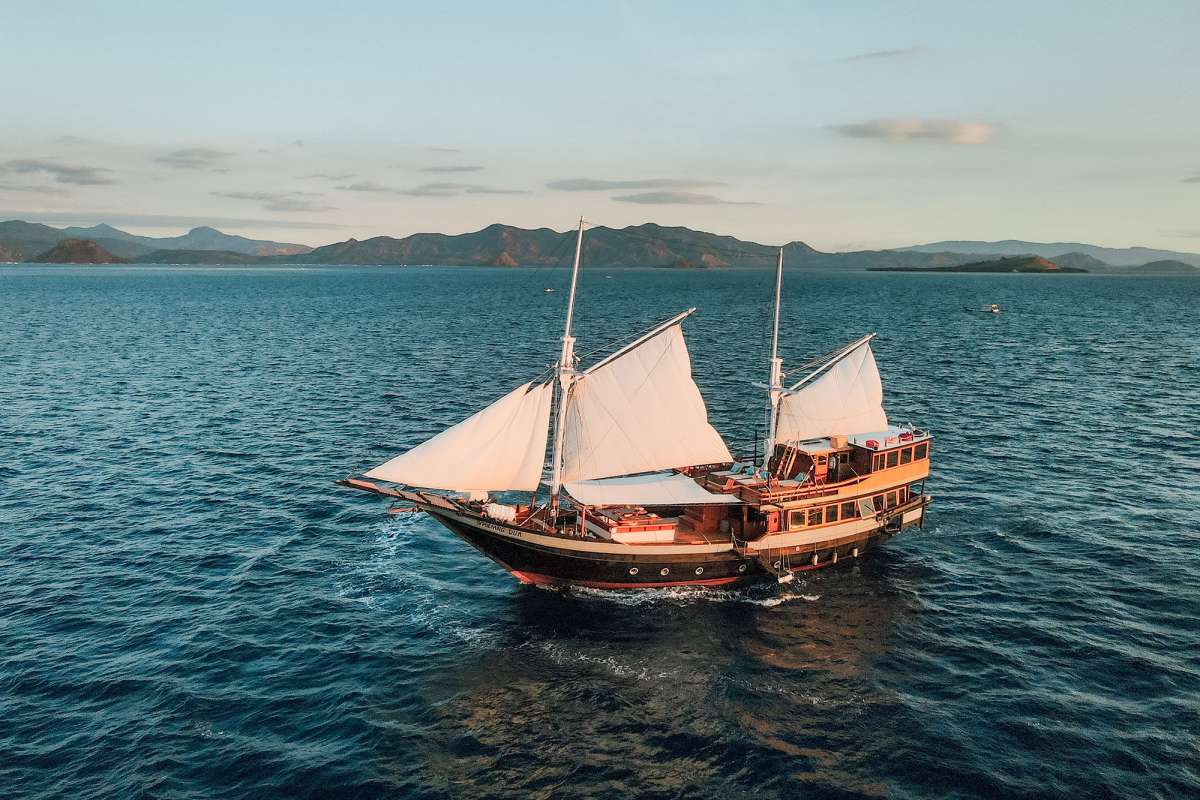
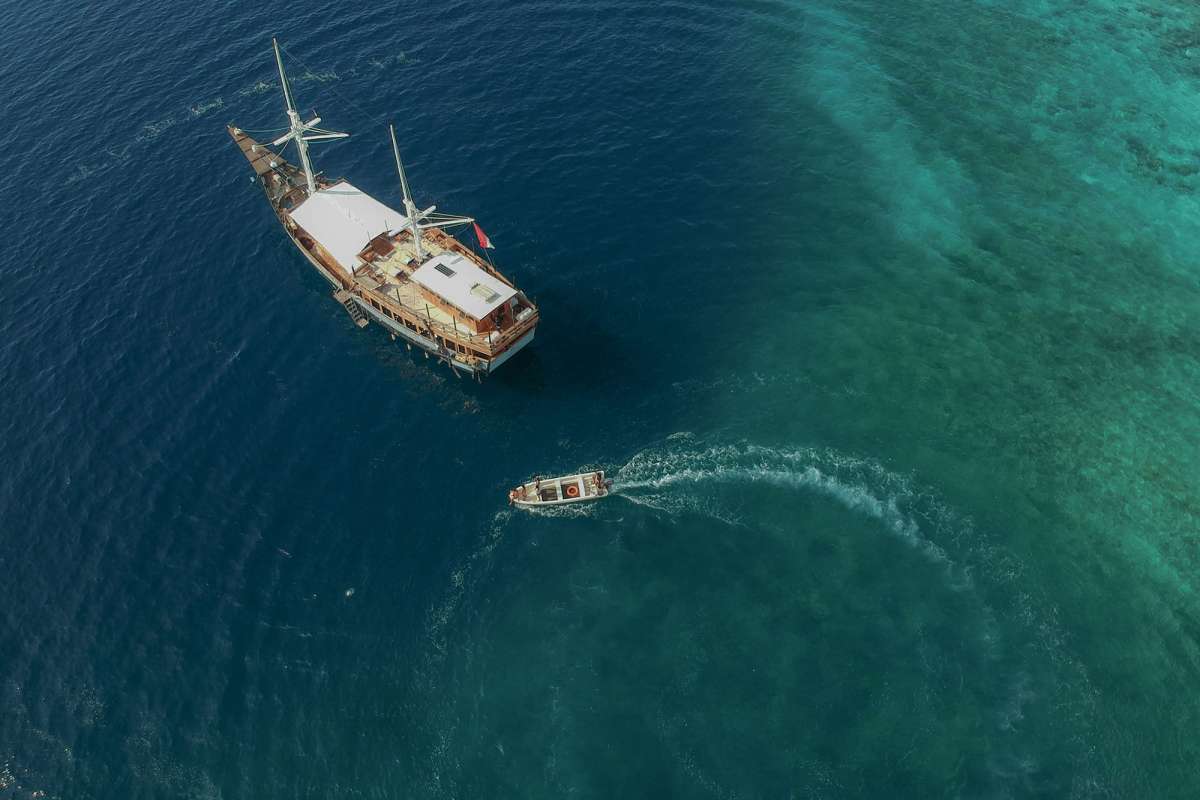
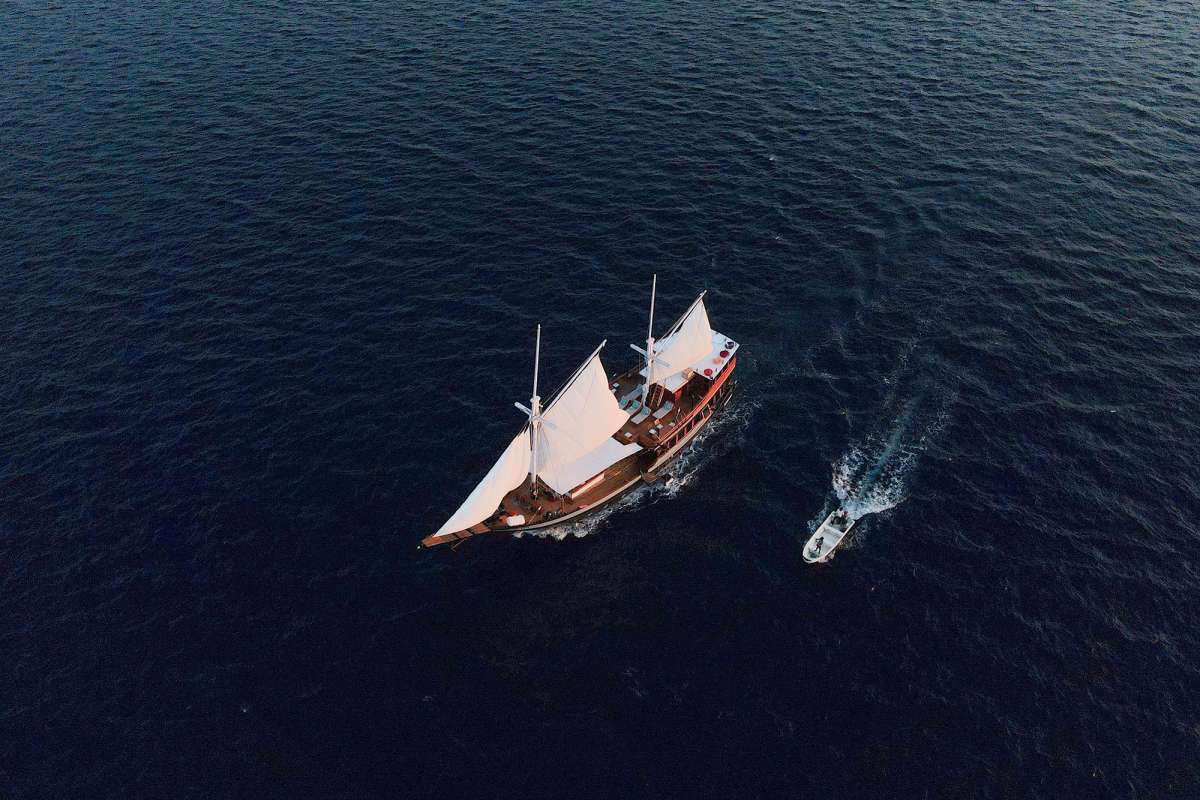
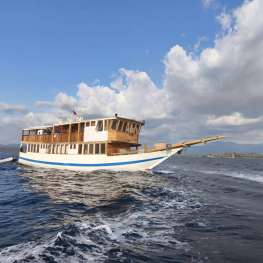
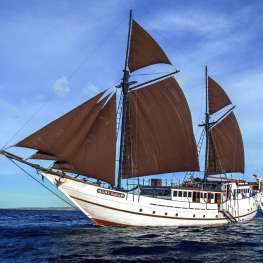
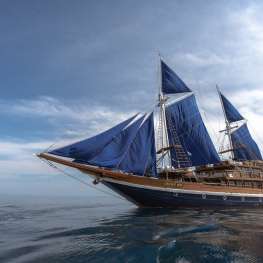
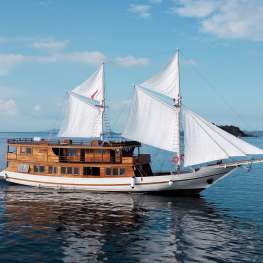
Queenesia II is a 32-metre ironwood phinisi with seven ensuite cabins, a standard published operating capacity of 14 and physical bedding for up to 16 when authorised. Two compressors, 12-litre aluminium tanks, small dive groups and wide-ranging schedules support expeditions through Raja Ampat, Banda Sea, Derawan, North Sulawesi and Komodo.
Description
Boat
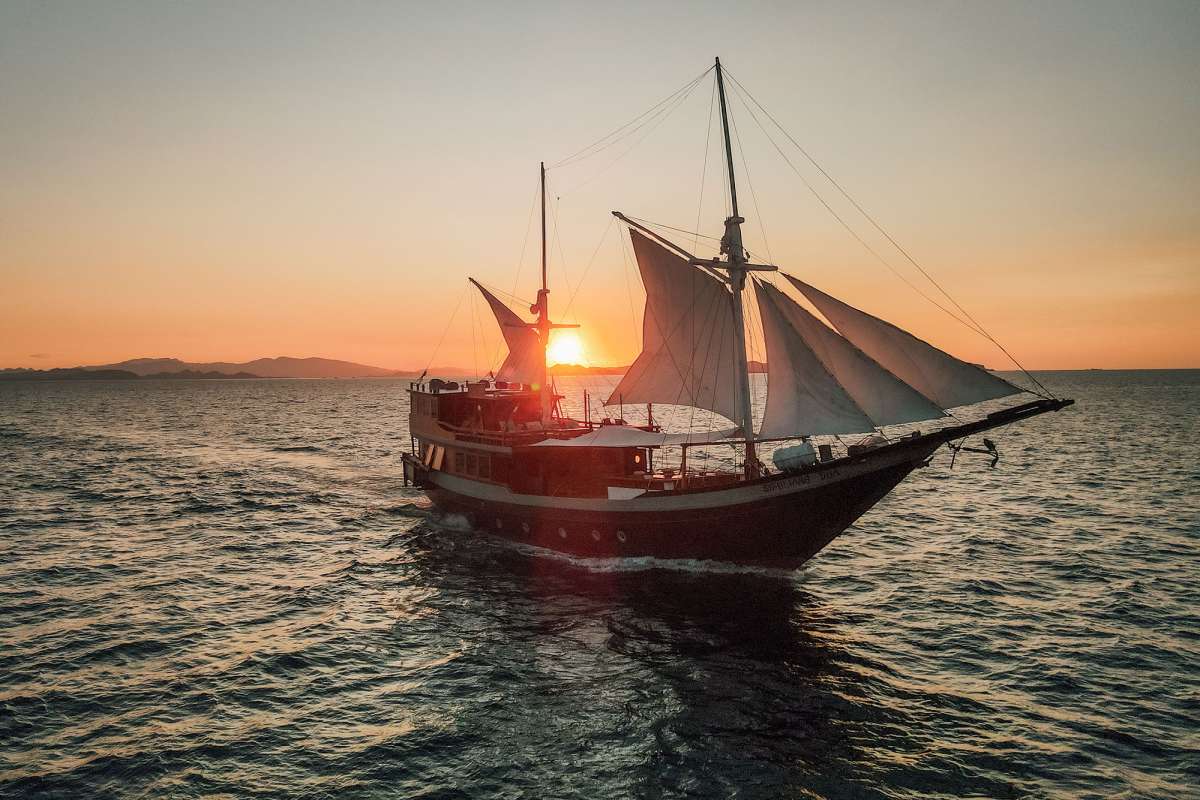
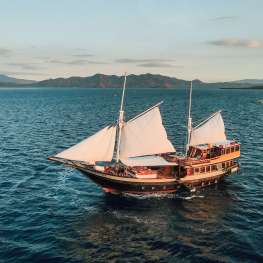
Queenesia II is the larger, expedition-oriented member of Queenesia Fleet. Built in 2016 as a traditional Buginese phinisi schooner and reported refurbished in 2022, the vessel uses ironwood construction and measures 32 metres long by 7.5 metres wide. Her published cruising speed is 7–8 knots. Unlike Queenesia 1, which remains focused on Komodo, Queenesia II follows seasonal and crossing itineraries through Raja Ampat, Misool, the Banda Sea, Ambon, Derawan, North Sulawesi and Komodo.
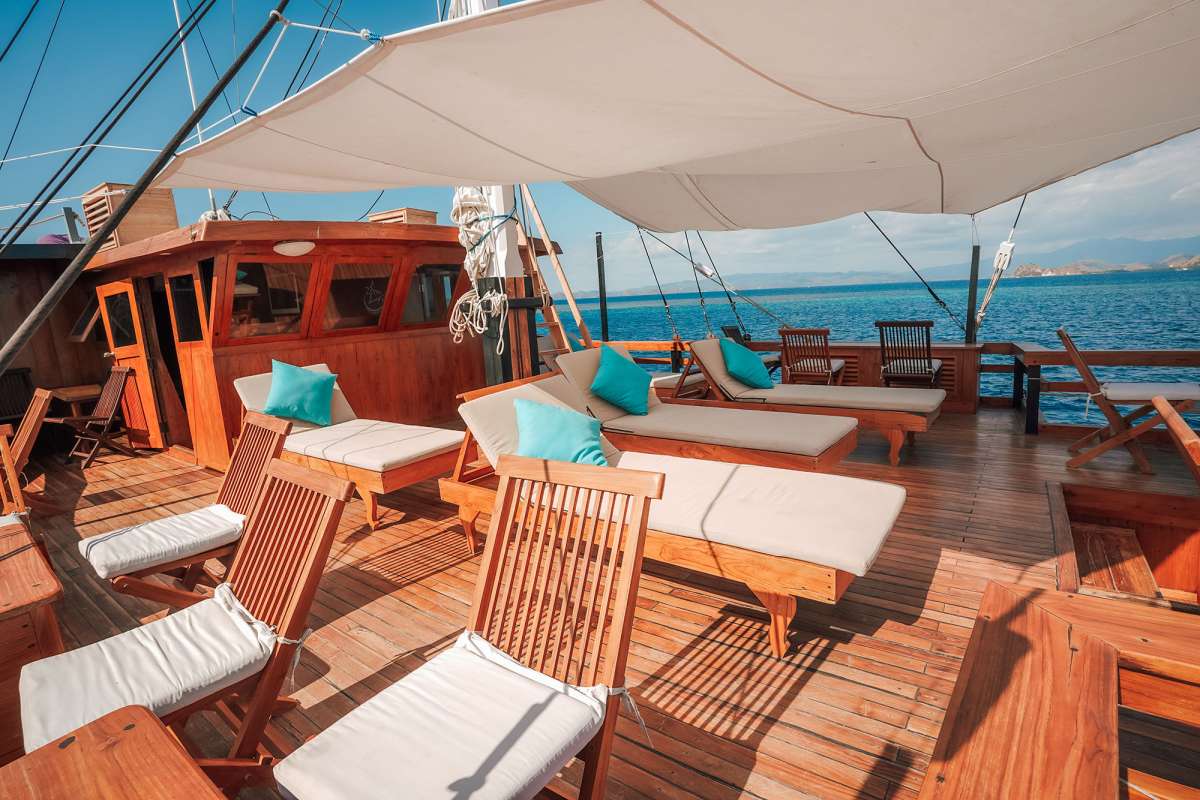
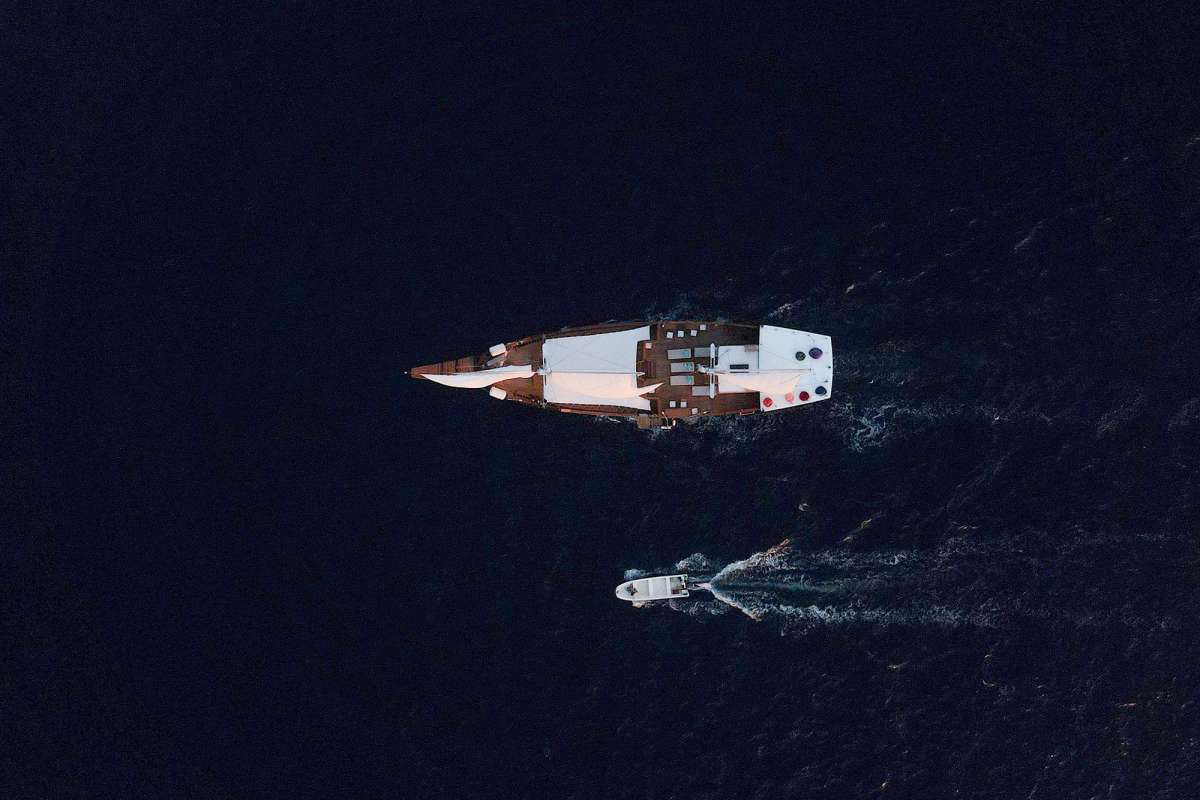
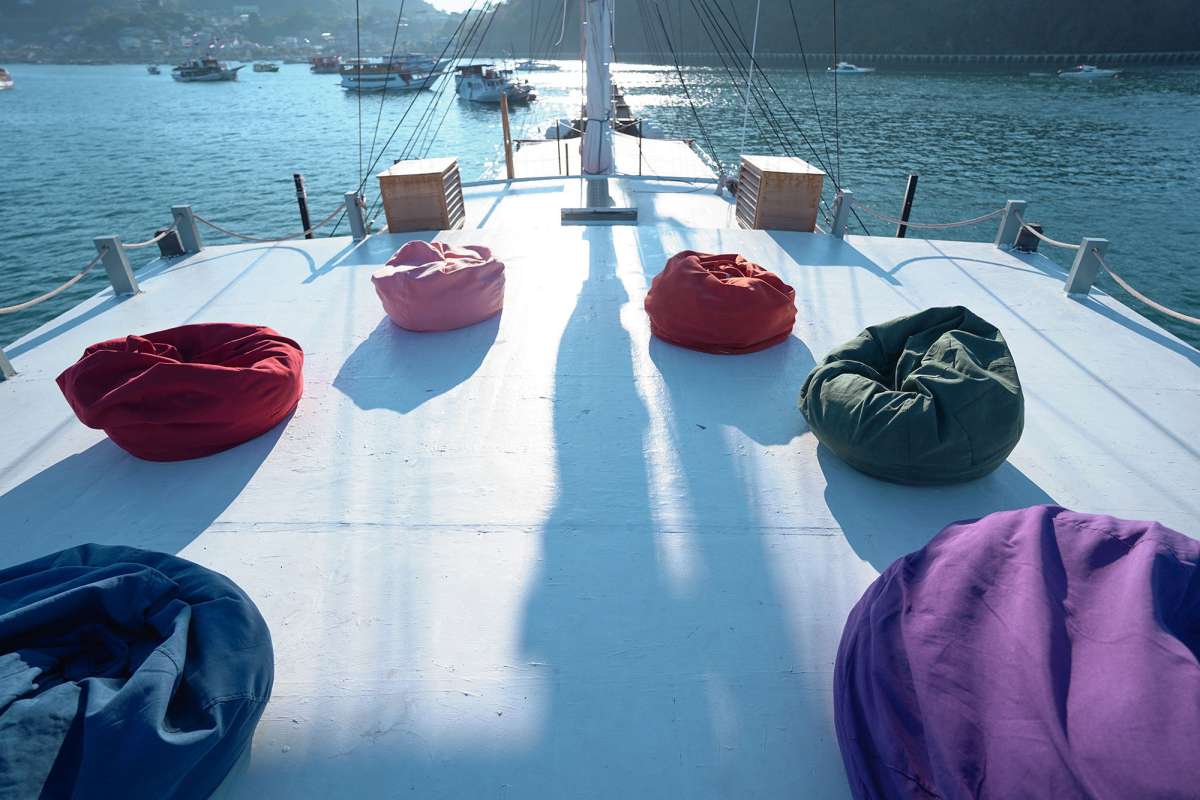
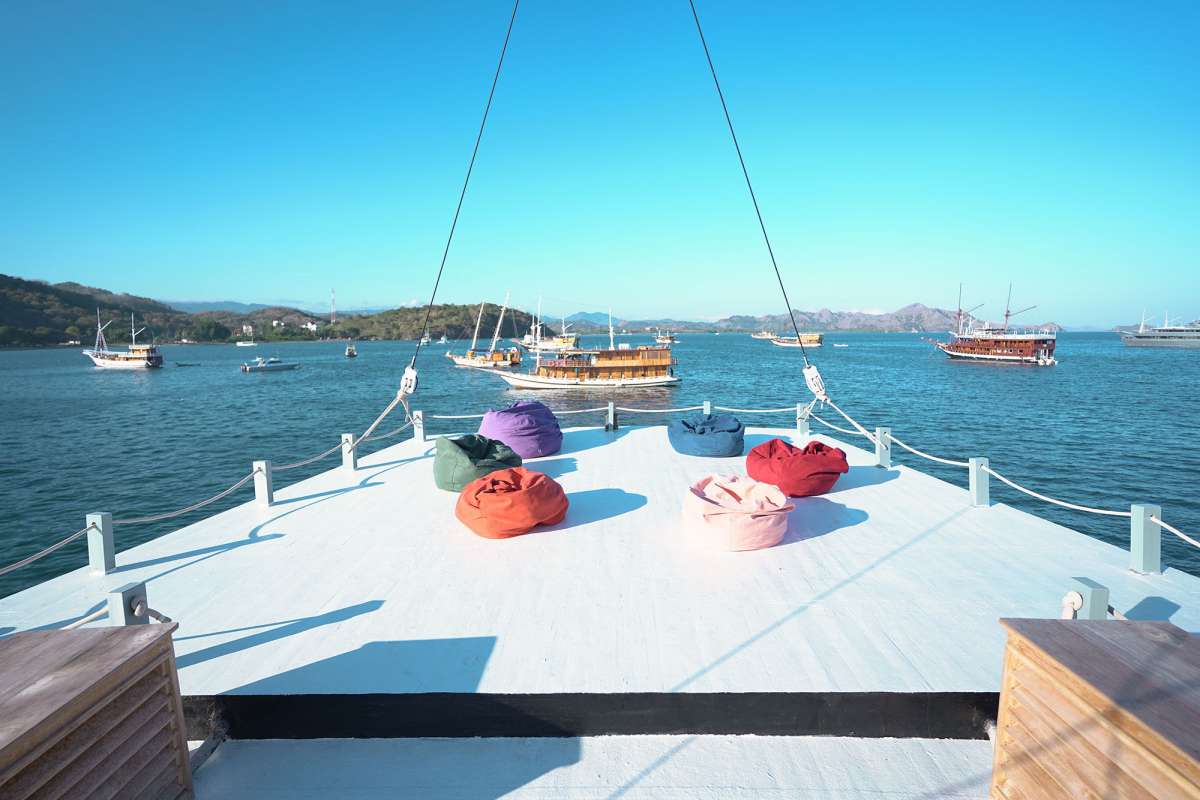
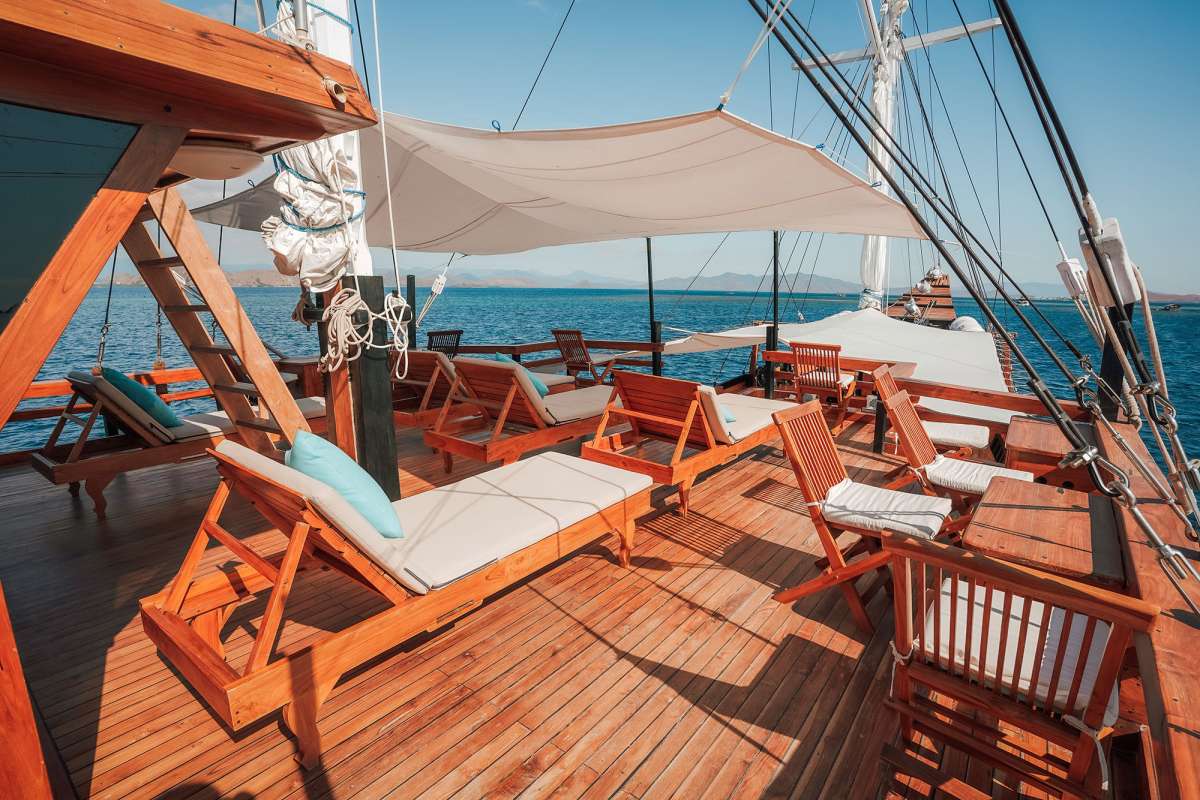
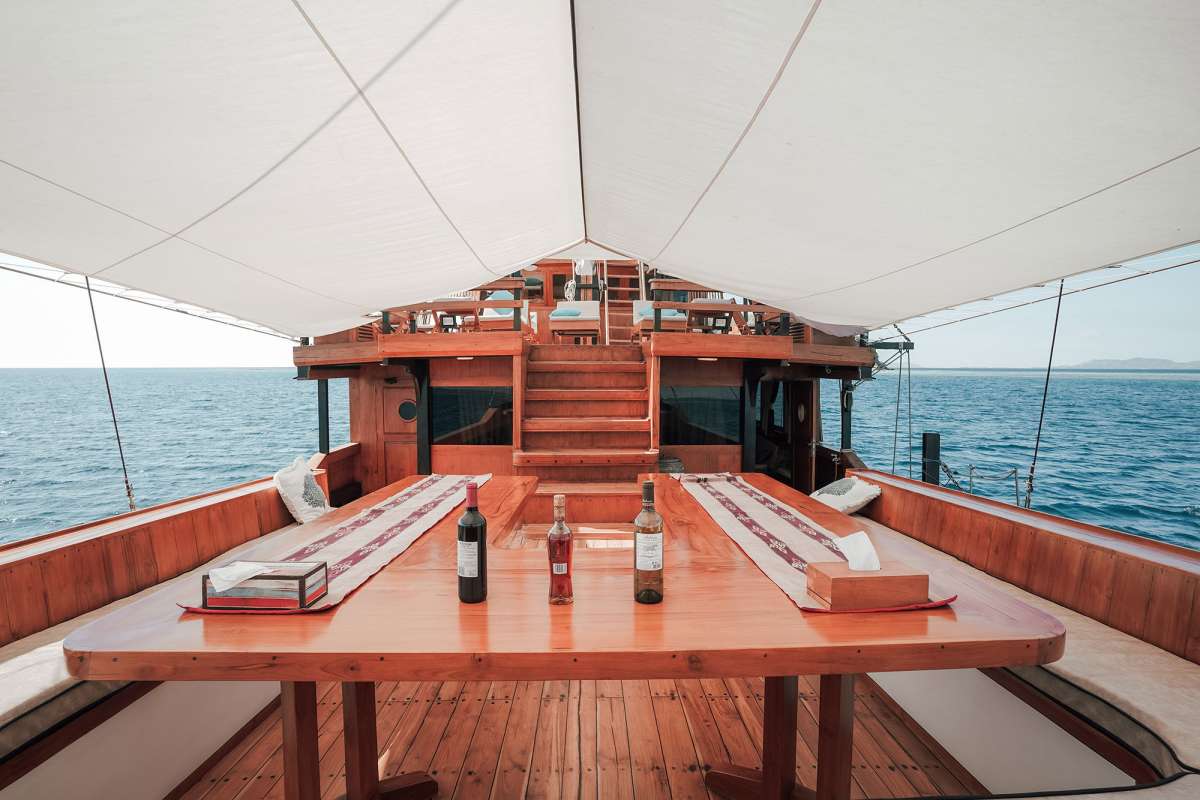
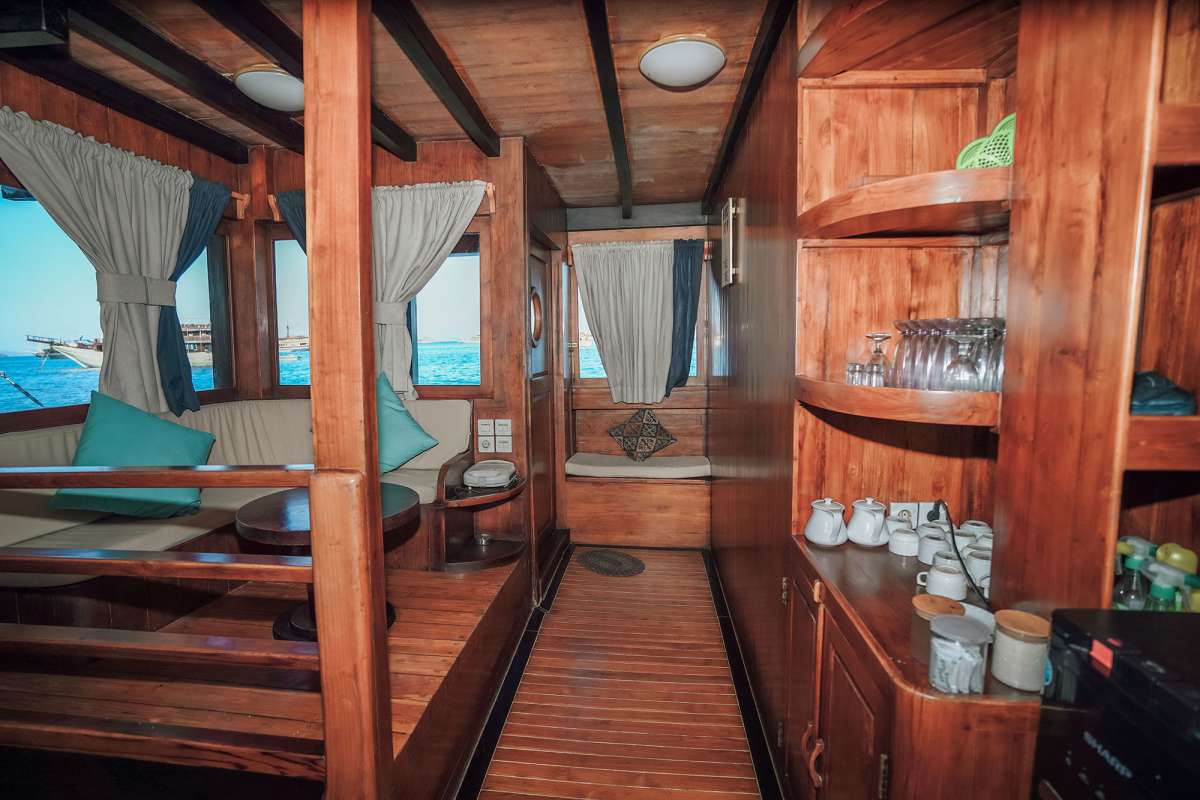
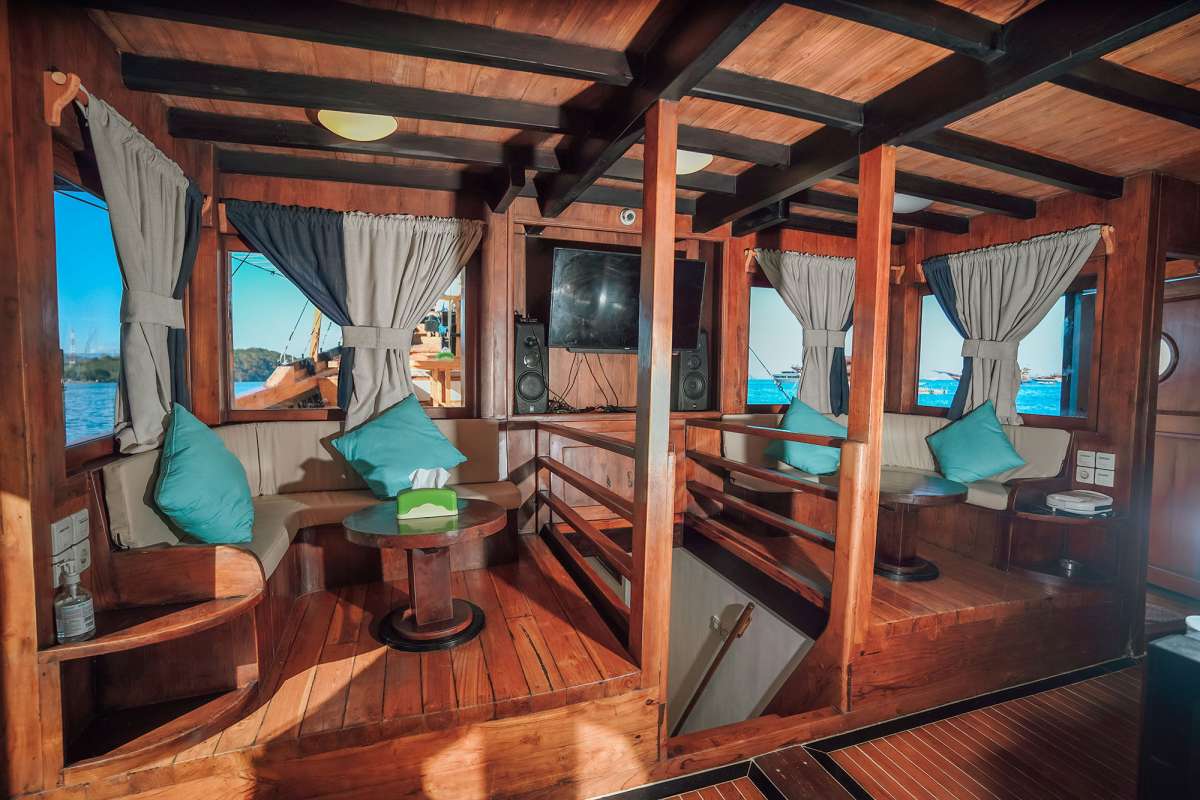
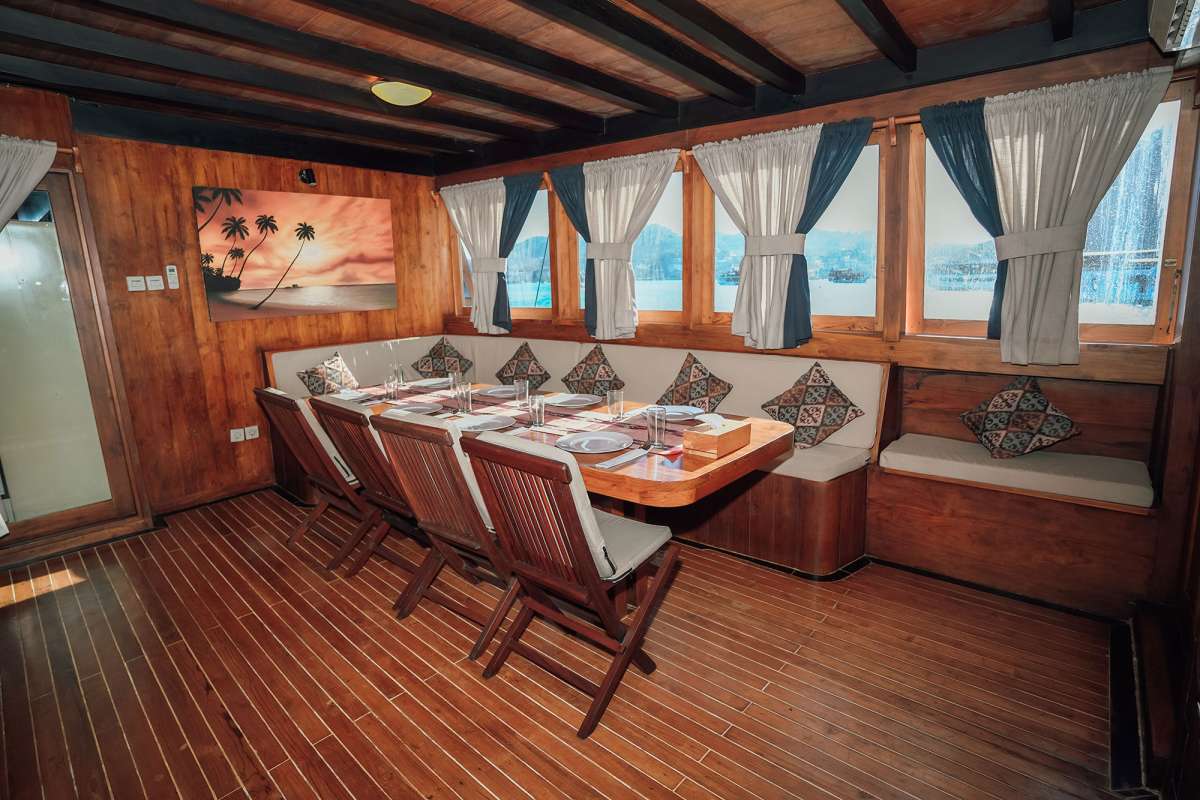
The deck layout separates active diving from rest. A forward leisure deck and broad upper sun deck provide open space for beanbags and loungers, while shaded exterior seating and dining areas allow guests to remain outside without full tropical sun. Indoors, a timber salon and restaurant provide air-conditioned alternatives for meals, camera review and quiet surface intervals. The vessel also carries a kitchen, guide room, captain's room and separated crew area.
The extended cruising range requires self-contained systems and disciplined scheduling. The operator lists radar, GPS, depth sounder, fish finder, searchlights, satellite telephone and VHF/DSC/SSB radio. Safety equipment includes EPIRB, emergency life rafts, fire alarm and extinguishers, flares, bilge-pump alarm, engine-room CCTV, medical oxygen and first-aid kits. A current technical record counts nine bathrooms across the vessel, although seven are the private cabin ensuites described below.
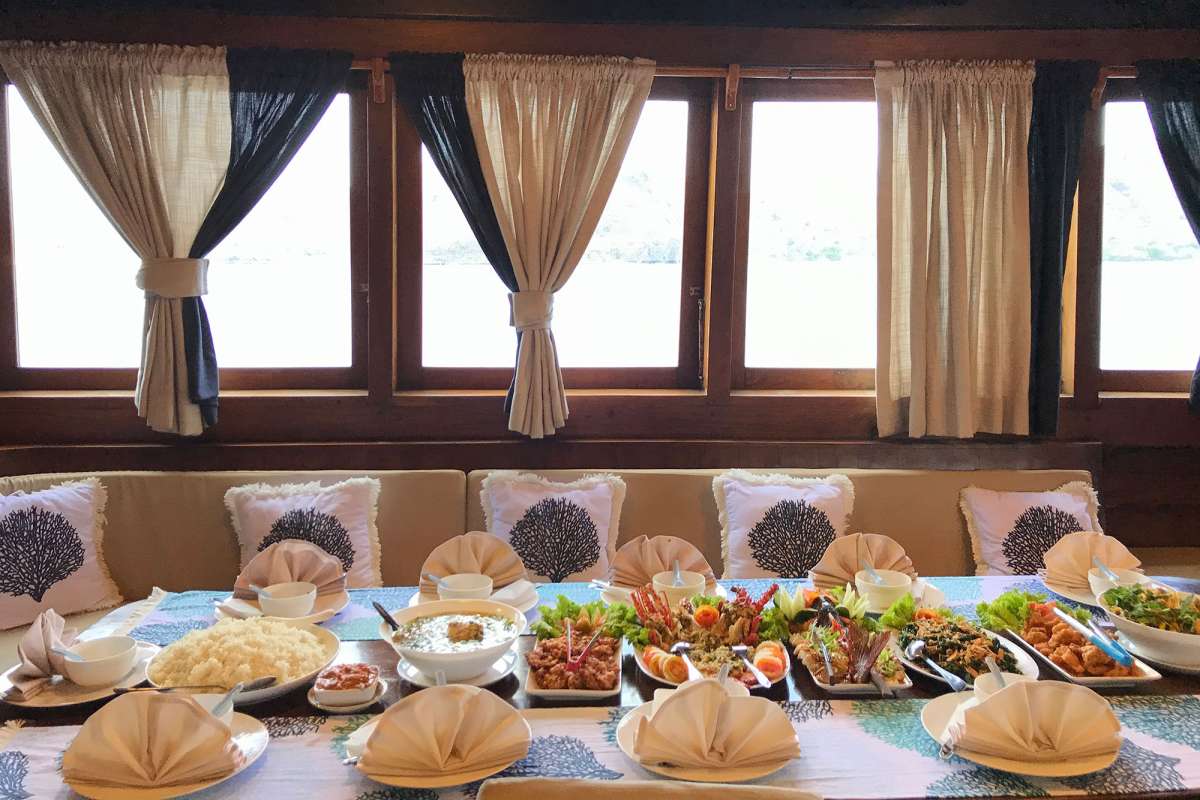
Meals are organised around diving and passage times. Current package records include breakfast, lunch, dinner, snacks, mineral or drinking water, tea and coffee. Menus combine Indonesian and Western food, and vegetarian or medically necessary dietary needs should be supplied early enough for remote provisioning. The indoor restaurant and open-air tables give the crew flexibility according to weather. Soft drinks and alcoholic beverages are currently listed as extra.
Queenesia II is suitable for non-divers on selected routes because snorkelling, island visits, beaches, viewpoints and wildlife excursions are published alongside scuba diving. However, a non-diver should verify the amount of dedicated guide support and whether each planned site offers safe snorkelling. A tender drop in a strong channel is not automatically transferable to a surface activity.
Cabin
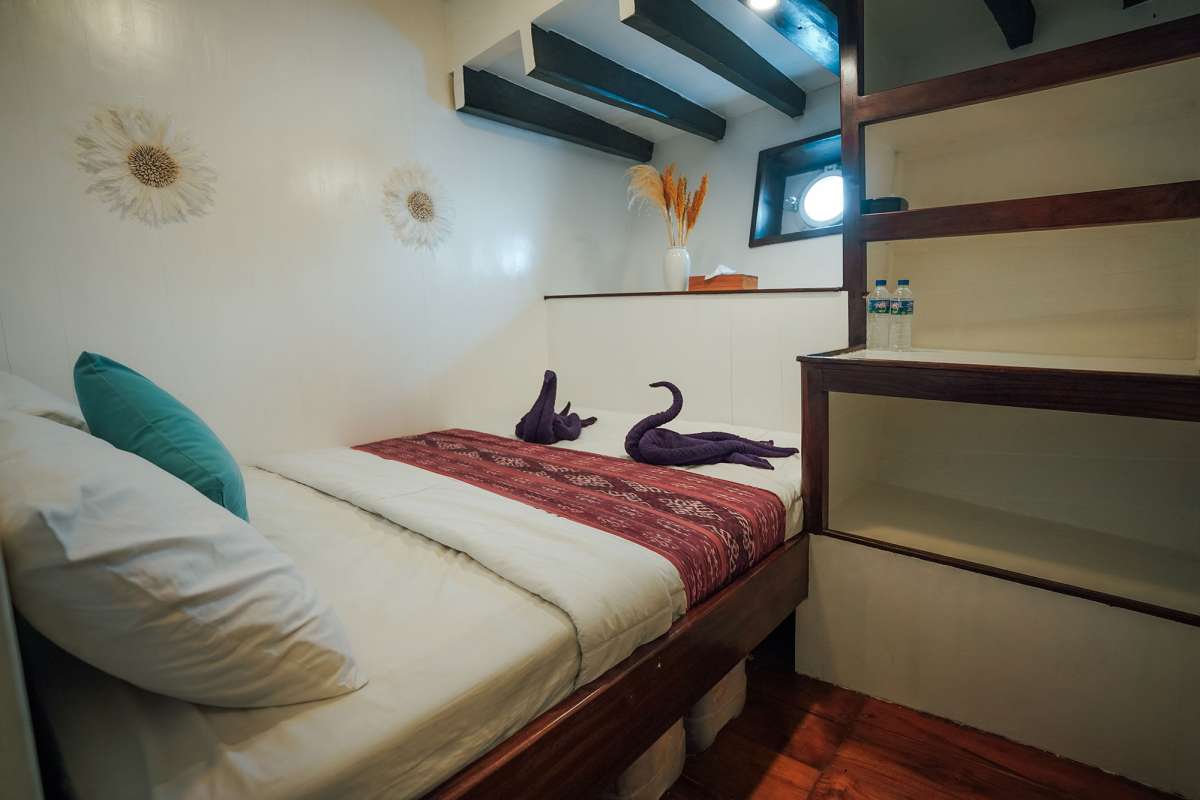
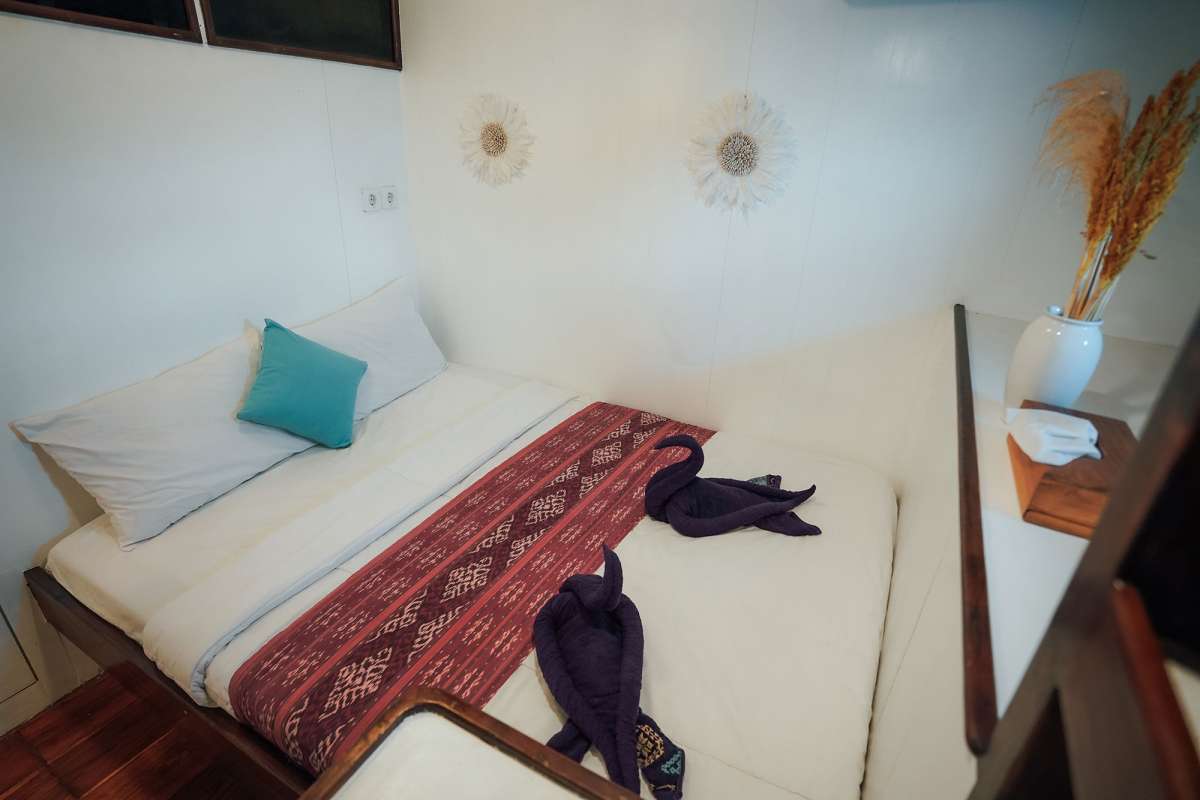
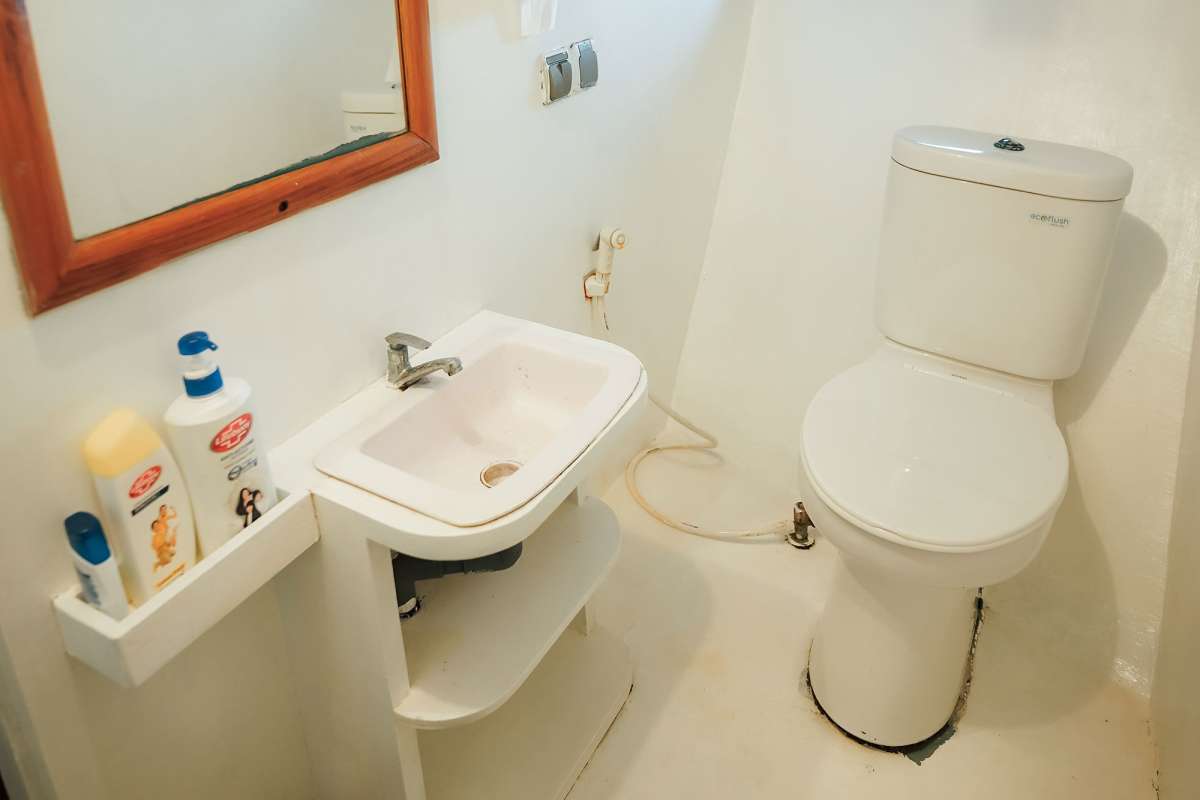
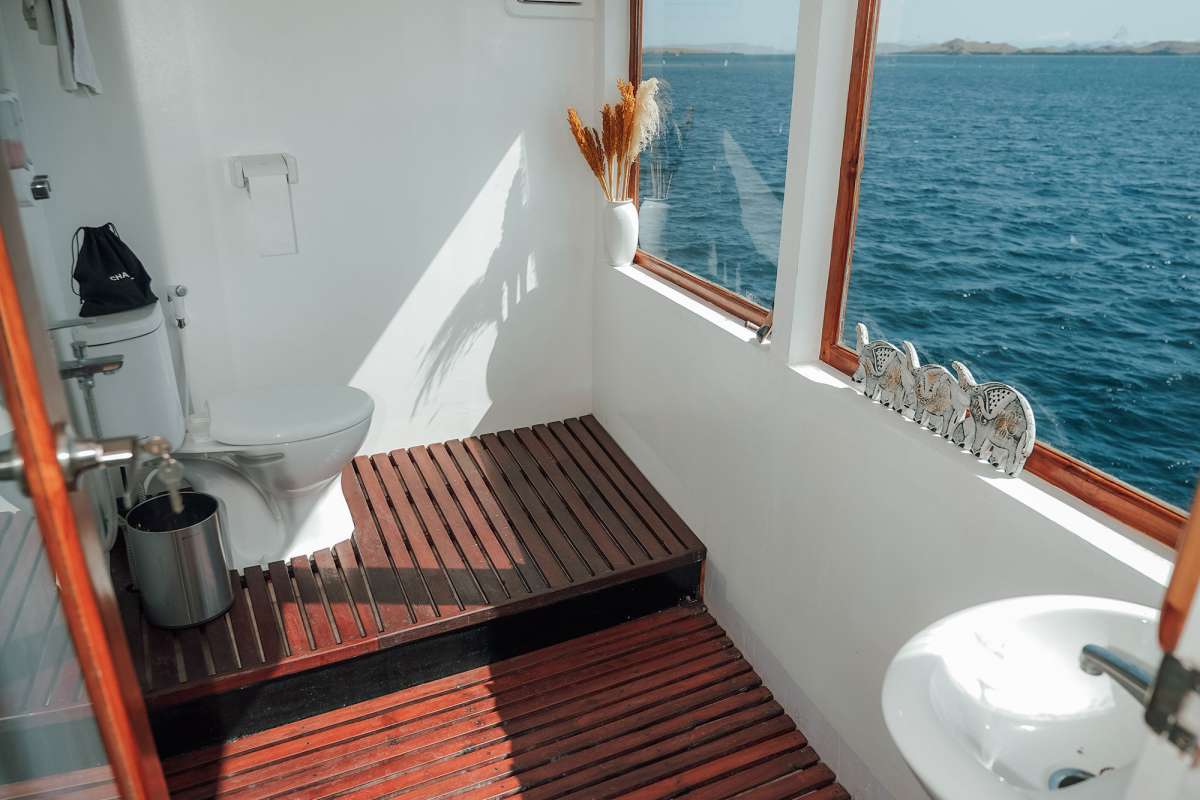
The operator publishes exactly seven air-conditioned cabins with private ensuite bathrooms and charging ports. The current cabin-by-cabin inventory is:
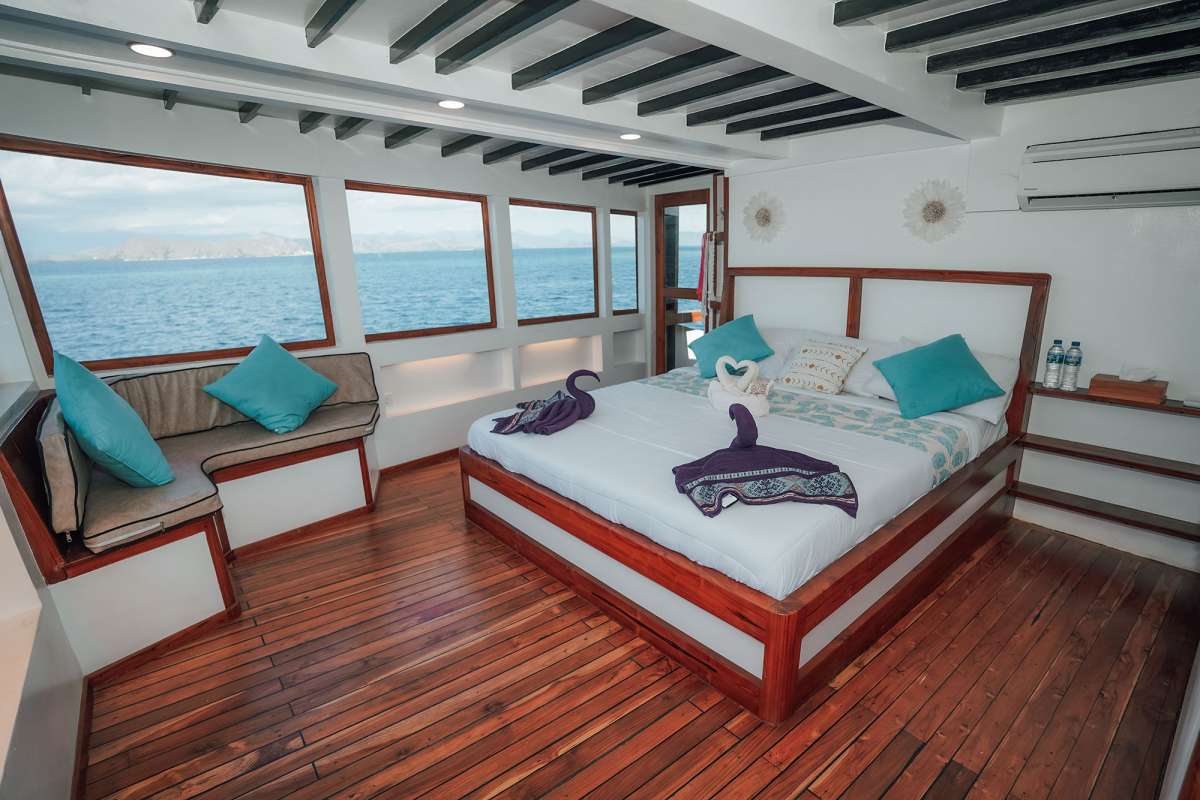
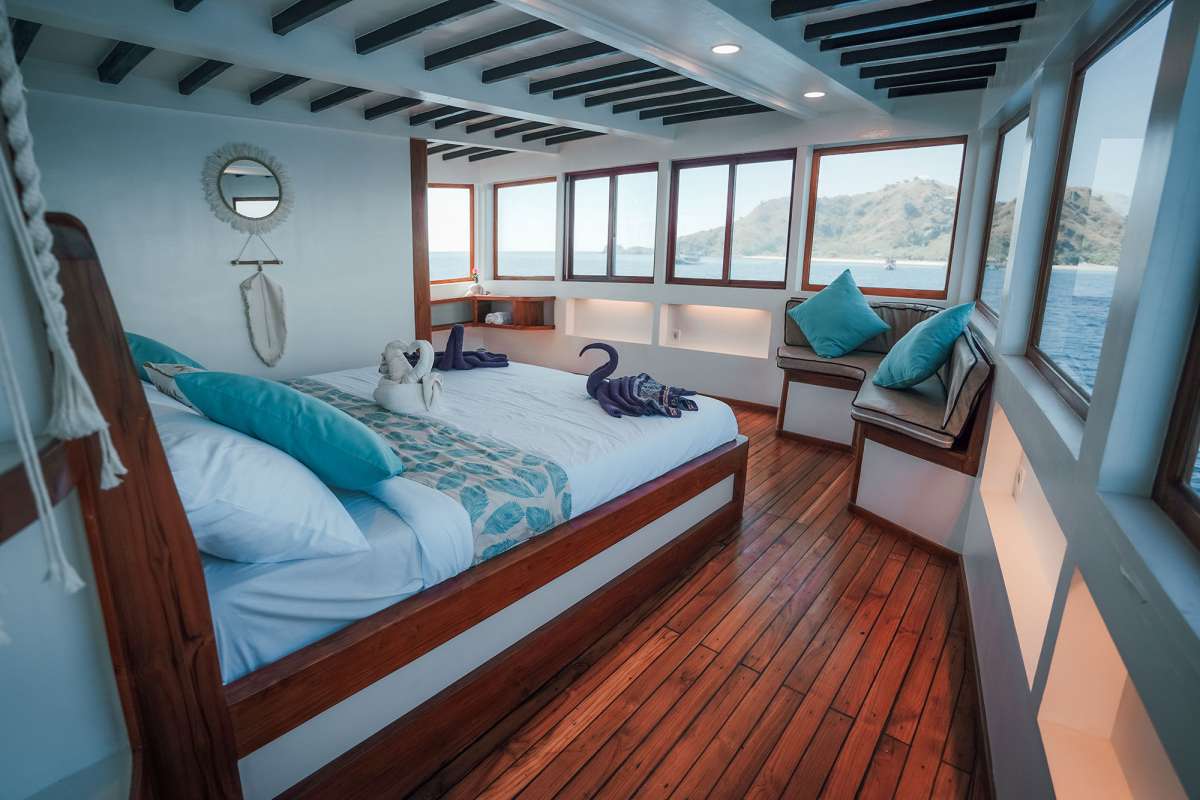
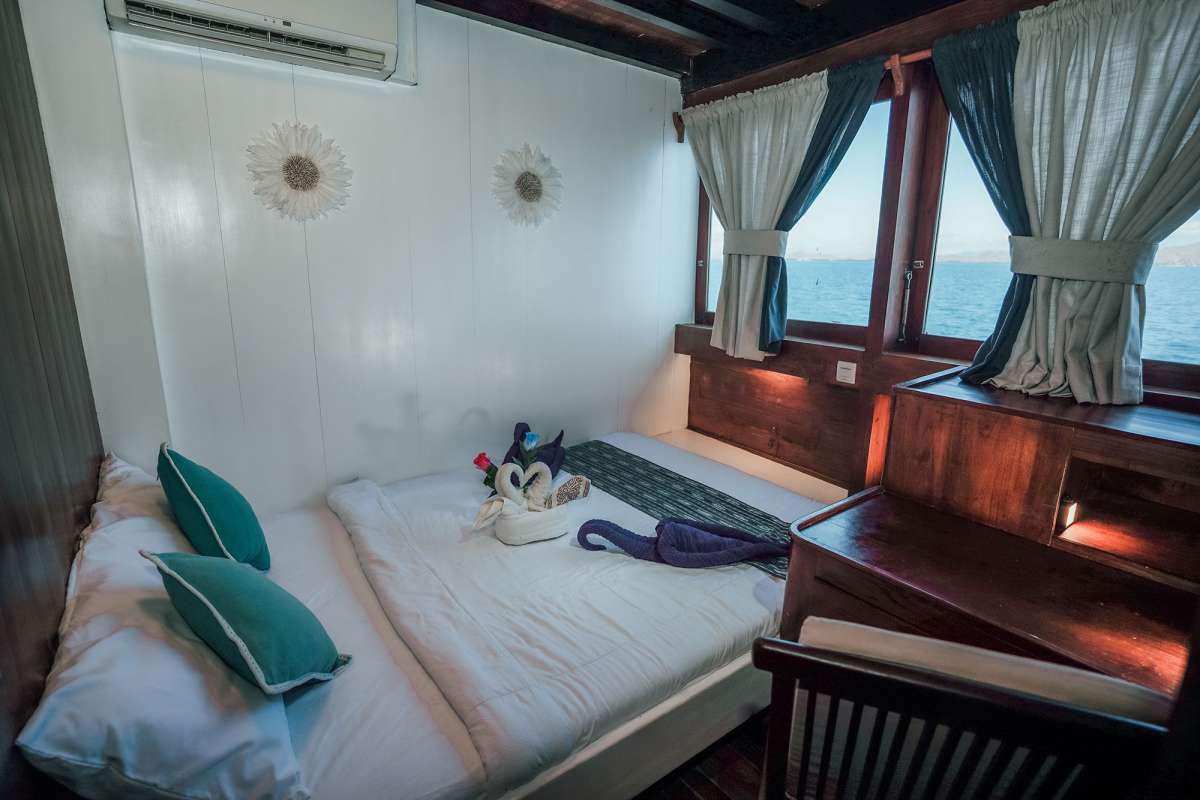
- 1 Master Cabin — upper deck: one double bed, large panoramic windows, maximum 2 guests, private ensuite bathroom, individual air-conditioning unit and charging ports; sold as non-sharing
- 1 Sea View Cabin — main deck: one double bed, broad sea-view windows, maximum 2 guests, private ensuite bathroom, individual air-conditioning unit and charging ports; sold as non-sharing
- 3 Double Cabins — lower deck: one double bed in each room, maximum 2 guests per cabin, private ensuite bathroom, individual air-conditioning unit and charging ports; sold as non-sharing
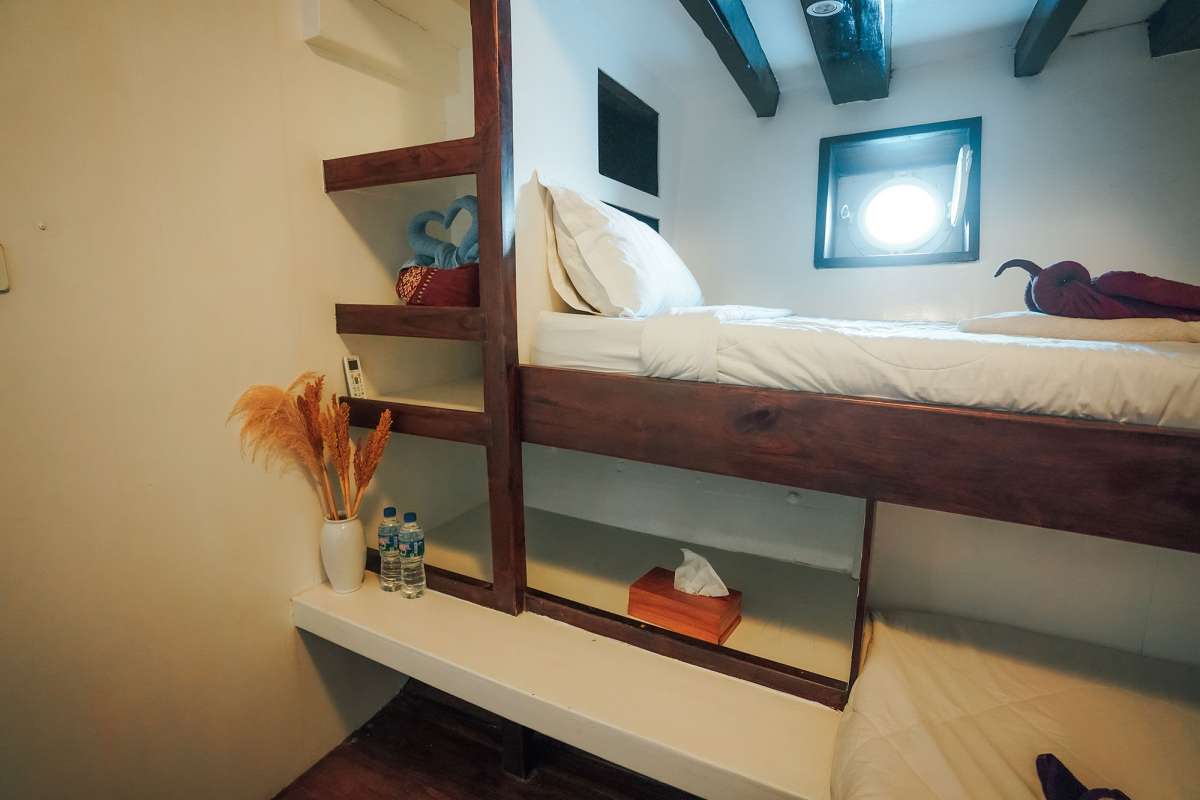
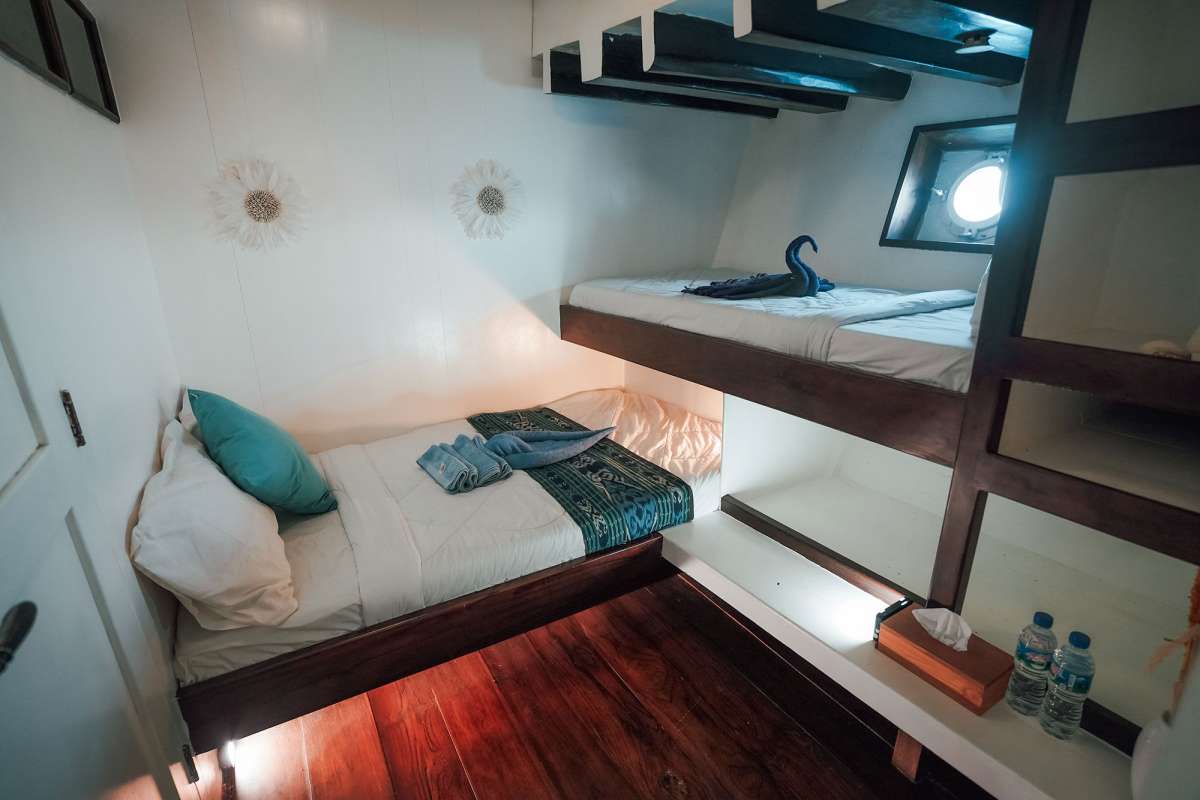
- 2 Triple Cabins — lower deck: one double bed plus one separate single bed in each room, maximum 3 guests per cabin, private ensuite bathroom, individual air-conditioning unit and charging ports; operator lists them as non-sharing cabin units suited to families or small private groups
The physical bed arithmetic is 1 × 2 + 1 × 2 + 3 × 2 + 2 × 3 = 16 berths across 7 cabins. However, Queenesia Fleet's current homepage markets Queenesia II as a 14-passenger phinisi, and the current DiveBooker technical record also states capacity 14. Other current records—including the operator's own per-cabin maximums, LiveAboard.com and PADI Travel—state up to 16.
For accurate sales copy, 14 should be treated as the standard published operating capacity, with 16 used only when the operator confirms in writing that both single beds in the Triple Cabins are released for that departure. The extra two physical berths do not create an eighth cabin and should not be sold automatically. The final rooming list must identify each triple-occupancy approval, passenger age and bed allocation.
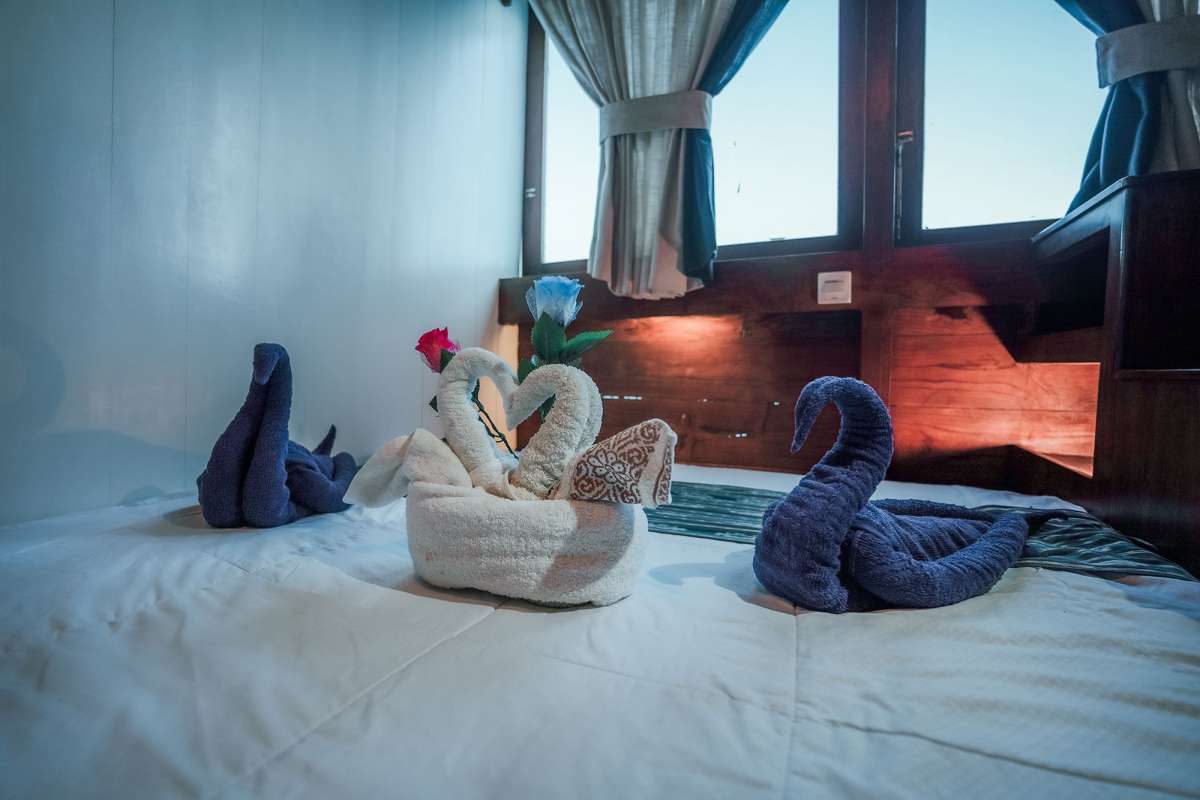
The deck position affects the experience. The Master gives elevated outlook and the largest panoramic glazing; the Sea View keeps its double bed on the main accommodation level close to shared spaces; the five lower-deck rooms provide more limited windows and may transmit more machinery or water noise. All categories are photographed with simple white interiors, dark timber accents, individual cooling and compact ensuite wet rooms.
No published category offers two fully separate floor-level twin beds. The Triple's separate single is elevated in the photographed configuration, while the three standard lower rooms are described by the operator as doubles. Some reseller pages use legacy labels such as “twin/double” or show an incomplete six-category inventory; those variants do not reconcile with the operator's exact seven-room list and should not replace it.
Towels and toiletries are currently included. Cabin sizes are not consistently published, and room-specific storage, hairdryer, safe and housekeeping frequency should be confirmed rather than assumed. Guests who require single occupancy, a particular deck, step-free access or a non-bunk third bed should obtain the cabin number and written layout before payment.
Diving
Queenesia II's dive operation is designed for multi-region itineraries rather than one fixed park. The vessel carries aluminium 12-litre cylinders, two compressors, DIN adaptors, underwater dive lights, assorted equipment and tender support. Current seller records describe a maximum guide-to-diver ratio near 1:4, a shaded dive area, charging station or camera workspace, separate camera rinse and outside showers. Rental gear is available for a surcharge.
Published tender counts conflict: the operator equipment list and DiveBooker say one diving tender, while LiveAboard.com's current technical table counts two. The boat should therefore be marketed as offering tender-supported diving, not “two-tender operation,” unless the departure confirmation names both craft. The same caution applies to guest capacity.
The standard listed gas is compressed air. PADI Travel and DiveBooker currently label Nitrox unavailable, and Wi-Fi is also listed as unavailable. Some historical guest material mentions Nitrox on particular voyages, but it is not safe to promise it as a regular service. A Nitrox-dependent diver should obtain written confirmation of availability, price, analyser procedures and fill schedule before booking.
Dive counts depend on route length. Current examples include roughly 14–15 dives on a 7-day / 6-night Banda Sea program, 17–18 on 8 days / 7 nights, about 18 dives on a 7-night Raja Ampat program and approximately 21 on an 8-night option. Komodo's 6-day / 5-night program is published with 15–16. Crossing days, land excursions and the final no-fly window reduce the number of entries.
A current detailed record states Advanced Open Water or equivalent and at least 50 logged dives for its major safaris. That is reasonable for strong current, negative entries, deep pinnacles, blue-water ascents and remote emergency response, but the signed requirements for the chosen departure are decisive. Derawan includes accessible reefs as well as the demanding channel at Maratua; Raja Ampat combines sheltered macro sites with fast Dampier passages; Banda Sea crossings add isolation and open-ocean swell; Komodo can shift dramatically with tide and season.
Guides may split groups by experience, air consumption and photographic pace. A private cabin or higher category does not buy a private guide. Divers should travel with a computer, DSMB, suitable exposure protection, current insurance and recent skills. Wildlife—manta rays, schooling hammerheads, reef sharks, turtles, barracuda, trevally, whales and rare macro subjects—is never guaranteed.
Other Information
- Destinations: Raja Ampat, Misool, Banda Sea, Ambon, Derawan, North Sulawesi and Komodo according to season
- Typical ports: Sorong, Ambon, Berau, Bitung and Labuan Bajo; crossings can use different start and finish ports
- Vessel: Ironwood Buginese phinisi schooner, built 2016 and reported refurbished 2022
- Dimensions: 32 m × 7.5 m
- Cabins: 7 private ensuite cabins
- Capacity: 14 standard published operating guests; physical category maximum 16 only with written confirmation
- Bathrooms: 9 published vessel-wide, including 7 cabin ensuites
- Cruising speed: 7–8 knots
- Compressors: 2
- Standard tanks: 12 L aluminium
- Dive groups: approximately 1 guide to 4 divers in current sales material
- Nitrox: Not currently advertised as a regular service
- Wi-Fi: Not available in current technical listings
- Languages: English listed for crew
- Payments: Current PADI listing accepts cash in USD, EUR and local currency; departure instructions prevail
Currently included in the detailed package: accommodation and scheduled dives; local airport and hotel transfer linked to the published embarkation; standard tank and weights in the fuller package description; breakfast, lunch, dinner, snacks, mineral/drinking water, tea and coffee; eligible night dives; listed land excursions; naturalist and snorkelling guide service; cabin, beach and deck towels; basic toiletries; and VAT where expressly stated. A reseller offers short-term DAN cover on request, but this should be treated as an optional seller benefit, not comprehensive travel insurance.
Normally excluded or charged separately: national-park and port fees; dragon trek and ranger fees on Komodo programs; BCD, regulator, wetsuit, fins, mask, computer and other rental gear; underwater camera; soft drinks and alcoholic beverages; Nitrox if exceptionally available; domestic airport tax where applicable; gratuities; private guide or special transfer requests; flights, pre/post hotels, laundry and personal purchases; travel, medical and dive-accident insurance.
Itineraries
Queenesia II's schedule changes with Indonesia's seasons. Current published durations range from 5 to 11 nights and include Derawan returns, Berau–Bitung crossings, Bitung–Ambon, Banda Sea returns, Ambon–Banda–Misool–Sorong, central Raja Ampat and a 10-night Best of Raja Ampat covering north, south and central sectors. The two planning outlines below are original representative routes, not guaranteed site lists. Weather, permits, current, harbour clearance and passenger safety control every decision.
Best of Raja Ampat — Representative 11-Day / 10-Night Expedition
Day 1 — Sorong embarkation
Guests are met within the confirmed airport or hotel window and transfer to the vessel. After cabin allocation, document checks, equipment setup and emergency briefing, Queenesia II departs Sorong. Lunch and dinner are served onboard. The first night is used for a long repositioning leg, so no arrival-day dive should be assumed.
Day 2 — Misool check dives
The first sheltered reef allows guides to verify weighting, buoyancy, air consumption and camera configuration. A second and third dive introduce Misool's limestone islands, coral slopes and dense clouds of reef fish. A night dive may be offered in a protected bay, beginning the expedition's working rhythm of early briefing, dive, meal, surface interval and repeat.
Day 3 — Southern Misool soft-coral country
Sites may be selected from the Fiabacet or nearby groups according to current and mooring availability. Pinnacles and ridges support colourful soft corals, sea fans, anthias and schooling fusiliers, while the blue can produce trevally, barracuda, tuna or reef sharks. Guides protect fragile areas by managing entry points and keeping photographers from settling on coral.
Day 4 — Misool manta and lagoon sector
A cleaning station may provide the possibility of oceanic or reef manta rays. Divers settle outside the cleaning zone and allow animals to choose the encounter. Other dives can focus on walls, overhangs and macro-rich slopes. A surface excursion through limestone scenery may replace a fourth dive or night entry. All manta and wildlife references remain possibilities, not promises.
Day 5 — Transfer toward central Raja Ampat
The vessel begins the long move north. One or two dives may be scheduled before or during the passage at an appropriate reef, but distance and sea state take priority. This is a useful day for camera maintenance, rest and route briefing. A reduced dive count is normal on a geography-spanning itinerary.
Day 6 — Central reefs and manta cleaning areas
Central Raja Ampat combines coral gardens, bommies and current-fed channels. A manta site may be attempted at the favourable tide, followed by fish-rich slopes or a protected night dive. Schools of sweetlips, snapper and fusiliers, wobbegong sharks, turtles and pygmy seahorses are possible across the region, but guides choose each site for conditions and group ability.
Day 7 — Dampier Strait
The strait channels large volumes of water between islands. Cape Kri, Sardine Reef, Blue Magic or alternatives can bring extraordinary fish biomass together with strong flow. Entries may be negative and groups carry DSMBs for blue-water recovery. A village, jetty or mangrove site can provide a contrasting third or night dive with smaller subjects.
Day 8 — Penemu or northern-sector scenery
Weather and the advertised route determine how far north the vessel travels. Around Penemu, submerged ridges and coral plateaus combine wide-angle scenery with schooling fish; a viewpoint climb may be added when authorised. A “north” label does not guarantee Wayag, whose distance and permissions require explicit inclusion on the final itinerary.
Day 9 — Arborek, manta sites and central alternatives
The route turns back through central Raja Ampat. Jetty structures can hold schooling fish and macro life, while sandy cleaning stations offer another manta opportunity. Snorkellers may use a protected village or shallow reef under guide supervision. A final night dive is possible if the next day's transfer and no-fly planning permit.
Day 10 — Final dives and return to Sorong
One or two morning dives complete the program at a site selected for tide and distance from port. Diving stops early enough for equipment drying and an appropriate no-fly interval. Queenesia II begins the return passage while guests complete accounts and pack cameras. The advertised total for a 10-night program is an upper planning figure, not a contractual guarantee.
Day 11 — Disembarkation
Breakfast is followed by check-out and the included scheduled transfer to the confirmed Sorong airport or hotel. There is no diving on departure day.
Banda Sea — Representative 8-Day / 7-Night Safari
Day 1 — Ambon arrival and embarkation
Local transfer, boarding, cabin allocation, dive paperwork and safety briefing take place before Queenesia II leaves Ambon. Depending on arrival times, the vessel may remain in sheltered water or begin the passage toward the Spice Islands. No dive is guaranteed on embarkation day.
Day 2 — Ambon Bay or Nusa Laut transition
The first dives may use a sheltered Ambon site for the check or begin around Nusa Laut when the crossing allows. Ambon can be macro-oriented, with frogfish, rhinopias, seahorses, octopus and unusual crustaceans possible on dark sand. Nusa Laut changes the scale to coral walls and schooling fish. The exact combination depends on port timing and sea state.
Day 3 — Banda Islands reefs
Walls and slopes around the Banda group can carry large sea fans, sponges, hard coral and abundant reef fish. Current may draw trevally, tuna or reef sharks into open water. Between dives, the vessel may position near Banda Neira, where the volcanic skyline and colonial-era spice history give the journey a strong sense of place.
Day 4 — Banda Neira and historical land visit
Early diving can be followed by an authorised walk through Banda Neira, subject to local opening times and the cruise plan. Forts, nutmeg heritage and views toward Gunung Api provide context for the islands. Afternoon dives return to lava flow, wall or reef sites. A night dive is possible in sheltered conditions.
Day 5 — Remote seamount or outer-island diving
If weather permits, Queenesia II reaches more isolated formations. Deep water, open-ocean swell and limited shelter make this an advanced day. Schooling hammerheads are a celebrated seasonal possibility in the wider Banda Sea, but their depth, movement and presence are unpredictable. The route remains valuable for coral, fish schools and dramatic topography even without sharks.
Day 6 — Hatta or alternate southern reefs
Clear water and steep walls may characterise the next sector. Guides select sites around current and passenger performance, with two or three day dives and a possible night entry. Long passages can reduce the total. Divers should secure equipment and camera systems carefully before the vessel leaves protected anchorages.
Day 7 — Final dives and passage to Ambon
One or two morning dives finish the program before the return crossing. Equipment is rinsed and dried while the boat navigates back to Ambon. The 17–18 dive figure published for some seven-night Banda programs is a target maximum and may be lower when ocean conditions demand longer transits.
Day 8 — Ambon disembarkation
After breakfast, guests leave for the included scheduled airport or hotel transfer. Flights must respect the no-fly interval created by the final dive.
Other Published Queenesia II Routes
Derawan Islands — 9 days / 8 nights normally starts and ends via Berau. Sangalaki is associated with manta cleaning areas, Kakaban with its landlocked stingless-jellyfish lake and Maratua with reef walls and a channel that can run strongly. Turtles, barracuda, jacks and macro life add variety. Jellyfish access and manta activity are conditional; lake rules must be followed precisely.
Derawan–Bitung and Bitung–Ambon crossings link widely separated ecosystems over 10 or 11 nights. Derawan's turtles and mantas can give way to open-water passages, volcanic islands and eventually North Sulawesi's celebrated macro terrain. Lembeh-style black-sand diving rewards slow searches for blue-ringed octopus, hairy frogfish, mimic octopus and other small subjects, none guaranteed.
Ambon–Banda–Misool–Sorong is a point-to-point expedition that moves from muck and macro habitat through remote Banda Sea reefs into southern Raja Ampat. Guests must arrange different arrival and departure airports and expect crossing days. This is the vessel's clearest example of an expedition where geography—not a fixed four-dives-per-day formula—sets the pace.
Komodo National Park — commonly 6 days / 5 nights uses Labuan Bajo and may advertise 15–16 dives. Possible highlights include Manta Point, Batu Bolong, Castle Rock, Crystal Rock, Padar, Pink Beach and a ranger-led dragon walk. Current, temperature and site suitability vary between north, central and south Komodo.
Expedition Planning Notes
- Current records commonly require Advanced certification and at least 50 logged dives; confirm the rule for the exact departure.
- Expect compressed air unless Nitrox is confirmed in writing.
- Bring a computer, DSMB, recent logbook evidence and exposure protection appropriate to the region.
- One-way routes require different domestic flights and careful baggage planning.
- Night diving, land visits and the published dive total remain subject to permission, weather and passage time.
- Park and port fees differ by region; use the invoice, not a generic web amount.
- Allow a prudent 24-hour no-fly interval after the final dive of a repetitive safari.
Schedules & routes
Prices & conditions
Included
- Transfers from airport and/or hotel to the yacht
- Full-board meal plan (including snacks)
- Complimentary beverages (water, tea, coffee)
- Diving activity (incl. tanks, weights, weight belts)
- Dive guide service
- Land excursions and activities throughout the trip
- Cabin towels and complimentary toiletries
- Cabin cleaning service
Not included
- Domestic flights in destination country
- Marine park fees & Port fees
- Fuel surcharge
- Alcoholic beverage
- Soft drinks
- Dive equipment rentals
- Larger tank (15 L)
- Dive courses on board
- Dive insurance (mandatory requirement)
- Travel insurance (trip cancellation insurance)
- Crew gratuity
Useful information
Alor
Best time for diving
April to November, as this is when both visibility and weather are at their best, while September is the best time to spot Mola Mola. The currents usually are strongest in October and November, making conditions more challenging. From late December until early March, Alor is usually considered as off-season due to the rainy season.
About temperatures
Air : winter months are between 26°C - 29°C, summer months are between 27°C - 32°C.
Sea : between 25°C - 27°C from March to April & October to November, between 27°C - 30°C from May to September. Thermoclines are common year round, the water can drop at times to 22°C or lower.
Wetsuit Recommendation
We recommend a 5 mm full wetsuit. If you get cold easily, we recommend also bring gloves and a hood, or even a 7 mm full wetsuit.
Diver requirement
Suitable for all levels of diver from beginners to experienced. However, in the open blue, the current can be strong at times, so divers should to be comfortable with their skills. While the muck dive sites only have little current. You can find out more information about diving in Alor here : Alor
Embarkation / Disembarkation
Alor liveaboard trips are usually from Maumere to Maumere, guests need to fly to Maumere airport (MOF).
However, some liveaboards often combine Alor with other destinations like Komodo, Banda Sea, Raja Ampat. Then you might only need to arrive or depart from Maumere.
Visa Requirements
Indonesia offers a free visa on arrival service for many nationalities which allows visitors to stay in the country for up to 30 days. A list of countries that are eligible for visa on arrival can be found on the Indonesian Government's Directorate General of Immigration.
Please note: Immigration officials in Indonesia may ask for proof of onward travel (e.g. a return or onward air ticket).
Vaccinations
Yellow fever vaccination certificate is required for travellers over the age of 9 months arriving from countries with risk of yellow fever transmission.
Money Matters
The local currency is Indonesian Rupiah (IDR), all liveaboards accept cash payments in USD.
Rupiah can be purchased from all major banks and exchange outlets. Credit and debit cards are also accepted in major hotels, restaurants & shops.
Drones
There are very few restrictions on the use of drones for photography purposes within Indonesia. Please check Drone laws in Indonesia for details.
Extending your holiday
We offer a range of hotels/resorts, land-based diving packages, and excursions that can be arranged before or after your liveaboard holiday. Just ask us if you need such service.
Komodo
Best time for diving
May to October, the weather in Komodo is at its best between April and November. During the wet season (December to March) the weather can get a bit windy, with heavy quick rains, sometimes can cause rough surface conditions. However, liveaboards run trips here year-round.
The visibility in the North is excellent at 30 meters or even more, while it ranges between 10-15 meters in the South.
Some dive sites can have significant currents, whirlpools and see downdrafts. Sea conditions might change very quickly. Other dive sites are more quiet and rich in macro, especially in the South.
About temperatures
Air : range between 23°C - 32°C year-round.
Sea : in the North Komodo it can be around 26°C -29°C, while it gets colder towards the south where it can drop down to 22° C.
Wetsuit Recommendation
We recommend a 3 - 5 mm full wetsuit throughout the year for Komodo area.
Diver requirement
Intermediate to Advanced level, A good level in diving and some experience in drift diving are recommended to participate to Komodo cruise.
You can find out more information about diving in Komodo here : Komodo
Embarkation / Disembarkation
Most of the embarkation / disembarkation will be in Labuan Bajo (LBJ).
Unless the trip is from Bali - Komodo, then the embarkation can be in Bali (DPS).
Visa Requirements
Indonesia offers a free visa on arrival service for many nationalities which allows visitors to stay in the country for up to 30 days. A list of countries that are eligible for visa on arrival can be found on the Indonesian Government's Directorate General of Immigration.
Please note: Immigration officials in Indonesia may ask for proof of onward travel (e.g. a return or onward air ticket).
Vaccinations
Yellow fever vaccination certificate is required for travellers over the age of 9 months arriving from countries with risk of yellow fever transmission.
Money Matters
The local currency is Indonesian Rupiah (IDR), all liveaboards accept cash payments in USD.
Rupiah can be purchased from all major banks and exchange outlets. Credit and debit cards are also accepted in major hotels, restaurants & shops.
Drones
There are very few restrictions on the use of drones for photography purposes within Indonesia. Please check Drone laws in Indonesia for details.
Extending your holiday
We offer a range of hotels/resorts, land-based diving packages, and excursions that can be arranged before or after your liveaboard holiday. Just ask us if you need such service.
Banda Sea
Best time for diving
October to November & March to April, the seas are generally calmer during these months and in October to November there is higher chance to see hammerhead sharks. From May to August the surface conditions can get quite rough.
The visibility is generally good to excellent in Banda Sea areas, except in Ambon bay and in other bays for critter dives. Currents are low to moderate on most of the sites, however, strong currents may occur at times.
About temperatures
Air : range between 25°C - 31°C year-round.
Sea : range between 26°C - 29°C year-round.
Wetsuit Recommendation
We recommend a 3 - 5 mm full wetsuit throughout the year.
Diver requirement
Most dive sites are suitable for all levels with a few exceptions that are suitable only for advanced divers. You can find out more information about diving in Banda Sea here : Banda Sea
Embarkation / Disembarkation
The embarkation / disembarkation can be in Ambon (AMQ), Kaimana (KNG), Maumere (MOF), Sorong (SOQ), Waisai (RJM), Saumalaki (SXK) etc. As some of the Banda Sea trip will combine with other destinations like Raja Ampat, Halmahera, Triton Bay. So please ask our agent to know the exact port for your trip.
Visa Requirements
Indonesia offers a free visa on arrival service for many nationalities which allows visitors to stay in the country for up to 30 days. A list of countries that are eligible for visa on arrival can be found on the Indonesian Government's Directorate General of Immigration.
Please note: Immigration officials in Indonesia may ask for proof of onward travel (e.g. a return or onward air ticket).
Vaccinations
Yellow fever vaccination certificate is required for travellers over the age of 9 months arriving from countries with risk of yellow fever transmission.
Money Matters
The local currency is Indonesian Rupiah (IDR), all liveaboards accept cash payments in USD.
Rupiah can be purchased from all major banks and exchange outlets. Credit and debit cards are also accepted in major hotels, restaurants & shops.
Drones
There are very few restrictions on the use of drones for photography purposes within Indonesia. Please check Drone laws in Indonesia for details.
Extending your holiday
We offer a range of hotels/resorts, land-based diving packages, and excursions that can be arranged before or after your liveaboard holiday. Just ask us if you need such service.
Raja Ampat
Best time for diving
Mid October to April, the wind then picks up in May until the end of August, causing rougher seas and this means Misool area in the south will be shut from June to September. From July until September the diving in the north still can be enjoyable. The visibility can vary from 10 - 30 meters, current can be from mild to strong at times.
About temperatures
Air : fairly constant between 25°C - 31°C year-round.
Sea : it is warm all year round, about 27°C - 31°C
Wetsuit Recommendation
We recommend a 3 mm full wetsuit throughout the year.
Diver requirement
Intermediate to Advanced level. You can find out more information about diving in Raja Ampat here : Raja Ampat
Embarkation / Disembarkation
Most of the embarkation / disembarkation will be in Sorong (SOQ).
Few liveaboards also departs from Waisai (RJM).
The easiest to fly through to & from Sorong (SOQ) via Jakarta (CGK), Makassar (UPG), Bali (DPS), or Manado (MDC).
Visa Requirements
Indonesia offers a free visa on arrival service for many nationalities which allows visitors to stay in the country for up to 30 days. A list of countries that are eligible for visa on arrival can be found on the Indonesian Government's Directorate General of Immigration.
Please note: Immigration officials in Indonesia may ask for proof of onward travel (e.g. a return or onward air ticket).
Vaccinations
Yellow fever vaccination certificate is required for travellers over the age of 9 months arriving from countries with risk of yellow fever transmission.
Money Matters
The local currency is Indonesian Rupiah (IDR), all liveaboards accept cash payments in USD.
Rupiah can be purchased from all major banks and exchange outlets. Credit and debit cards are also accepted in major hotels, restaurants & shops.
Drones
There are very few restrictions on the use of drones for photography purposes within Indonesia. Please check Drone laws in Indonesia for details.
Extending your holiday
We offer a range of hotels/resorts, land-based diving packages, and excursions that can be arranged before or after your liveaboard holiday. Just ask us if you need such service.
Sulawesi
Best time for diving
April to October, with peak season being July and August - it's also the best time to spot whales and dolphins (however, in the peak season, it's usually gonna be super busy, so you need to book your space long ahead). The diving can still be great in late March, November and early December, but the rain are generally a daily occurrence in these months, then the rainiest months will be between January and February but still can have good dives if you don't mind the rain.
The visibility range between 20 - 40 meters, currents are different from one location to another, some have minimal-to-no current, while some other sites can experience strong currents that attract big pelagic fish.
About temperatures
Air : range between 23°C to 32°C throughout the year.
Sea : between 26°C - 29°C, with the Lembeh Strait can be as low as 25°C/26°C during the summer (July/August).
Wetsuit Recommendation
We recommend a 3 - 5 mm wetsuit throughout the year.
Diver requirement
Suitable for all levels. Especially the photographers! You can find out more information about diving in this area here : Sulawesi
Embarkation / Disembarkation
Depending on the liveaboard and the itinerary you chose, it can be Manado (MDC), Kendari (KDI), Luwuk (LUW). Or some itineraries also combined North & Centra Sulawesi with other destinations such as Halmahera, Raja Ampat, Wakatobi (in South Sulawesi). So please ask our agent to know the exact port for your trip.
Visa Requirements
Indonesia offers a free visa on arrival service for many nationalities which allows visitors to stay in the country for up to 30 days. A list of countries that are eligible for visa on arrival can be found on the Indonesian Government's Directorate General of Immigration.
Please note: Immigration officials in Indonesia may ask for proof of onward travel (e.g. a return or onward air ticket).
Vaccinations
Yellow fever vaccination certificate is required for travellers over the age of 9 months arriving from countries with risk of yellow fever transmission.
Money Matters
The local currency is Indonesian Rupiah (IDR), all liveaboards accept cash payments in USD.
Rupiah can be purchased from all major banks and exchange outlets. Credit and debit cards are also accepted in major hotels, restaurants & shops.
Drones
There are very few restrictions on the use of drones for photography purposes within Indonesia. Please check Drone laws in Indonesia for details.
Extending your holiday
We offer a range of hotels/resorts, land-based diving packages, and excursions that can be arranged before or after your liveaboard holiday. Just ask us if you need such service.
Derawan Islands
Best time for diving
April to October during the dry season, although the Derawan Islands is possible to dive year-round. And the islands receive consistent rainfall throughout the year. If you want to have the best chance to see manta rays, then try the beginning of the rainy season around November or December. The visibility is usually between 10 - 40 meters, with mild to medium currents.
About temperatures
Air : generally ranges between 27°C - 32°C year-round.
Sea : it is warm all year round, about 27°C - 30°C
Wetsuit Recommendation
We recommend a 3 mm wetsuit throughout the year.
Diver requirement
Suitable for all levels. You can find out more information about diving in Derawan Islands here : Derawan Islands
Embarkation / Disembarkation
Depending on the liveaboard you choose, the embarkation / disembarkation can be in Tarakan (TRK) or Berau (BEJ).
It also can be combined with Sulawesi (Lembeh) on longer cruise like 14D/13N, then the embarkation and disembarkation will be different, please ask our agent to know the exact port for your trip.
Visa Requirements
Indonesia offers a free visa on arrival service for many nationalities which allows visitors to stay in the country for up to 30 days. A list of countries that are eligible for visa on arrival can be found on the Indonesian Government's Directorate General of Immigration.
Please note: Immigration officials in Indonesia may ask for proof of onward travel (e.g. a return or onward air ticket).
Vaccinations
Yellow fever vaccination certificate is required for travellers over the age of 9 months arriving from countries with risk of yellow fever transmission.
Money Matters
The local currency is Indonesian Rupiah (IDR), all liveaboards accept cash payments in USD.
Rupiah can be purchased from all major banks and exchange outlets. Credit and debit cards are also accepted in major hotels, restaurants & shops.
Drones
There are very few restrictions on the use of drones for photography purposes within Indonesia. Please check Drone laws in Indonesia for details.
Extending your holiday
We offer a range of hotels/resorts, land-based diving packages, and excursions that can be arranged before or after your liveaboard holiday. Just ask us if you need such service.
Diver's reviews (0)
Photos